
Get,

Free Doctor Tips

to manage your symptom

Get your,

FREE Doctor Tips Now!!

4 Cr+ families

benefitted

Enter your Phone Number

+91

|

Enter a valid mobile number

Send OTP

Verify your mobile number

OTP sent to 9988776655

CONGRATULATIONS!!!

You’ve successfully subscribed to receive

doctor-approved tips on Whatsapp


Get ready to feel your best.

Hi There,

Download the PharmEasy App now!!

AND AVAIL

AD FREE reading experience
Get 25% OFF on medicines
Banner Image

Register to Avail the Offer

Send OTP

By continuing, you agree with our Privacy Policy and Terms and Conditions

Success Banner Image
Verify your mobile number

OTP sent to 9988776655

Comments

Subscribe
Notify of
guest
0 Comments
Inline Feedbacks
View all comments

Leave your comment here

Your email address will not be published. Required fields are marked *

25% OFF on medicines

Collect your coupon before the offer ends!!!

COLLECT

Mucus in Urine: Is It Normal or a Sign of Infection?

By Dr. Aniket Hase +2 more

Join Health Talk by PharmEasy on WhatsApp

Introduction

Have you ever noticed something unusual in your urine? Like a cloudy appearance or a stringy, jelly-like substance or white mucus in urine for females? While it can definitely feel concerning, it is not always a cause for panic.

One possible cause of these changes is the presence of mucus in urine. Mucus is a thick, slippery fluid naturally produced by the body. In small amounts, it is completely normal and often goes unnoticed1.

mucus in urine

However, when mucus becomes more visible or is accompanied by other symptoms, it may signal an underlying issue, such as an infection or inflammation1. Therefore, understanding what causes mucus in urine and when it might be a concern is important for maintaining urinary health.

Advertisement

In this blog, we’ll explore what mucus in urine means, its common causes, associated symptoms, available management options, and practical prevention tips.

What is Mucus in Urine?

Mucus is a natural, gel-like substance produced by the body that coats and protects moist surfaces in the body like the eyes, lungs, stomach, and even the urinary tract (which includes organs that help make and remove urine, such as the kidneys, ureters, bladder, and urethra).

Mucus acts as a lubricant, reducing friction and avoiding damage caused by normal bodily processes. It also works as a protective barrier, helping to trap and block harmful substances while allowing essential molecules to pass through2.

A small amount of mucus in the urine is usually considered normal. However, if it becomes more noticeable, it may indicate an infection or an underlying condition1.

Did You Know?

  • Mucus is mostly water: Around 95% of mucus is water (rest 5% is mucins, lipids, salts, and proteins), yet its gel-like structure allows it to trap microbes and particles efficiently2.
  • Special proteins (mucins) give mucus its unique properties: Mucus gets its sticky, stretchy nature from large glycoproteins called mucins, which form a mesh-like network2.
  • Mucus can change its colour and thickness based on your health: During an infection or inflammation, mucus becomes thicker and more visible due to increased mucin production and immune activity3.
  • It plays a role in immune signalling (not just trapping germs): Mucus contains antibodies (proteins that help the body identify and fight against harmful substances in the blood) and antimicrobial molecules that actively help neutralise harmful microbes4.
  • Your body clears mucus constantly without you noticing: Tiny hair-like structures called cilia move the mucus along surfaces (like in the lungs or intestines), helping remove trapped particles silently and continuously4.

Causes of Mucus in Urine

While a small amount of mucus threads in urine is normal, increased or visible mucus may be linked to underlying conditions affecting the urinary system or nearby organ systems. Common causes of mucus in urine include1:

Advertisement
  • Urinary Tract Infection (UTI): Infection and inflammation of the urinary tract may stimulate excess mucus production1,5.
  • Sexually Transmitted Infections (STIs): Conditions like chlamydia or gonorrhoea (bacterial infections) can cause inflammation and lead to urethral discharge (discharge of fluid that is not urine from the urethra [opening for passing urine])6 that may include mucus.
  • Kidney Stones: Stones may irritate the lining of the urinary tract, leading to an increased risk of UTIs7, which may further increase mucus secretion.

Symptoms of Mucus in Urine

Mucus in urine itself may not always cause noticeable symptoms, especially when present in small amounts. However, when it is linked to an underlying condition, the following signs may be observed:

  • Cloudy or abnormal-looking urine (hazy appearance or containing white jelly-like threads)1,5
  • Burning or pain during urination (dysuria)
  • Frequent urge to urinate (even with little output)
  • Foul-smelling urine
  • Pelvic or lower abdominal discomfort1
  • Unusual discharge (especially in case of STIs)6
  • Lower back or side pain (may indicate kidney involvement)7
  • Fever or chills (suggesting infection)5

Is Mucus in Urine Normal or Abnormal?

In most cases, mucus threads in urine are normal. A routine urine test (urinalysis) may show a small to moderate amount of mucus, which is simply due to the natural shedding and lubrication of the urinary tract lining. This usually does not indicate any health problem.

However, a large amount of mucus may be abnormal and could signal an underlying medical condition (discussed in the causes section)1.

If your urine test reports a higher-than-normal amount of mucus present in urine (especially when associated with symptoms like pain, burning, or changes in urine appearance), further evaluation by a doctor may be needed to determine the cause.
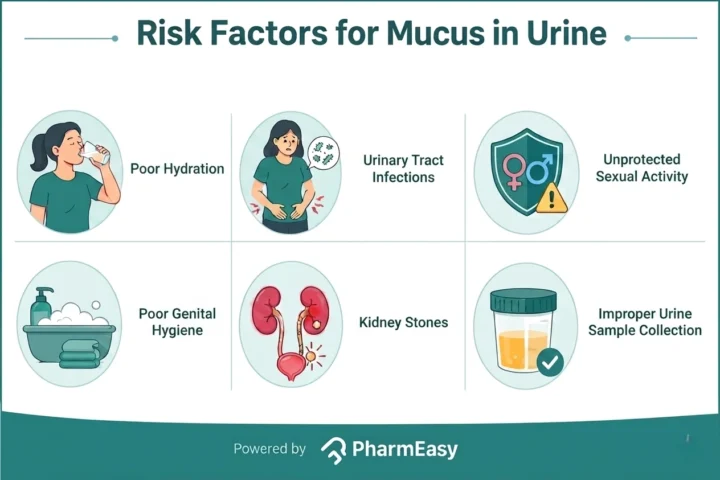
Risk Factors for Mucus in Urine

mucus in urine

Certain factors may increase the likelihood of excess mucus in urine, especially when linked to infections, irritation, or underlying conditions:

  • Poor hydration: Not drinking enough fluids can make urine more concentrated and darker10. This may make mucus more noticeable in urine.
  • Urinary tract infections (UTIs): A history of frequent UTIs increases the risk of inflammation11. This may lead to increased mucus production.
  • Unprotected sexual activity: It may increase the risk of STIs6 and can lead to symptoms like urethral discharge and mucus in urine.
  • Poor genital hygiene: Not washing the external genitalia properly can increase susceptibility to infections and irritation (such as UTI)12.
  • Kidney stones: Individuals prone to kidney stones may experience repeated UTIs (which may lead to mucus in urine)7.
  • Improper urine sample collection: Contamination during urine sample collection (e.g., contamination with vaginal discharge in women) can make mucus appear in test results1.

Treatment Options for Mucus in Urine

Treatment options for mucus threads in urine depend on its underlying cause and include:

  • Treatment for UTIs: Antibiotics are commonly prescribed to eliminate bacterial infections5.
  • Management of STIs: Targeted antibiotic medications, depending on the specific infection (e.g., chlamydia, gonorrhoea) will be given by a doctor6.
  • Treatment for Kidney Stones: Increased fluid intake may be advised to help pass small stones naturally. Your doctor may prescribe pain management medications to help with this. However, larger stones may need medical procedures such as lithotripsy or surgical removal13.

Note: You should never self-medicate and should always consult a doctor for an accurate diagnosis and treatment.

Complications of Mucus in Urine

Mucus present in urine itself usually does not cause complications. However, if it is due to an underlying condition that is left unaddressed, it may lead to the following complications:

  • Spread of infection: UTIs can progress to the kidneys, leading to severe illness5.
  • Chronic or recurrent infections: Repeated infections can cause ongoing urinary discomfort and damage to the urinary tract11.
  • Kidney damage: Severe or untreated infections and kidney stones may impair kidney function over time11,16.
  • Urinary obstruction: Kidney stones or inflammation may block the flow of urine, causing pain and complications16.
  • Sepsis (rare but serious): In severe cases, untreated bacterial infections can spread to the bloodstream, becoming life-threatening11.
  • Complications from STIs: Untreated STIs may lead to reproductive health issues, including pelvic inflammatory disease (PID) in women6.
  • Progression of serious conditions: If mucus in urine is related to conditions like bladder cancer, delayed diagnosis may worsen the outcome1,9.

Diagnosis and Tests of Mucus in Urine

To determine the cause of mucus in urine, doctors rely on a combination of medical history, physical examination, and laboratory tests. Since mucus in urine is not a disease by itself, identifying the underlying condition is key. Some common tests that help with an accurate diagnosis include:

  • Urinalysis: This is the primary urine screening test and includes1,17,18:
    • Dipstick Testing: A quick test strip is used to detect parameters like leukocytes, nitrites, protein, blood, and pH in urine. It helps identify infection or inflammation.
    • Microscopic Examination: Urine is examined under a microscope to identify mucus threads, white/red blood cells, bacteria, or crystals.
  • Urine Culture: This test is performed if an infection is suspected. It helps to identify the specific bacteria causing a UTI and helps guide appropriate antibiotic treatment19.
  • Tests for STIs: It includes urine tests or nucleic acid amplification testing (NAATS) to detect infections like chlamydia or gonorrhoea6. It may be recommended if symptoms or risk factors are present.
  • Imaging Tests: Ultrasound or CT scan may be used to detect kidney stones or structural abnormalities in the body16.

Also Read: Leukocytes in Urine: Causes, Symptoms, Treatment & Prevention Tips 

Prevention of Mucus in Urine

While mucus in urine is often normal, certain measures can help reduce the risk of excess mucus associated with infections or irritation:

  • Stay well hydrated: Drinking enough water helps flush bacteria and toxins from the urinary tract. This may help reduce the risk of infections20.
  • Maintain good personal hygiene: Proper genital hygiene (like washing the genitals with gentle liquid soap) can help avoid infections11.
  • Practice safe sex: Using protection (such as condoms) reduces the risk of STIs6.
  • Do not hold urine for long periods: Regular urination (if possible every 4 hours) helps avoid bacterial growth in the urinary tract11.
  • Wipe properly (for women): Wiping from front to back reduces the risk of spreading bacteria to the urinary tract11.
  • Avoid irritants: Limit the use of harsh soaps, loofahs, or scented products in the genital area11.
  • Follow proper sample collection techniques: Avoid contamination of the urine sample to reduce the chance of falsely detecting mucus1,17.
  • Manage underlying conditions: Proper control of conditions like recurrent UTIs or kidney stones can help lower risk. You should consult a doctor for appropriate evaluation and treatment to avoid recurrence.

Also Read: Foul Smelling Urine: Causes, Symptoms, Diagnosis, Treatment & Home Remedies

Conclusion

Mucus in urine is often a normal finding, especially when it is present in small amounts, and may simply reflect the body’s natural protective processes. However, when it becomes more noticeable or is accompanied by symptoms such as pain, burning, or changes in urine appearance, it could indicate an underlying condition like infection, inflammation, or other urinary conditions. Thus, understanding the possible causes, recognising warning signs, and seeking timely medical advice when needed are key to maintaining urinary health.

Also Read: Crystals in Urine: Types, Causes, Symptoms & When to Worry

Frequently Asked Questions (FAQs)

Is it normal to have mucus in urine?

Yes, having a small amount of mucus in urine is completely normal. The urinary tract naturally produces mucus to protect and lubricate its lining. In most cases, this small amount is not visible and
is only detected during a urine test. However, if the mucus becomes noticeable, persistent, or is accompanied by symptoms like pain or burning, it may need medical evaluation1.

Can kidney problems cause mucus in urine?

Yes, certain kidney-related conditions may lead to mucus in urine. For example, kidney stones can irritate the urinary tract, triggering increased mucus production. These conditions are often associated with other symptoms such as pain in the lower back or sides, or fever1,7.

Can diet affect mucus in urine?

Diet does not directly cause mucus in urine. However, poor hydration can make urine more concentrated, which may make mucus more visible10. Therefore, drinking enough water helps dilute urine and maintain overall urinary tract health.

Is mucus in urine normal during pregnancy?

Yes, small amounts of mucus can be normal during pregnancy due to hormonal changes and increased vaginal discharge. However, any unusual accompanying symptoms, such as pain, fever, or foul-smelling urine should be checked by a doctor21.

Is mucus in urine a sign of bladder cancer?

In rare cases, persistent or excessive mucus in urine may be associated with bladder cancer1. However, it is not a common or primary symptom. More typical warning signs for bladder cancer include blood in urine, frequent urination, and pelvic pain22. These symptoms (if present) should be evaluated by a doctor.

Is mucus in urine visible?

Sometimes, mucus in urine may be seen with the naked eye. It may appear as cloudy urine or as thin, stringy, or jelly-like threads. In many cases, however, it is only detected during microscopic examination in a laboratory.

Can dehydration cause mucus in urine?

Dehydration may make mucus more noticeable. When the body lacks adequate fluids, urine becomes more concentrated, which can make even normal amounts of mucus easier to see10.

Can antibiotics cause mucus in urine?

Antibiotics do not directly cause mucus in urine. However, they can sometimes disrupt the body’s normal microbial balance23. This may increase the risk of further infections, which might contribute to the presence of mucus.

Can yeast infection cause mucus in urine?

A yeast infection can lead to discharge that may mix with urine, giving the appearance of mucus. This is more common in women and may be associated with itching or irritation24.

References

  1. Mucus in Urine: MedlinePlus Medical Test. Accessed April 23, 2026. https://medlineplus.gov/lab-tests/mucus-in-urine/
  2. Wagner CE, Wheeler KM, Ribbeck K. Mucins and Their Role in Shaping the Functions of Mucus Barriers. Annu Rev Cell Dev Biol. 2018;34:189-215. doi:10.1146/annurev-cellbio-100617-062818. https://www.annualreviews.org/docserver/fulltext/cellbio/34/1/annurev-cellbio-100617-062818.pdf?expires=1777445559&id=id&accname=guest&checksum=C5F2F310F28766657576EB3248E5498F
  3. Marvels of Mucus and Phlegm. NIH News in Health. Accessed April 23, 2026. https://newsinhealth.nih.gov/2020/08/marvels-mucus-phlegm
  4. Sheng YH, Hasnain SZ. Mucus and Mucins: The Underappreciated Host Defence System. Front Cell Infect Microbiol. 2022;12:856962. doi:10.3389/fcimb.2022.856962. https://www.frontiersin.org/journals/cellular-and-infection-microbiology/articles/10.3389/fcimb.2022.856962/full
  5. Fang NW, Ou SH, Huang YS, Chiou YH. Urethral discharge as an early manifestation of urinary tract infection in children ≤24 months old. Front Pediatr. 2023;11:1149218. doi:10.3389/fped.2023.1149218. https://www.frontiersin.org/journals/pediatrics/articles/10.3389/fped.2023.1149218/full
  6. Young A, Toncar A, Leslie SW, Wray AA. Urethritis. In: StatPearls. StatPearls Publishing; 2026. Accessed April 23, 2026. http://www.ncbi.nlm.nih.gov/books/NBK537282/
  7. Ripa F, Pietropaolo A, Montanari E, Hameed BMZ, Gauhar V, Somani BK. Association of Kidney Stones and Recurrent UTIs: the Chicken and Egg Situation. A Systematic Review of Literature. Curr Urol Rep. 2022;23(9):165-174. doi:10.1007/s11934-022-01103-y. https://pubmed.ncbi.nlm.nih.gov/35877059/
  8. Ruța F, Avram C, Mardale E, Pribac M, Suciu S, Nyulas V. A Perspective on the Interaction Between Recurrent Lower Urinary Tract Infections and Irritable Bowel Syndrome. Nutrients. 2024;16(21):3613. doi:10.3390/nu16213613. https://www.mdpi.com/2072-6643/16/21/3613/notes
  9. Pan X, Jin L, He T, et al. Mucinous adenocarcinoma of the bladder: A case report and review of the literature. Mol Clin Oncol. 2016;5(4):447-448. doi:10.3892/mco.2016.985. https://pmc.ncbi.nlm.nih.gov/articles/PMC5038899/
  10. Belasco R, Edwards T, Munoz AJ, Rayo V, Buono MJ. The Effect of Hydration on Urine Color Objectively Evaluated in CIE Lab* Color Space. Front Nutr. 2020;7:576974. doi:10.3389/fnut.2020.576974. https://www.frontiersin.org/journals/nutrition/articles/10.3389/fnut.2020.576974/full
  11. Aggarwal N, Leslie SW. Recurrent Urinary Tract Infections. In: StatPearls. StatPearls Publishing; 2026. Accessed April 23, 2026. http://www.ncbi.nlm.nih.gov/books/NBK557479/
  12. Vyas S, Sharma P, Srivastava K, Nautiyal V, Shrotriya VP. Role of Behavioural Risk Factors in Symptoms Related to UTI Among Nursing Students. J Clin Diagn Res JCDR. 2015;9(9):LC15-LC18. doi:10.7860/JCDR/2015/10995.6547. https://pmc.ncbi.nlm.nih.gov/articles/PMC4606256/
  13. Treatment for Kidney Stones – NIDDK. National Institute of Diabetes and Digestive and Kidney Diseases. Accessed April 23, 2026. https://www.niddk.nih.gov/health-information/urologic-diseases/kidney-stones/treatment
  14. Irritable Bowel Syndrome – StatPearls – NCBI Bookshelf. Accessed April 23, 2026. https://www.ncbi.nlm.nih.gov/books/NBK534810/
  15. Bladder Cancer Treatment (PDQ®) – NCI. Accessed April 23, 2026. https://www.cancer.gov/types/bladder/hp/bladder-treatment-pdq
  16. Leslie SW, Sajjad H, Murphy PB. Renal Calculi, Nephrolithiasis. In: StatPearls. StatPearls Publishing; 2026. Accessed April 23, 2026. http://www.ncbi.nlm.nih.gov/books/NBK442014/
  17. Urinalysis – StatPearls – NCBI Bookshelf. Accessed April 23, 2026. https://www.ncbi.nlm.nih.gov/books/NBK557685/
  18. Almuhanna HS, Alhojelan AM, Al Rusayni YA, Almohanna MA, AlDhalea HM, Aljulajil AA. Comparison Between Urine Dipstick and Microscopic Examination Urinalysis With Urine Culture to Evaluate the Sensitivity and Specificity for Each in Diagnosing Urinary Tract Infection in Qassim Region, Saudi Arabia. Cureus. 16(4):e59069. doi:10.7759/cureus.59069. https://pubmed.ncbi.nlm.nih.gov/38800344/
  19. Urine culture: MedlinePlus Medical Encyclopedia. Accessed April 23, 2026. https://medlineplus.gov/ency/article/003751.htm
  20. McCollum BJ, Garigan T, Earwood J, Jarrett JB. PURLs: Can drinking more water prevent urinary tract infections? J Fam Pract. 2020;69(3):E19-E20. https://pmc.ncbi.nlm.nih.gov/articles/PMC7271893/
  21. Vaginal discharge. nhs.uk. December 3, 2020. Accessed April 24, 2026. https://www.nhs.uk/pregnancy/common-symptoms/vaginal-discharge/
  22. Symptoms of bladder cancer. nhs.uk. April 24, 2025. Accessed April 24, 2026. https://www.nhs.uk/conditions/bladder-cancer/symptoms/
  23. Francino MP. Antibiotics and the Human Gut Microbiome: Dysbioses and Accumulation of Resistances. Front Microbiol. 2015;6:1543. doi:10.3389/fmicb.2015.01543. https://www.frontiersin.org/journals/microbiology/articles/10.3389/fmicb.2015.01543/full
  24. Overview: Vaginal yeast infection (thrush). In: InformedHealth.Org [Internet]. Institute for Quality and Efficiency in Health Care (IQWiG); 2022. Accessed April 24, 2026. https://www.ncbi.nlm.nih.gov/books/NBK543220/

Disclaimer: The information provided here is for educational/awareness purposes only and is not intended to be a substitute for medical treatment by a healthcare professional and should not be relied upon to diagnose or treat any medical condition. The reader should consult a registered medical practitioner to determine the appropriateness of the information and before consuming any medication. PharmEasy does not provide any guarantee or warranty (express or implied) regarding the accuracy, adequacy, completeness, legality, reliability or usefulness of the information and disclaims any liability arising thereof.

Links and product recommendations in the information provided here are advertisements of third-party products available on the website. PharmEasy does not make any representation on the accuracy or suitability of such products/services. Advertisements do not influence the editorial decisions or content. The information in this blog is subject to change without notice. The authors and administrators reserve the right to modify, add, or remove content without notification. It is your responsibility to review this disclaimer regularly for any changes.

Advertisement

Comments

Leave your comment...