
Introduction
If your skin often feels dry, flaky, tight, or dull, you’re not alone; many people experience this. And to get softer skin, most of them search for complicated routines or expensive products, hoping for quick hydration. However, they often overlook some of the simplest, most effective ingredients already present in their skincare.
One such ingredient is glycerine (also called glycerol)1. It’s widely used in cleansers, moisturisers, serums, and even medical creams, but is often misunderstood or underestimated because of its simplicity.
In this blog, we will help you understand what glycerine is, its role in skincare, how to use it correctly, and whether it has any side effects.
Advertisement
What Is Glycerine?
Glycerine is a clear, colourless, and odourless liquid that naturally occurs in plants and animals. It has a syrup-like texture2.
Did you know?
- It was first discovered in the late 1700s during the processing of fats3.
- The name “glycerine” comes from the Greek word for “sweet,” because it tastes mildly sweet3.
- It is part of the structure of fats (triglycerides) and plays a role in energy storage and metabolism3.
In this blog, we will only stick to glycerine’s role in skincare and not as a food additive.
Types of Glycerine & How to Choose the Right One
Glycerine is broadly classified according to source and purity:
- Vegetable glycerine: This is derived from plant oils such as soy, palm, or coconut through hydrolysis (where triglycerides break into glycerol and fatty acids) or saponification (where fats and oils are turned into soaps and glycerol). It is widely used in skincare, pharmaceuticals, and food products3.
- Animal-derived glycerine: This is obtained from animal fats during fat processing (hydrolysis as well as saponification). It is found mainly in pharmaceutical and industrial applications4.
While choosing glycerine, you should focus on the purity and grade. Here’s how to choose correctly:
- Prefer vegetable glycerine, as it is recommended for cosmetic and personal use.
- Look for pharmaceutical grade or Indian Pharmacopoeia/United States Pharmacopoeia/British Pharmacopoeia (IP/USP/BP) on the label.
- Read the label, it should say “For cosmetic or pharmaceutical use”.
- Pick a product of good quality (should be 100% glycerine) with no added fragrance or colour.
Is Glycerine Good for Skin?
Glycerine is widely used in skincare as a humectant, meaning it draws water toward the skin and helps retain moisture, keeping the skin soft and hydrated5. This is why it is commonly found in lotions, creams, cleansers, and serums, and is suitable for most skin types, including dry, sensitive, and ageing skin.
Advertisement
However, glycerine should not be used in its pure form (100%) directly on the skin. This is because when 100% glycerine is applied directly, it could feel sticky and may pull water from deeper layers of the skin, especially in dry environments, leading to discomfort or dryness5.
So, for best results, glycerine should always be diluted or used as part of a well-formulated product, where it provides effective, long-lasting hydration without irritation.
Benefits of Glycerine for Skin
When it comes to skin hydration, glycerine stands out as a simple yet powerful ingredient. Below are some of the most common glycerine benefits:
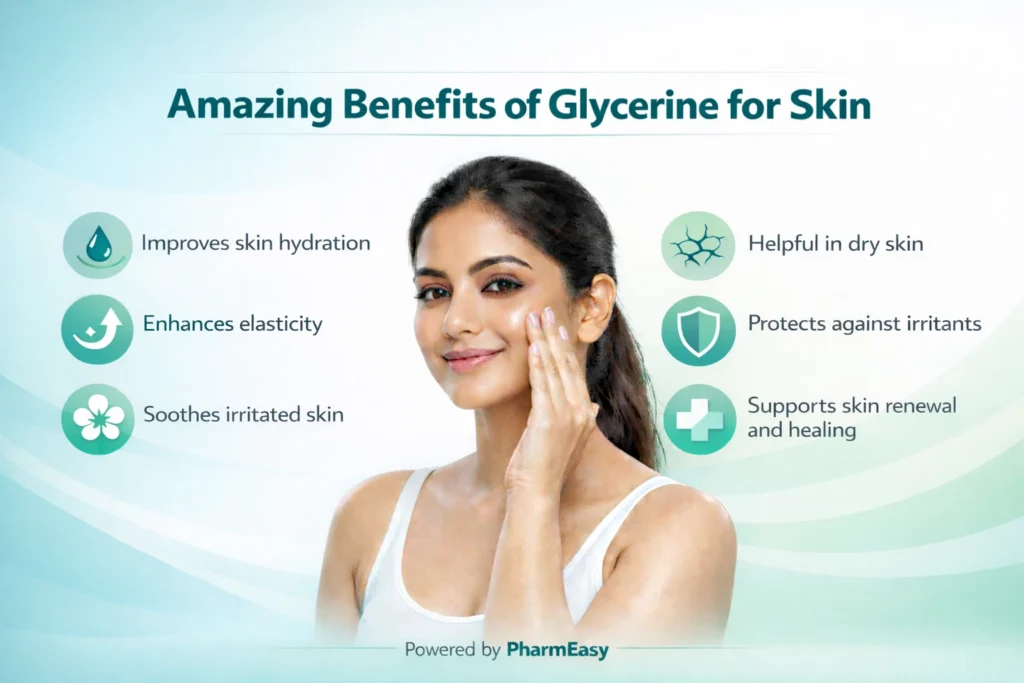
- Improves skin hydration: Topical glycerine significantly increases water content in the outer skin layer. This helps to keep the skin soft and moisturised5.
- Enhances elasticity: Glycerine improves not only hydration but also the mechanical characteristics of the skin, such as elasticity1. This makes your skin more resilient and flexible.
- Soothes irritated skin: Glycerine has soothing properties that help calm irritated, sensitive, or inflamed skin1,6. This makes it a good option for people with compromised skin barriers.
- Helpful in dry skin: Topical glycerine improves skin properties in conditions like xerosis (dry skin) by increasing hydration as well as supporting skin repair1.
- Protects against irritants: Glycerine helps to stabilise the topmost layer of the skin. This helps protect the skin from external irritants1.
- Supports skin renewal and healing: Glycerine helps the skin shed dead cells normally and speeds up healing1. This supports healthy skin repair and renewal.
- Provides mild antimicrobial protection: Glycerine has a gentle antimicrobial effect1. This may help protect the skin from harmful microbes and support overall skin defence.
Also Read: Beauty Benefits of Using Ice Cubes On The Skin
How to Use Glycerine on Face?
Glycerine for skin is safe and effective, but only when used correctly. Here are simple and practical glycerine uses:
- Glycerine as a gentle cleanser: Not a replacement for your regular cleanser, but it can be used occasionally to help reduce dryness during cleansing.
- How to use: Mix 1 to 2 drops of glycerine with your regular face wash or mild cleanser.
- How often: Once daily or when skin feels very dry.
- Glycerine as a hydrating toner: Can act as a moisture-boosting step after cleansing.
- How to use: Mix 1 part glycerine with 4 to 5 parts rose water or plain water. Apply this mixture with clean hands or cotton.
- How often: Once or twice daily.
- Glycerine as a moisturiser: Can help attract and hold moisture in the skin.
- How to use: Mix 1 to 2 drops of glycerine with your regular moisturiser and apply to slightly damp skin. No separate dilution is needed if you mix it with a moisturiser.
- How often: Once or twice daily.
- Glycerine for dry skin: Good option for very dry or flaky skin.
- How to use: Dilute 1 part glycerine with 3 or 4 parts water or a hydrating toner. Apply this mixture after cleansing, preferably on slightly damp skin. Leave it on if you prefer and follow with a moisturiser (only if needed). There is no need to wash it off.
- How often: Once daily or on alternate days.
- Glycerine for sensitive skin: A gentle and soothing option for sensitive skin.
- How to use: Mix 1 drop of glycerine with a fragrance-free moisturiser and apply to damp skin. Always dilute with a moisturiser that suits your skin.
- How often: Once daily.
- Glycerine as a night care ingredient: Works best at night when the skin repairs itself.
- How to use: Apply diluted glycerine (1:3 or 1:4 with water or toner), then follow with a moisturiser. You may leave it overnight.
- How often: Alternate days a week or daily if well tolerated.
- Glycerine for body care: Very effective for thicker and drier skin areas.
- How to use: Add 2 to 3 drops (or as needed) of glycerine to body lotion. Apply this mixture to your hands, feet, elbows, knees, and heels.
- How often: Once or twice daily.
Side Effects of Glycerine
Glycerine is well tolerated for most skin types, but like any skincare ingredient, it could cause side effects if used incorrectly or in certain individuals. Here’s what you should be aware of:
- When used in its undiluted (100%) form, glycerine might feel sticky and uncomfortable on the skin.
- If applied alone (at higher concentrations) without water or a moisturiser, glycerine may draw moisture from deeper skin layers, making the skin feel tight or dry5.
- Some people with very sensitive (or compromised skin barrier) may experience mild irritation, stinging, or redness.
- Using too much glycerine or layering it improperly may clog pores, especially when combined with heavy products.
- Though uncommon, itching or rashes may occur in individuals with ingredient sensitivities (such as fragrance or alcohols).
Note: If you notice persistent redness, itching, burning, or worsening of a skin condition, stop using glycerine and consult a dermatologist. This is especially important if you have eczema, rosacea, acne, or a damaged skin barrier.
Also Read: 16 Simple Home Remedies for Glowing Skin!
Conclusion
Glycerine is a safe, affordable, and effective skincare ingredient that has been trusted for decades for its excellent hydrating properties. When used correctly, it can help attract and retain moisture, support the skin barrier, and keep the skin soft and healthy across all skin types.
The key to getting the best results lies in proper usage, which is always diluting glycerine or using it as part of a well-formulated product rather than applying it in its pure form. With the right approach, glycerine can be a simple yet powerful addition to a consistent skincare routine.
Also Read: Red Light Therapy: What It Is, Benefits, Uses & More!
Frequently Asked Questions (FAQs)
Can we use glycerine directly on the face? Glycerine should not be used in its pure (100%) form on the face5. When undiluted, it can feel sticky and may draw moisture from deeper layers of the skin, especially in dry weather. So, it is best to use it after diluting it with water or as part of a formulated skincare product.
Does glycerine help in skin whitening? Glycerine does not whiten the skin. Its main role is to provide hydration by improving moisture levels and skin barrier health5,6. This can make the skin look brighter and healthier, but it does not change natural skin colour.
How to use glycerine for babies? For babies, glycerine should be used only in very low concentrations and preferably as part of a baby-safe moisturiser or lotion8. You should never apply pure glycerine. If dryness or rashes persist, consult a paediatrician or dermatologist.
Does glycerine remove tan? Glycerine does not remove tan. However, by keeping the skin hydrated and healthy, it may help the skin recover and look more even-toned over time, especially when used along with sun protection.
Why is glycerine so good for skin? Glycerine is effective because it draws water into the skin and helps maintain the skin barrier. This improves softness, elasticity, and overall skin health, making it suitable for most skin types5,7.
Can we use glycerine on the tongue? Food- or pharmaceutical-grade glycerine is sometimes used in oral products for dryness, but it should not be used casually without medical advice9. For any oral use, it is best to consult a doctor first.
References
- Fluhr JW, Darlenski R, Surber C. Glycerol and the skin: holistic approach to its origin and functions. Br J Dermatol. 2008 Jul;159(1):23-34. Available from: https://pubmed.ncbi.nlm.nih.gov/18510666/
- Becker LC, Bergfeld WF, Belsito DV, Hill RA, Klaassen CD, Liebler DC, et al. Safety Assessment of Glycerin as Used in Cosmetics. Int J Toxicol. 2019 Nov/Dec;38(3_suppl):6S-22S. Available from: https://pubmed.ncbi.nlm.nih.gov/31840548/
- USDA Agricultural Marketing Service. Technical Evaluation Report: Glycerin—produced by hydrolysis of fats and oils [Internet]. USDA; [cited 2026 Jan 21]. Available from: https://www.ams.usda.gov/sites/default/files/media/Glycerin%20Petition%20to%20remove%20TR%202013.pdf
- Dhanavel N., Nandakrishnan M. Halada A Review of Animal Fat: A Great Source for Industrial Applications. J. Chem. Rev., 2024; 6(2): 115-137. Available from: https://www.jchemrev.com/article_188241.html
- Chen HJ, Lee PY, Chen CY, Huang SL, Huang BW, Dai FJ, et al. Moisture retention of glycerin solutions with various concentrations: a comparative study. Sci Rep. 2022 Jun 17;12(1):10232. Available from: https://pmc.ncbi.nlm.nih.gov/articles/PMC9205919/
- Lodén M, Wessman W. The influence of a cream containing 20% glycerin and its vehicle on skin barrier properties. Int J Cosmet Sci. 2001 Apr;23(2):115-9. Available from: https://pubmed.ncbi.nlm.nih.gov/18498456/
- De Paepe K, Wibaux A, Ward C, Rogiers V. Skin efficacy and biophysical assessment of glycerol-containing hydrocolloid patches. Skin Pharmacol Physiol. 2009;22(5):258-65. Available from: https://pubmed.ncbi.nlm.nih.gov/19690451/
- Capone KA, Friscia DL, Nikolovski J, Telofski LS, Stamatas GN. A randomized clinical study on the effects of emollient use on the developing infant skin microbiome and metabolome. Exp Dermatol. 2023 Jan;32(1):75-77. Available from: https://pmc.ncbi.nlm.nih.gov/articles/PMC10092030/
- Vinke J, Kaper HJ, Vissink A, Sharma PK. Dry mouth: saliva substitutes which adsorb and modify existing salivary condition films improve oral lubrication. Clin Oral Investig. 2020 Nov;24(11):4019-4030. Available from: https://pmc.ncbi.nlm.nih.gov/articles/PMC7544715/
Disclaimer: The information provided here is for educational/awareness purposes only and is not intended to be a substitute for medical treatment by a healthcare professional and should not be relied upon to diagnose or treat any medical condition. The reader should consult a registered medical practitioner to determine the appropriateness of the information and before consuming any medication. PharmEasy does not provide any guarantee or warranty (express or implied) regarding the accuracy, adequacy, completeness, legality, reliability or usefulness of the information; and disclaims any liability arising thereof.
Links and product recommendations in the information provided here are advertisements of third-party products available on the website. PharmEasy does not make any representation on the accuracy or suitability of such products/services. Advertisements do not influence the editorial decisions or content. The information in this blog is subject to change without notice. The authors and administrators reserve the right to modify, add, or remove content without notification. It is your responsibility to review this disclaimer regularly for any changes.





































Comments