




Typhoid Test: What is It, When To Be Taken & Side Effects
By Dr. Vishesh Bharucha +2 more

Medically reviewed by Dr. Vishesh Bharucha
Last updated: Sep 9, 2026 Published on: Jul 23, 2025


Get,

to manage your symptom
Get your,

4 Cr+ families
benefitted

OTP sent to 9988776655



You’ve successfully subscribed to receive
doctor-approved tips on
Whatsapp

Get ready to feel your best.


Register to Avail the Offer
Send OTPBy continuing, you agree with our Privacy Policy and Terms and Conditions
Hi There,
Sign up on PharmEasy now!!


Trusted by 4 crore+ families

OTP sent to 9988776655
You have unlocked 25% off on medicines


Code: NU25

By Dr. Vishesh Bharucha +2 more
Table of Contents
The typhoid infection has been increasing in India over the past few years, affecting around 10 million people in 20211. The infection is caused by the Salmonella typhi bacteria that enters and spreads throughout your body when you consume contaminated food or water1,2. Some symptoms of typhoid, like fever, tiredness, and stomach pain, can resemble other diseases like malaria. Therefore, doing a typhoid test may help confirm the infection3,4.
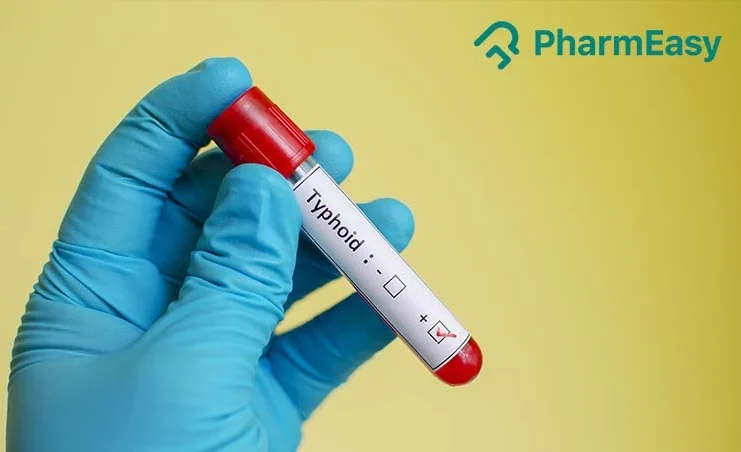
In this blog, we will explain what typhoid is, which test is done for typhoid, and when to take it.
Typhoid fever is a serious infection that spreads throughout the body after the bacteria enter the body through contaminated food or water. After the bacteria pass through the intestinal walls, they reach the blood within 24 hours. The infection then spreads to other organs like the liver, spleen, bone marrow, gall bladder, and, sometimes, into the brain. Within 7 to 14 days of exposure, symptoms like high fever, body pain, abdominal pain, and weakness start to show. If not tested and treated early, typhoid can become more severe with complications like bleeding in the stomach, perforation of the intestines, and brain-related issues like delirium, confusion, and memory loss2,5.
The typhoid test is important to confirm that you have a typhoid infection. It helps to differentiate typhoid from other illnesses like dengue and malaria, which may have similar symptoms6.
Testing in the early stage may help you take the right antibiotic and medicines, so the disease doesn’t become more severe and cause complications6,7,8. It also may help your doctor choose the most effective antibiotic, as some bacteria in India do not respond well to certain antibiotics like fluoroquinolones2.
Testing may help find who is having typhoid, and necessary precautions can be taken to not spread it to others. In places where typhoid is prevalent, it may help to find out how many people are affected and whether it is becoming an outbreak, so that action can be taken to prevent its spread9.
Your doctor may advise you to get a typhoid test if you have2,10:
In such cases, a doctor may look into your symptoms, medical history and accordingly recommend an appropriate blood test for typhoid.
In my experience, I have noticed that unlike other fevers where pulse usually rises by 10 with every 1 degree increase in temperature, in typhoid fever, the heart beat may remain normal or slow down to less than 60 beats per minute. This relative bradycardia is classical sign seen in typhoid.
Dr. Kathak Shah, MBBS, DDV, Fellowship in Lasers & Aesthetics, Fellowship in Dermatosurgery
The risks of typhoid depend on an individual’s age, environment, and location and is higher in the following individuals2,3,13:
If these individuals experience symptoms of typhoid fever, it is best to consult a doctor who may advise a blood test for typhoid.
A with a fever lasting more than two weeks with decrease in white blood cell counts should raise the suspicion of typhoid fever. If you notice any rose coloured spots present over your chest and abdomen resembling mosquitoes/insects bites along with persistent fever, these could be signs of typhoid.
Dr. Kathak Shah, MBBS, DDV, Fellowship in Lasers & Aesthetics, Fellowship in Dermatosurgery
There is no single test that can confirm a typhoid infection. A blood culture test is considered the gold standard test for typhoid; however, different typhoid tests may help identify typhoid infection and provide more accurate results when done early. Let us see how to test for typhoid using different tests:
This is considered the standard test for typhoid. In this test, a sample of your blood or bone marrow is checked to find the presence of bacteria causing typhoid. It may give more reliable results compared to other tests when done in the first week of illness. It has a sensitivity of 50-80%, which means it can correctly detect the infection 5 to 8 times out of 10. Stool and urine samples can also be helpful, but they may be less reliable early on.
The widal blood test for typhoid checks for antibodies which your body produces against the bacteria. It may be used commonly in areas where the disease is spreading fast. However, the results may be affected if there was any past infection or other Salmonella diseases2,6. It usually shows positive results only after 7 to 10 days of infection, and also may miss real cases or show false positives due to low sensitivity and low specificity2,15.
The Polymerase Chain Reaction (PCR) test may help identify the genetic material (DNA) of the typhoid bacteria and show which antibiotic may work and which may not (including fluoroquinolone antibiotics). It may be more reliable compared to other tests, but it is costly and not commonly used for routine typhoid testing2,16.
Along with these, the doctor may advise other tests to rule out conditions like malaria and brain fever. A blood count is taken to check for a low white cell count or anaemia, and liver function tests may also be done. Together, these tests may help the doctor get a clearer picture of your disease condition and decide on how to manage it2,6.
Treatment of typhoid primarily involves appropriate antibiotics, based on the resistance pattern of typhoid in that region.
Once typhoid is suspected, medication should be started as soon as possible to help prevent complications. Doing a blood culture test before starting antibiotics may help confirm the infection and guide the right choice of antibiotic for it16. However, antibiotics may also be started early based on the individual’s condition and the doctor’s judgement before test results are available, especially in areas with limited medical facilities2.
Oral antibiotic medicines may be given along with fever medicines like paracetamol to manage typhoid. Oral replacement fluids may help for symptoms like vomiting or diarrhoea2,17,18.
Hospital admission may be needed. Medicines like antibiotics and fluids may need to be given through the vein.
The following antibiotics may help manage typhoid:
Usually, the fever may reduce in 3 to 5 days after taking medicines. If not, antibiotics may need to be changed based on blood test results2,17.
It is important to consult a doctor to get the right plan for managing the disease based on your symptoms and clinical condition.
Complications may develop in some patients after 2 to 3 weeks of typhoid infection. These may vary based on age, gender, existing health conditions, and the region, as follows.
Even after treatment, some people may carry the bacteria for weeks or months without feeling sick, but they can still spread the disease. In such cases, proper precautions should be taken to reduce the risk of spreading it to others2,3.
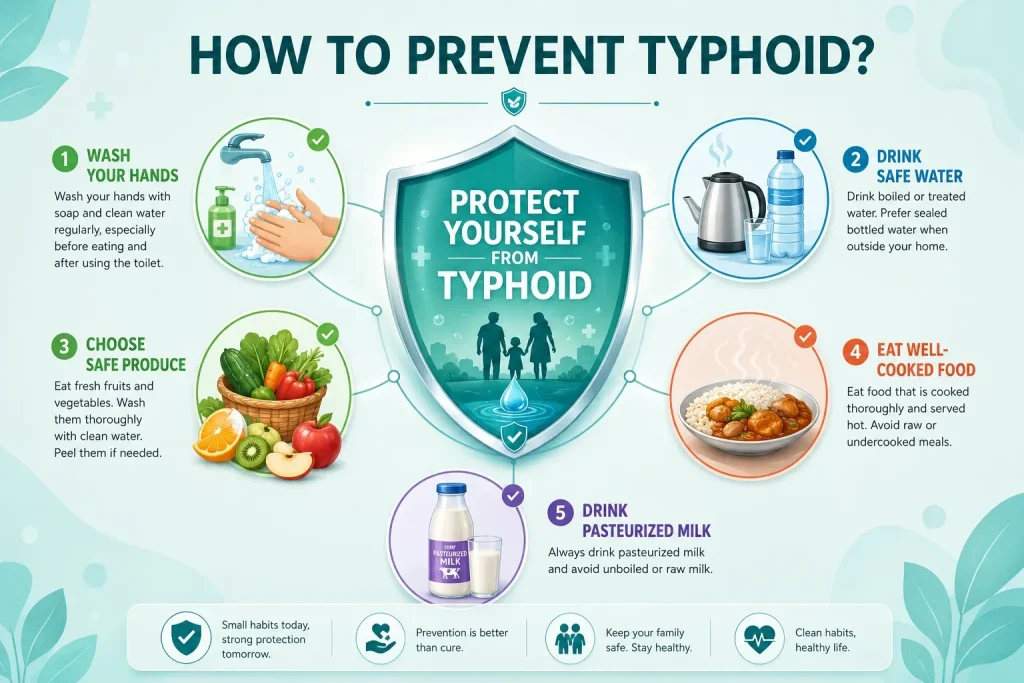
As typhoid is mainly spread by contaminated food and water, following these practices may help reduce the risk of getting typhoid:
Vaccination against typhoid may give you added protection, especially when you are going to areas where it is more common22,23.
Typhoid vaccination may be advised for those who travel to typhoid-affected areas, laboratory workers handling typhoid bacteria, and those who are in close contact with a typhoid case. Two vaccines that may help in such cases are:
This may help to develop antibodies that may fight against typhoid. It is given as an injection taken as per the doctor’s advice at least 2 weeks before travel (as protection usually starts within 7–14 days), and repeat doses every 2 years5,26.
Immunity is usually achieved within 7–14 days with the Vi polysaccharide vaccine, but it’s ideal to take it at least 2 weeks before exposure.
Vi conjugate vaccine (TCV): This is a vaccine with Vi polysaccharide but joined to a special protein, which is why it is called a conjugate vaccine. It is WHO-prequalified and preferred in many countries where typhoid is common, even in India. It may give protection for up to 5 years, may work well in children under 2 years, and needs only one dose5,27,28.
It may help stimulate the immune system to act against typhoid bacteria. It can be given to people aged 6 years and older. One capsule is taken every other day (on day 1, 3, 5, and 7), for a total of 4 capsules. It should be taken at least 1 week before travel, and a booster dose may be given once in 5 years. This vaccine may not be suitable for people with weak immune systems or those taking antibiotics.
Vaccine is not a substitute for safe hygiene practices, as it may not be 100% effective5,25.
Also Read: Typhoid Fever Rash: When Rose Spots Appear & What You Should Do
For quicker recovery from typhoid and to prevent spread of the disease, follow these things:
Once you have fully recovered, you also need to monitor closely for typhoid symptoms for at least 3 months, as there is a risk of relapse or developing complications of typhoid during this period29.
Also Read: Pneumococcal Vaccine: Types, Side Effects, and Who Needs It
You need to see a doctor and may be advised to undergo a blood test for typhoid if you:
Also Read: Mean Platelet Volume (MPV) Blood Test: Understanding Its Importance and Results
Typhoid fever can become life-threatening if not identified early with a typhoid test, and treatment is delayed. If you have persistent fever, body pain, and tiredness, especially after recent travel or close contact with a typhoid patient, you need to consult a doctor and get tested. To reduce your chances of getting typhoid, always follow safe hygiene practices for food and water during your travel and even where you stay.
Also Read: Typhoid Vaccine: What is It, Types, When to Be Taken & Side Effects
You may feel better in 2 to 4 weeks once medicines are started. If treatment is started early, the chances of better recovery are higher, while complications may delay recovery31.
Yes, a few people may carry the bacteria for a long time, sometimes even for life, and can still spread it to others.
Not everyone who has typhoid needs to be isolated. The bacteria usually spread through the faeces. Only children or those who cannot control diarrhoea may need isolation. Others should follow good hygiene after using the toilet and can return to normal activities once recovered30.
The injectable Vi polysaccharide vaccine may be given to pregnant women as it does not contain live bacteria. The oral Ty21a vaccine is not recommended during pregnancy32.
Disclaimer: The information provided here is for educational/awareness purposes only and is not intended to be a substitute for medical treatment by a healthcare professional and should not be relied upon to diagnose or treat any medical condition. The reader should consult a registered medical practitioner to determine the appropriateness of the information and before consuming any medication. PharmEasy does not provide any guarantee or warranty (express or implied) regarding the accuracy, adequacy, completeness, legality, reliability or usefulness of the information; and disclaims any liability arising thereof.
Links and product recommendations in the information provided here are advertisements of third-party products available on the website. PharmEasy does not make any representation on the accuracy or suitability of such products/services. Advertisements do not influence the editorial decisions or content. The information in this blog is subject to change without notice. The authors and administrators reserve the right to modify, add, or remove content without notification. It is your responsibility to review this disclaimer regularly for any changes.
 1
1 
Comments

Leave your comment...
You may also like
























Comments