




Female Condom: What It Is, Benefits, Side Effects, and How to Use It
By Dr. Charmi Shah +2 more

Medically reviewed by Dr. Charmi Shah
Last updated: Sep 3, 2026 Published on: Apr 14, 2026


Get,

to manage your symptom
Get your,

4 Cr+ families
benefitted

OTP sent to 9988776655



You’ve successfully subscribed to receive
doctor-approved tips on
Whatsapp

Get ready to feel your best.


Register to Avail the Offer
Send OTPBy continuing, you agree with our Privacy Policy and Terms and Conditions
Hi There,
Sign up on PharmEasy now!!


Trusted by 4 crore+ families

OTP sent to 9988776655
You have unlocked 25% off on medicines


Code: NU25

By Dr. Charmi Shah +2 more
Table of Contents
Many women rely on contraceptive pills as a convenient method to avoid pregnancy. Contraceptive pills are widely used and can be effective if taken as prescribed; however, some women prefer not to take them as they contain hormones and have to be taken daily. Although several other contraceptive options are available, many methods are less commonly used despite their potential benefits. One such option, which is underused and underdiscussed, is the female condom.
A female condom, which is also known as an internal condom, is a soft pouch that is placed inside the vagina before intercourse. It acts as a barrier, not allowing the sperm to enter the vagina and reach the egg. It also provides protection against sexually transmitted infections (STIs), which may make it a suitable option for some individuals1.
Although condoms are widely used, most people are more familiar with male condoms. Female condoms are used much less, making up only 1.6% of the total condom use worldwide. However, the use of female condoms is increasing gradually2 as more awareness is being created about giving women better management options over their sexual and reproductive health.
This article will guide you to better understand what a female condom is, its benefits, how to use it, and its side effects, helping you make the right choices.
As mentioned earlier, a female condom is a thin pouch, which is placed inside the vagina before sex to avoid pregnancy. Like the male condom, it acts as a barrier by avoiding contact between the sperm and the egg. It also provides protection against several STIs.
Several types of female condoms are available based on their material. While earlier they were made from polyurethane, most modern female condoms are now made from a durable material called nitrile. These condoms have a ring on each end1,2. The use of a female condom is controlled by the woman, giving her more independence in protecting herself.
The application of a female condom differs from that of a male condom. The steps suggested by the Centers for Disease Control and Prevention (CDC) on how to use female condoms to avoid pregnancy are as follows.
The female condom application process can be divided into three stages:
Before Intercourse:
During Intercourse:
After Intercourse:
Proper insertion and consistent use of the female condom play an important role in providing better protection.
For birth control, female condoms can be a reliable method when used correctly. With perfect use (correct use every time), female condoms may be about 95% effective. With typical use (which includes inconsistent or incorrect use), effectiveness may be around 79%1,4,5.
In addition to avoiding pregnancy, female condoms are also known for their benefits in reducing the chances of getting STIs, making them a dual-protection method. These estimates are supported by global health organisations like the CDC and the World Health Organisation (WHO)3,6.
However, like male condoms, female condoms can also fail in some cases due to the following reasons:
While these cases are rare, they can still occur. Proper handling of the condom during insertion, intercourse, and removal can improve its effectiveness and provide maximum benefits. Do not use male and female condoms together, as friction between them can increase the risk of slipping or breakage, reducing effectiveness.
Like any product available in the market, female condoms have both advantages and disadvantages. The following sections outline the key benefits and limitations of using female condoms.
These include:
These include:
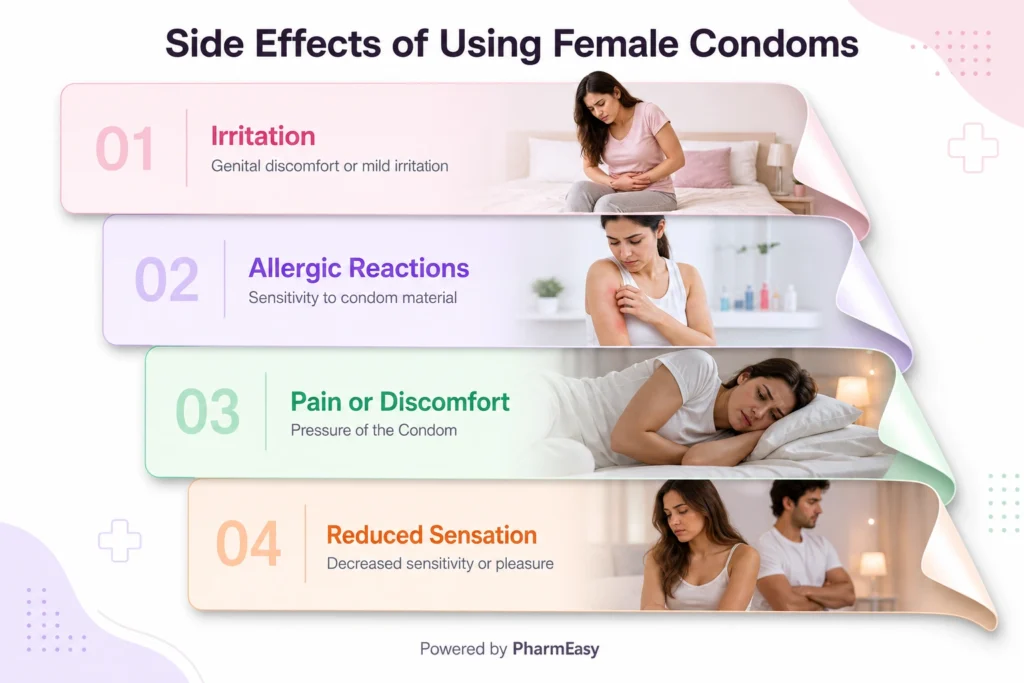
Female condoms are generally associated with very few side effects, and these may not be experienced by all. Possible female condom side effects include:
Although female condoms are generally safe to use, certain situations may require medical advice. Consult your doctor if:
Female condoms are a reliable and safe option for avoiding pregnancy while also offering protection against STIs and are as effective as a male condom when used correctly. Although they are less commonly used, they provide an important advantage by giving women greater control over their sexual health.
Understanding how to use them correctly, along with being aware of their possible benefits and side effects, can help you in making the right choices. With proper and consistent use, female condoms can be an effective and convenient non-hormonal method for protection against pregnancy and STIs.
Condoms, whether male or female, should not be reused. They are designed for single use only3,4,11.
Female condoms are not considered 100% safe. They are considered to be 79% effective with normal use1.
Using a female condom is generally not painful; however, it may cause irritation or discomfort in some individuals or pain during intercourse due to the inner ring1,7,9.
High cost (compared to male condoms), limited availability, limited knowledge of how to wear a female condom, and a fear of embarrassment or social or cultural stigma are considered to be some of the reasons behind less use of female condoms5.
Female condoms stay in place using the two flexible rings: the inner ring, which is thick and rests inside the vagina near the cervix, and the outer ring, which is thin and remains outside, covering the vaginal opening3.
1. Female Condoms. 2024. Available from: https://medlineplus.gov/ency/article/004002.htm
2. Chen BA, Blithe DL, Muraguri GR, et al. Acceptability of the Woman’s Condom in a phase III multicenter open-label study. Contraception. 2019;99(6):357362. doi:10.1016/j.contraception.2019.02.006. Available from: https://pmc.ncbi.nlm.nih.gov/articles/PMC7363037/
3. How to Use an Internal Condom. 2024. Available from: https://www.cdc.gov/condom-use/resources/internal.html
4. Contraception-Female (Internal) Condoms. 2022. Available from: https://www.betterhealth.vic.gov.au/health/healthyliving/contraception-condoms-for-women
5. Weerasinghe M, Agawane S, Karandikar N, Fisher J, Sastry J. Examining the place of the female condom in India’s family planning program: A qualitative investigation of the attitudes and opinions of key stakeholders in Pune, India. BMC Public Health. 2022;22(1):1675. doi:10.1186/s12889-022-14054-3. Available from: https://pubmed.ncbi.nlm.nih.gov/36064344/
6. World Health Organization. Condoms [Internet]. Geneva: World Health Organization; 2025 Feb 14 [cited 2026 Apr 14]. Available from: https://www.who.int/news-room/fact-sheets/detail/condoms
7. American Pregnancy Association. Female condom [Internet]. [cited 2026 Apr 14]. Available from: https://americanpregnancy.org/unplanned-pregnancy/birth-control-pills-patches-and-devices/female-condom/
8. Birth Control Methods. 2025. Available from: https://womenshealth.gov/a-z-topics/birth-control-methods
9. Bowling J, Dodge B, Bindra N, et al. Female condom acceptability in urban India: Examining the role of sexual pleasure. J Health Psychol. 2018;23(2):218-228. doi:10.1177/1359105317745963. Available from: https://pmc.ncbi.nlm.nih.gov/articles/PMC5772445/
10. NHS. Internal condoms [Internet]. National Health Service; 2024 Feb 15 [cited 2026 Apr 14]. Available from: https://www.nhs.uk/contraception/methods-of-contraception/internal-condoms/
11. Better Health Channel. Contraception – condoms for men [Internet]. Victoria State Government; [cited 2026 Apr 14]. Available from: https://www.betterhealth.vic.gov.au/health/healthyliving/contraception-condoms-for-men
Disclaimer: The information provided here is for educational/awareness purposes only and is not intended to be a substitute for medical treatment by a healthcare professional and should not be relied upon to diagnose or treat any medical condition. The reader should consult a registered medical practitioner to determine the appropriateness of the information and before consuming any medication. PharmEasy does not provide any guarantee or warranty (express or implied) regarding the accuracy, adequacy, completeness, legality, reliability or usefulness of the information; and disclaims any liability arising thereof.
Links and product recommendations in the information provided here are advertisements of third-party products available on the website. PharmEasy does not make any representation on the accuracy or suitability of such products/services. Advertisements do not influence the editorial decisions or content. The information in this blog is subject to change without notice. The authors and administrators reserve the right to modify, add, or remove content without notification. It is your responsibility to review this disclaimer regularly for any changes.
 0
0  0
0Comments

Leave your comment...
You may also like


















Comments