




Eye Floaters: What They Are, Causes, Types, Treatment, and Prevention
By Dr. Poonam Rai +2 more

Medically reviewed by Dr. Poonam Rai
Last updated: Mar 2, 2026 Published on: Feb 2, 2026


Get,

to manage your symptom
Get your,

4 Cr+ families
benefitted

OTP sent to 9988776655



You’ve successfully subscribed to receive
doctor-approved tips on
Whatsapp

Get ready to feel your best.


Register to Avail the Offer
Send OTPBy continuing, you agree with our Privacy Policy and Terms and Conditions
Hi There,
Sign up on PharmEasy now!!


Trusted by 4 crore+ families

OTP sent to 9988776655
You have unlocked 25% off on medicines


Code: NU25

By Dr. Poonam Rai +2 more
Table of Contents
Have you ever noticed tiny spots, lines, or spiderweb-like shapes floating across your vision? They move as your eyes move and can be hard to ignore. These are called eye floaters, and almost everyone sees them at some point in life, especially as they get older.
Floaters are surprisingly common. Research shows that between 27% and 63% of people notice them, and one study reported that 76% of adults have experienced floaters. Most people hardly notice them, but about 76% feel worried and 33% say floaters affect their daily activities1,2.

Usually, floaters are harmless. However, a sudden increase in floaters, especially when accompanied by flashes of light or reduced side vision, can indicate a more serious eye problem. This may occur due to retinal tears or detachment, more commonly seen in individuals with high myopia (high minus power). In some cases, it may also be due to vitreous haemorrhage (bleeding in the vitreous chamber of the eye), particularly following eye trauma or in people with diabetes. Such symptoms require prompt medical attention2,4.
So, let us explore what causes eye floaters, why they happen more with age, and what you can do to keep your eyes healthy.
The eye is divided into 3 chambers, the anterior and posterior chambers and the vitreous chamber. The anterior chamber is the area right behind the cornea (the clear window of the eye). The posterior chamber is the area from the iris (the coloured part of the eye) to the anterior part of the lens of the eye. The vitreous chamber is the space behind the lens, and this is where eye floaters commonly originate. This chamber is filled with a jelly-like material called the vitreous gel, which has tiny fibres attached to the retina, the light-sensitive layer at the back of the eye that helps form the images that we see.
Floaters happen when the jelly slowly shrinks and clumps together. Some fibres break, and parts of the gel pull away from the retina. These clumps cast tiny shadows on the retina, which we see as moving shapes. Floaters can look like dots, lines, circles, cobwebs, clouds, or tiny flying shapes. They usually appear slowly and most of the time are harmless, so people hardly notice them.
Floaters move when the eyes move because they float in the gel, but they do not move exactly with the eyes. If you try to look directly at them, they seem to drift away. Blinking does not get rid of floaters2,4.
There can be many reasons for eye floaters, usually related to natural changes inside the eye, though injury or eye problems may occasionally play a role. Some of these include:
While many floaters are harmless, the way they appear and feel can differ from person to person. Let’s look at some common eye floaters symptoms.
Eye floaters can cause different visual changes, which may be mild for some people and more noticeable for others. These eye floaters symptoms often become clearer in certain lighting conditions or during eye movement and include:
To understand the cause of floaters, eye specialists ask important questions, such as how long have the floaters been present, whether they appeared suddenly, if there has been any recent eye surgery, or if there is a family history of retinal problems. The eye is examined using special lights and lenses to look for signs of bleeding, tears, or changes in the jelly inside the eye and to help identify whether the floaters are harmless or linked to retinal damage4,6.
Eye floaters can be grouped into different types based on where they come from and how they appear in the eye. This can help us understand why some floaters are mild and common, while others may be linked to eye problems.
Primary vitreous floaters are the most common type. They develop from changes within the eye jelly itself and usually appear slowly over time. These floaters are often seen as thin lines, threads, dots, or cobweb-like shapes that move when the eyes move. They are more noticeable against bright backgrounds such as a white wall or the sky. In most cases, primary floaters are harmless and become less noticeable as the brain adjusts to them.
Secondary vitreous floaters occur when materials that do not normally belong in the eye jelly appear inside it, for example, cells or blood. These floaters may look darker, larger, or appear suddenly. They are more likely to be linked with eye injury, bleeding, inflammation, or other eye conditions. Because they can be associated with damage inside the eye, secondary floaters may require medical evaluation6,7.
Based on the type of floaters, the treatment is decided.
Eye floaters are usually managed conservatively, as most floaters are harmless and do not require active treatment. Doctors often advise patients to observe the floaters and seek medical attention only if there is a sudden increase, flashes of light, or changes in vision. Treatment is considered only when floaters are severe, persistent, or significantly interfere with vision.
The methods to treat eye floaters depend on how many floaters are present, how large they are, and how much they disturb a person’s vision.
Each eye floater treatment has its own benefits and risks, and not all floaters need medical treatment. Eye specialists carefully decide when treatment for eye floaters is needed. Let’s take a look at how to reduce floaters in eyes naturally5,6.
Certain nutrients and supplements, as listed below, can help protect the jelly inside the eye and may reduce the appearance of floaters.
Including these nutrients in your diet and taking supplements safely, as part of a balanced diet, can support the health of the eye’s jelly and may help reduce the effects of floaters5,8.
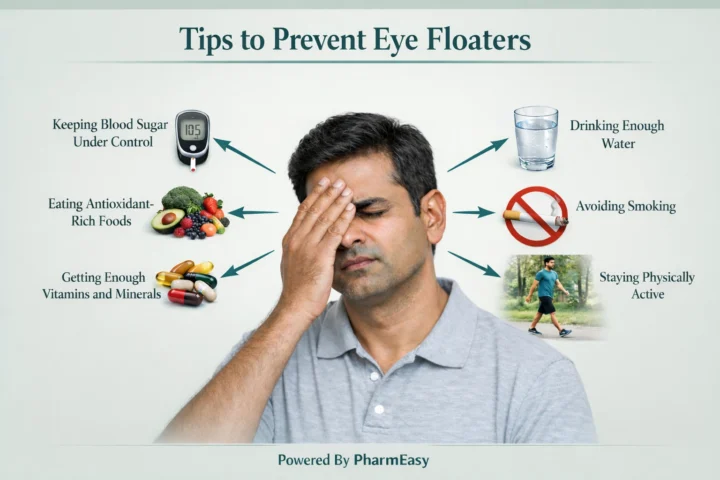
Eye floaters may be avoided by protecting the jelly inside the eye and reducing damage caused by harmful substances. The following lifestyle changes may help keep your eyes healthy and may lower the risk of floaters becoming more noticeable over time:
Floaters are usually harmless, but you should see an eye specialist immediately if you notice sudden changes like:
Eye floaters are a common part of ageing and are usually harmless. They happen when the jelly inside the eye slowly shrinks and forms tiny clumps. Most floaters settle on their own and do not affect vision. However, sudden new floaters, flashes of light, or changes in eyesight should never be ignored. Maintaining good eye health through a balanced diet, proper hydration, and regular eye check-ups can help reduce the risk and impact of eye floaters.
Eye floaters cannot be completely cured in most cases. Laser treatments or vitrectomy may help reduce or remove some floaters in severe cases.
Floaters are usually harmless small shapes in your vision, such as spots or threads. However, if you suddenly see many floaters or flashes of light, it could indicate a problem with the retina, and you should have your eyes checked by an eye specialist3.
Not drinking enough water may make floaters more noticeable. The jelly inside your eye is mostly water, so when you are dehydrated, it can shrink or change, causing spots or threads in your vision8.
Blue light from phones, tablets, and computers can affect the eyes, but it may not create new floaters. However, too much exposure may speed up changes in the jelly inside the eye, making floaters more visible and noticeable in your vision9.
High blood sugar can damage the jelly inside the eye. In people with uncontrolled diabetes, the most common cause of floaters is bleeding into the jelly (vitreous haemorrhage) due to changes in the blood vessels at the back of the eye, known as proliferative diabetic retinopathy5,8.
It is usually not safe to ignore eye floaters. They can make your vision blurry, hazy, or cause glare because small clumps in the eye’s jelly move into your line of sight. This can make daily tasks like reading, driving, or close work harder2.
1. Zhang B, Liu H, Zhu H, Sun X, Gao R. Knowledge, attitudes, and practices regarding floaters among patients. Frontiers in Medicine. 2025 Jul 9;12. Available from: https://www.frontiersin.org/journals/medicine/articles/10.3389/fmed.2025.1579435/full?utm_source=chatgpt.com
2. Lumi X, Hawlina M, Glavač D, Facskó A, Moe MC, Kaarniranta K, et al. Ageing of the vitreous: From acute onset floaters and flashes to retinal detachment. Ageing Research Reviews [Internet]. 2015 May [cited 2019 Feb 28];21:71–7. Available from: https://www.sciencedirect.com/science/article/pii/S1568163715000343
3. Eye floaters: MedlinePlus Medical Encyclopedia [Internet]. Medlineplus.gov. 2020 [cited 2026 Jan 28]. Available from: https://medlineplus.gov/ency/article/002085.htm
4. Bergstrom R, Czyz CN. Vitreous Floaters [Internet]. Nih.gov. StatPearls Publishing; 2022 [cited 2026 Jan 28]. Available from: https://www.ncbi.nlm.nih.gov/books/NBK470420/
5. Skowronek J, Święch A. Vitreous floaters – etiology, diagnostics and treatment. OphthaTherapy Therapies in Ophthalmology. 2023;10(2):103108. Available from: https://www.researchgate.net/publication/373848805_Vitreous_floaters_-_etiology_diagnostics_and_treatment
6. Milston R, Madigan MC, Sebag J. Vitreous floaters: Etiology, diagnostics, and management. Survey of Ophthalmology. 2016 Mar;61(2):211–27. Available from: https://www.vmrinstitute.com/wp-content/uploads/2018/10/Floaters-Survey-Ophthalmol-2016.pdf
7. Ivanova T, Jalil A, Antoniou Y, Bishop PN, Vallejo-Garcia JL, Patton N. Vitrectomy for primary symptomatic vitreous opacities: an evidence-based review. Eye [Internet]. 2016 Mar 4 [cited 2022 May 6];30(5):645–55. Available from: https://www.ncbi.nlm.nih.gov/pmc/articles/PMC4869141/#__sec3title
8. Burakowska A, Święch A. The Role of Nutritional Supplementation and Lifestyle Modification in Patients with Vitreous Floaters. Ophthalmology [Internet]. 2025 Jul 2 [cited 2026 Jan 28];28(1):28–32. Available from: https://www.ophthalmologypoland.com.pl/pdf-207088-126689?filename=The%20Role%20of%20Nutritional.pdf
9. Chen J, Wu H. Blue light from electronic devices may be an important factor for vitreous floaters. Medical Hypotheses. 2020 Jun;139:109698. Available from: https://pubmed.ncbi.nlm.nih.gov/32244150/
Disclaimer: The information provided here is for educational/awareness purposes only and is not intended to be a substitute for medical treatment by a healthcare professional and should not be relied upon to diagnose or treat any medical condition. The reader should consult a registered medical practitioner to determine the appropriateness of the information and before consuming any medication. PharmEasy does not provide any guarantee or warranty (express or implied) regarding the accuracy, adequacy, completeness, legality, reliability or usefulness of the information; and disclaims any liability arising thereof.
Links and product recommendations in the information provided here are advertisements of third-party products available on the website. PharmEasy does not make any representation on the accuracy or suitability of such products/services. Advertisements do not influence the editorial decisions or content. The information in this blog is subject to change without notice. The authors and administrators reserve the right to modify, add, or remove content without notification. It is your responsibility to review this disclaimer regularly for any changes.


Comments

Leave your comment...
You may also like

























Comments