




Braxton Hicks Contractions: What They Are, Causes, Symptoms, and Management
By Dr. Charmi Shah +2 more

Medically reviewed by Dr. Charmi Shah
Last updated: Oct 1, 2026 Published on: Apr 28, 2026


Get,

to manage your symptom
Get your,

4 Cr+ families
benefitted

OTP sent to 9988776655



You’ve successfully subscribed to receive
doctor-approved tips on
Whatsapp

Get ready to feel your best.


Register to Avail the Offer
Send OTPBy continuing, you agree with our Privacy Policy and Terms and Conditions
Hi There,
Sign up on PharmEasy now!!


Trusted by 4 crore+ families

OTP sent to 9988776655
You have unlocked 25% off on medicines


Code: NU25

By Dr. Charmi Shah +2 more
Table of Contents
Pregnancy induces a range of physiologic changes in a woman’s body, which may make the experience feel overwhelming. One of these is a tightening sensation or pressure in the abdomen that may begin in the second or third trimester of pregnancy, commonly referred to as Braxton Hicks contractions. Braxton Hicks contractions may feel uncomfortable but are usually not painful and are considered a normal part of pregnancy as the body prepares for childbirth1,2.
Braxton Hicks contractions are often described as false labour or “practice contractions” as they help prepare the uterus for labour without causing cervical dilation. This article explains what Braxton Hicks contractions are and how they are different from true contractions.

Braxton Hicks contractions are intermittent contraction and relaxations of the uterine muscles that may occur during pregnancy2,3. They can be triggered by physical activity, dehydration, or changes in position1. They occur irregularly, do not last long, and are not very strong. Although they may feel uncomfortable, they do not follow a pattern1. Unlike true labour contractions, they do not become stronger or more painful over time. They usually subside over time; however, they may recur later1,4.
A possible role these contractions may play during pregnancy is to help the uterus adapt to the baby’s position. As pregnancy progresses, contractions of the uterine muscles may support the baby in moving into a more favourable position for birth, such as the head-down position5.
Braxton Hicks contractions usually begin in the second or third trimester. Their intensity and frequency may increase as pregnancy progresses and childbirth approaches1.
Braxton Hicks contractions may begin as mild or barely noticeable tightening sensations, but as pregnancy progresses, some women may become more aware of their intensity. Each individual may experience Braxton Hicks contractions differently depending on factors such as their activity levels, hydration status, and overall pregnancy changes1,2.
Braxton Hicks contractions can be characterised by:
Although the exact cause of Braxton Hicks contractions is not completely understood, they are thought to be related to the tightening and relaxation of uterine muscle fibres during pregnancy1. These contractions may occur due to increased irritability of the myometrium (the muscle layer of the uterus) or intermittent contractions of the uterus2,4. Some theories suggest that these tightening episodes may help improve blood circulation within the uterus, which supports the baby’s growth and development1,5.
Some lifestyle and situational factors listed below may increase the likelihood of experiencing Braxton Hicks contractions:
Although Braxton Hicks contractions are usually harmless, persistent, regular, or increasingly painful contractions should be evaluated by a doctor to rule out true labour or other pregnancy-related concerns1,3,5,6.
The symptoms of Braxton Hicks contractions can vary from person to person, and not everyone experiences them in the same way1. Some common signs and symptoms include:
Braxton Hicks contractions are generally considered a normal part of pregnancy. They are often described as “practice contractions” because they reflect natural tightening of the uterine muscles as the body gradually prepares for labour1.
It is important to understand the difference between Braxton Hicks contractions and true labour contractions, especially as the due date approaches1,2,4,8.
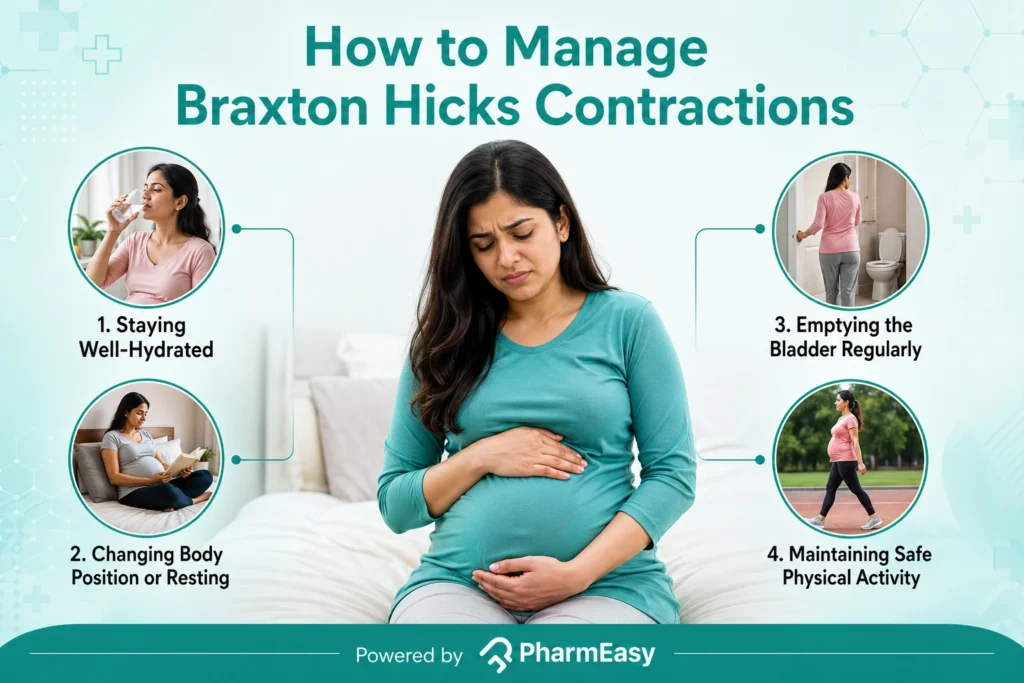
Braxton Hicks contractions usually do not require medical treatment, but certain simple measures may help reduce discomfort or make them less noticeable1.
Also Read: Itching During Pregnancy: Causes, Symptoms, Treatment and More
While Braxton Hicks contractions are usually harmless and irregular, it is important to seek medical advice if contractions become persistent, regular, or are associated with other concerning symptoms. Recognising warning signs can help ensure timely medical evaluation and appropriate care during pregnancy1,3,4.
You should contact the doctor if:
Also Read: How To Know If You’re Pregnant?
Braxton Hicks contractions are a common and usually harmless part of pregnancy. These tightening sensations reflect the natural activity of the uterine muscles as the body gradually prepares for labour. Although they may sometimes cause discomfort or concern, they typically remain irregular and do not lead to cervical changes1,7,8.
Understanding how Braxton Hicks contractions differ from true labour contractions can help pregnant individuals recognise and respond to the situation appropriately and seek medical advice when necessary. Simple measures such as staying hydrated, resting, and adjusting daily activities may help manage these sensations2.
However, any contractions that become regular, increasingly painful, or are associated with symptoms such as bleeding, fluid leakage, or reduced foetal movements should be evaluated by a doctor3.
Frequent Braxton Hicks contractions are not always a cause for concern and may occur as the uterus becomes more sensitive later in the pregnancy. However, if they become regular or painful, medical advice should be sought to rule out true labour1,2,5,7.
Some pregnant women may begin noticing these contractions during the second trimester, although they are often more noticeable in the third trimester1,2.
Early Braxton Hicks contractions do not usually indicate the onset of labour. True labour contractions typically become regular, stronger, and closer together over time1.
They are generally considered a normal physiological response as the uterus prepares for childbirth. Their presence alone does not necessarily predict when labour will begin1.
Some individuals may notice them daily, especially as pregnancy progresses. The frequency can vary depending on activity levels, hydration, and individual uterine sensitivity1.
Straining or abdominal discomfort associated with constipation may sometimes make uterine tightening more noticeable. Maintaining hydration and fibre intake may help improve comfort during pregnancy10.
Disclaimer: The information provided here is for educational/awareness purposes only and is not intended to be a substitute for medical treatment by a healthcare professional and should not be relied upon to diagnose or treat any medical condition. The reader should consult a registered medical practitioner to determine the appropriateness of the information and before consuming any medication. PharmEasy does not provide any guarantee or warranty (express or implied) regarding the accuracy, adequacy, completeness, legality, reliability or usefulness of the information; and disclaims any liability arising thereof.
Links and product recommendations in the information provided here are advertisements of third-party products available on the website. PharmEasy does not make any representation on the accuracy or suitability of such products/services. Advertisements do not influence the editorial decisions or content. The information in this blog is subject to change without notice. The authors and administrators reserve the right to modify, add, or remove content without notification. It is your responsibility to review this disclaimer regularly for any changes.


Comments

Leave your comment...
You may also like

























Comments