




Is Cancer a Genetic Disease? Hereditary Risk & Genetic Testing Guide
By Dr. Vishesh Bharucha +2 more

Medically reviewed by Dr. Vishesh Bharucha
Last updated: Aug 24, 2026 Published on: May 5, 2026


Get,

to manage your symptom
Get your,

4 Cr+ families
benefitted

OTP sent to 9988776655



You’ve successfully subscribed to receive
doctor-approved tips on
Whatsapp

Get ready to feel your best.


Register to Avail the Offer
Send OTPBy continuing, you agree with our Privacy Policy and Terms and Conditions
Hi There,
Sign up on PharmEasy now!!


Trusted by 4 crore+ families

OTP sent to 9988776655
You have unlocked 25% off on medicines


Code: NU25

By Dr. Vishesh Bharucha +2 more
Table of Contents
Cancer can be confusing, especially when people talk about genes. Some people think that if cancer runs in the family, they will definitely get it. Others believe cancer happens randomly and has nothing to do with genes. The truth lies somewhere in the middle.
Most cancers develop from gene changes that happen during the lifetime of an individual due to factors such as aging, lifestyle, and environment, though some cancers can be inherited from parents1,2. However, cancer itself doesn’t pass from parents to children, and the changes in cancer cells also aren’t passed down. But for certain cancers, parents can pass on some genes that increase the chance of developing that cancer in the offspring (subsequent generation)1. Understanding this helps people know their risk better and take appropriate measures.

In this blog, we will explore whether cancer is a genetic disease or not, explain the difference between somatic and hereditary cancers, and discuss how family history and genetic testing can help identify individuals at a higher risk.
Cancer is a genetic disease, but it is not always inherited. Cancer develops when specific genes undergo mutations (changes) that affect how cells grow, divide, and repair themselves. These mutations can cause cells to proliferate uncontrollably, resulting in cancer cell formation. These genetic changes are the root cause of all cancers1.
Genetic changes can happen in two different ways:
This is the most common type. Here, gene changes occur during a person’s lifetime. They are not present at birth and are not handed down to the generations. These genetic changes or mutations may be caused by aging, environmental exposures (such as pollution and radiation), lifestyle factors (such as smoking, poor diet, or lack of exercise), infections, etc1,2.
This type is less common (only up to 10% of cancer are caused by inherited gene changes)1. Here a person acquires a gene mutation from their parents. This mutation is present in their cells from early life and can increase the risk of certain cancers. These inherited changes can also be passed on to the next generation from father’s sperm or mother’s egg (germ cells). Examples of hereditary cancer syndromes include BRCA1/BRCA2-related breast and ovarian cancer and Lynch syndrome (an inherited condition that increases a person’s risk of developing certain cancers, especially colon and endometrial cancer, at an early age)3.
So, genetic mutations are responsible for the occurrence of all cancers, but only a small percentage of cancers occur due to certain genes being passed down from parents during conception.
Cancer can develop due to different types of changes in our genes. These changes affect how cells grow and behave. Here are the main types:
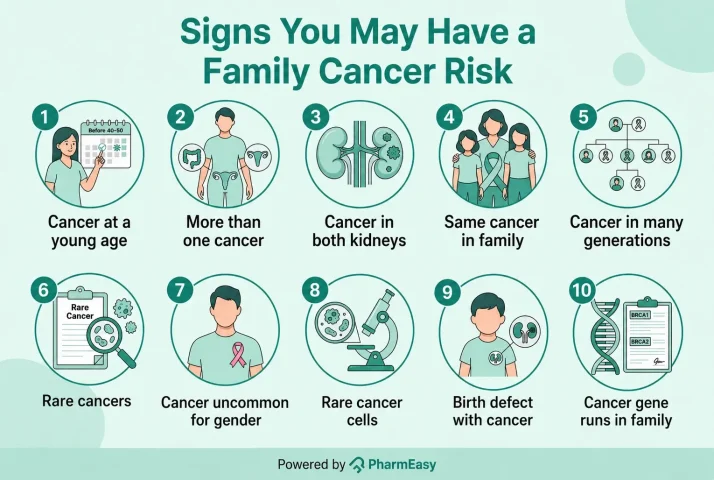
The following are some signs which say you may have a hereditary cancer:
Note: These signs don’t guarantee that cancer is hereditary, but they may indicate a higher risk and the need for medical advice or genetic testing.
Genetic testing in cancer is usually done to detect the presence of inherited gene mutations that increase the risk of developing certain type of cancers (presence of germline mutations). Sometimes, if a person is already diagnosed with cancer, genetic testing may be done to check for the gene mutations associated with the cancer (tumour or somatic genetic testing). There are numerous types of genetic tests available now, and many more are still being developed8.
For predicting cancer risk, genetic testing checks for the presence of specific genes that may raise a person’s chance of getting a cancer. It mainly helps to:
In somatic (tumour) genetic testing, the DNA of cancer cells is checked to find changes that led to the tumour. These tests do not detect inherited cancer risk but help doctors in the following way:
Genetic cancer testing checks your DNA to find inherited changes that may increase your risk of certain cancers. It is performed through the following steps:
Note: Testing is usually recommended based on trusted medical guidelines.
If you observe any warning symptoms or have a family history that puts you at risk for cancer, you should contact a doctor. Early medical guidance can aid in immediate detection and better results.
Signs and Symptoms That Need Medical Attention
The following are some warning signs that you should not ignore and seek immediate medical attention for:
Family History and Risk-Related Situations
Family history might enhance your cancer risk and should not be ignored, especially if you are experiencing symptoms. Multiple family members with cancer, cancer at a younger age, the same type of disease returning in the family, having a close relative with cancer, or a family history of related cancers such as breast and ovarian cancer are all warning signals that should be discussed with a doctor9.
Along with consulting a doctor, opting for a comprehensive full-body checkup can help in early detection of potential health risks.
Also Read: Testicular Cancer: Symptoms, Causes, Diagnosis, Treatment & Prevention
Cancer is a genetic disease however not all cancers are passed on. Understanding the difference between somatic and hereditary cancer might help you determine your risk and take appropriate action. Paying attention to family history and considering genetic testing as needed can help with early detection and treatment. Taking informed action now can result in improved health outcomes tomorrow.
Also Read: Types of Cancer: Symptoms, Early Signs, Diagnosis & More
Inherited gene changes can’t be changed, but cancer can often be prevented or found early through regular screening and healthy lifestyle choices3.
Many cancers are treatable if detected early, while some are more difficult to treat, particularly in advanced stages. Cancers such as pancreatic cancer, are often diagnosed at advanced stages and have poor survival rates, making them more difficult to treat. Similarly, oesophageal cancer, if not detected at an early stage, can spread to the other parts, making recovery difficult11.
The most common cancers which can be inherited are breast cancer, ovarian cancer, uterine cancer, prostate cancer, pancreatic and colorectal cancer1,8.
No, cancer is not 100% hereditary. Only a small percentage (10%) of cancers are inherited, while most develop due to gene changes that occur during a person’s lifetime1.
Yes, cancer occurrence may skip a generation. However, the faulty gene is still passed down, but not everyone who has it will develop cancer1.
An abnormal gene that increases cancer risk can come from either the mother or the father. Only about 5-10% of cancers are inherited; that is they are passed down through genes in sperm or egg cells1.
Cancer is usually not directly inherited, but some gene changes passed from parents (through sperm or egg) can increase cancer risk. These are found in all cells of the body and are linked to about 5-10% of cancers1.
Disclaimer: The information provided here is for educational/awareness purposes only and is not intended to be a substitute for medical treatment by a healthcare professional and should not be relied upon to diagnose or treat any medical condition. The reader should consult a registered medical practitioner to determine the appropriateness of the information and before consuming any medication. PharmEasy does not provide any guarantee or warranty (express or implied) regarding the accuracy, adequacy, completeness, legality, reliability or usefulness of the information and disclaims any liability arising thereof.
Links and product recommendations in the information provided here are advertisements of third-party products available on the website. PharmEasy does not make any representation on the accuracy or suitability of such products/services. Advertisements do not influence the editorial decisions or content. The information in this blog is subject to change without notice. The authors and administrators reserve the right to modify, add, or remove content without notification. It is your responsibility to review this disclaimer regularly for any changes.


Comments

Leave your comment...
You may also like

























Comments