Get,

Free Doctor Tips

to manage your symptom

Get your,

FREE Doctor Tips Now!!

4 Cr+ families

benefitted

Enter your Phone Number

+91

|

Enter a valid mobile number

Send OTP

Verify your mobile number

OTP sent to 9988776655

CONGRATULATIONS!!!

You’ve successfully subscribed to receive

doctor-approved tips on Whatsapp


Get ready to feel your best.

Hi There,

Download the PharmEasy App now!!

AND AVAIL

AD FREE reading experience
Get 25% OFF on medicines
Banner Image

Register to Avail the Offer

Send OTP

By continuing, you agree with our Privacy Policy and Terms and Conditions

Success Banner Image
Verify your mobile number

OTP sent to 9988776655

Comments

Subscribe
Notify of
guest
0 Comments
Inline Feedbacks
View all comments

Leave your comment here

Your email address will not be published. Required fields are marked *

25% OFF on medicines

Collect your coupon before the offer ends!!!

COLLECT

Braxton Hicks Contractions: What They Are, Causes, Symptoms, and Management

By Dr. Charmi Shah +2 more

Join Health Talk by PharmEasy on WhatsApp

Introduction

Pregnancy induces a range of physiologic changes in a woman’s body, which may make the experience feel overwhelming. One of these is a tightening sensation or pressure in the abdomen that may begin in the second or third trimester of pregnancy, commonly referred to as Braxton Hicks contractions. Braxton Hicks contractions may feel uncomfortable but are usually not painful and are considered a normal part of pregnancy as the body prepares for childbirth1,2

Braxton Hicks contractions are often described as false labour or “practice contractions” as they help prepare the uterus for labour without causing cervical dilation. This article explains what Braxton Hicks contractions are and how they are different from true contractions. 

braxton hicks contractions

What Are Braxton Hicks Contractions?

Braxton Hicks contractions are intermittent contraction and relaxations of the uterine muscles that may occur during pregnancy2,3. They can be triggered by physical activity, dehydration, or changes in position1. They occur irregularly, do not last long, and are not very strong. Although they may feel uncomfortable, they do not follow a pattern1. Unlike true labour contractions, they do not become stronger or more painful over time. They usually subside over time; however, they may recur later1,4

Advertisement

A possible role these contractions may play during pregnancy is to help the uterus adapt to the baby’s position. As pregnancy progresses, contractions of the uterine muscles may support the baby in moving into a more favourable position for birth, such as the head-down position5

When Do Braxton Hicks Contractions Start?

Braxton Hicks contractions usually begin in the second or third trimester. Their intensity and frequency may increase as pregnancy progresses and childbirth approaches1

What Do Braxton Hicks Contractions Feel Like?

Braxton Hicks contractions may begin as mild or barely noticeable tightening sensations, but as pregnancy progresses, some women may become more aware of their intensity. Each individual may experience Braxton Hicks contractions differently depending on factors such as their activity levels, hydration status, and overall pregnancy changes1,2

Braxton Hicks contractions can be characterised by: 

  • A hardening or tightening sensation that is often felt in the front of the abdomen, similar to menstrual cramps1,3
  • Mild discomfort that may stop or ease with time. However, some women may experience noticeable discomfort. 
  • Irregular occurrence that does not follow a predictable pattern. 
  • The uterus feeling firm or tight when touched, followed by relaxation after a short duration. 
  • Sensations that may stop with changes in physical activity or changes in position. 
  • Contractions that may ease with rest, hydration, or gentle movement1

What Causes Braxton Hicks Contractions?

Although the exact cause of Braxton Hicks contractions is not completely understood, they are thought to be related to the tightening and relaxation of uterine muscle fibres during pregnancy1. These contractions may occur due to increased irritability of the myometrium (the muscle layer of the uterus) or intermittent contractions of the uterus2,4. Some theories suggest that these tightening episodes may help improve blood circulation within the uterus, which supports the baby’s growth and development1,5

Some lifestyle and situational factors listed below may increase the likelihood of experiencing Braxton Hicks contractions: 

Advertisement
  • Dehydration and inadequate fluid intake may make these contractions more noticeable. 
  • A full bladder may act as a trigger by placing additional pressure on the uterus. Sudden changes in body position or sexual activity may also be a contributor. 
  • Increased uterine sensitivity as pregnancy progresses may make these contractions easier to notice during the later months. 
  • Multiparity: Women who have been pregnant before may notice Braxton Hicks contractions earlier or more clearly, as the uterus may respond more readily to normal contractile activity. 

Although Braxton Hicks contractions are usually harmless, persistent, regular, or increasingly painful contractions should be evaluated by a doctor to rule out true labour or other pregnancy-related concerns1,3,5,6

Signs and Symptoms of Braxton Hicks Contractions

The symptoms of Braxton Hicks contractions can vary from person to person, and not everyone experiences them in the same way1. Some common signs and symptoms include: 

  • Tightening or hardening of the abdomen: A sudden feeling of the abdomen becoming firm or tight is one of the most commonly reported signs. This tightening usually lasts for a short duration and then gradually subsides1
  • Irregular contractions: Braxton Hicks contractions typically do not follow a predictable pattern. They may occur at different intervals and usually do not become progressively closer together2,7
  • Mild discomfort rather than severe pain: These contractions are often described as uncomfortable rather than intensely painful. They may feel like pressure or stretching rather than sharp, labour-like pain².  
  • Contractions that ease with rest or position change: In many cases, changing body position, walking, or resting may help reduce the intensity or frequency of the contractions. Hydration may also provide relief1
  • Increased awareness during activity or later pregnancy: Some individuals may notice these contractions more frequently during physical activity or as pregnancy advances and uterine sensitivity increases1,5

Are Braxton Hicks Contractions Normal?

Braxton Hicks contractions are generally considered a normal part of pregnancy. They are often described as “practice contractions” because they reflect natural tightening of the uterine muscles as the body gradually prepares for labour1

Braxton Hicks vs. True Labour Contractions

It is important to understand the difference between Braxton Hicks contractions and true labour contractions, especially as the due date approaches1,2,4,8

  • Pattern and duration: Braxton Hicks contractions are usually irregular and do not follow a consistent pattern, whereas true labour contractions occur at regular intervals, typically lasting 30-90 seconds initially. 
  • Intensity and progression: Braxton Hicks contractions do not increase in intensity, duration, or frequency over time, while true labour contractions gradually become stronger, longer, and closer together. 
  • Changes with activity: Braxton Hicks contractions may stop with simple measures such as walking, resting, or improving hydration, whereas true labour contractions continue despite movement or changes in position. 
  • Location of the pain: Braxton Hicks contractions are usually felt in the front of the abdomen or in one area, whereas true labour contractions often begin in the lower back and move towards the abdomen. 
  • Cervical changes on examination: During Braxton Hicks contractions, the cervix usually remains closed, while in true labour, it progressively opens, softens, and shortens in length. 
  • Pain pattern: Pain with Braxton Hicks contractions is usually mild and does not worsen, whereas in true labour, pain may increase over time. 

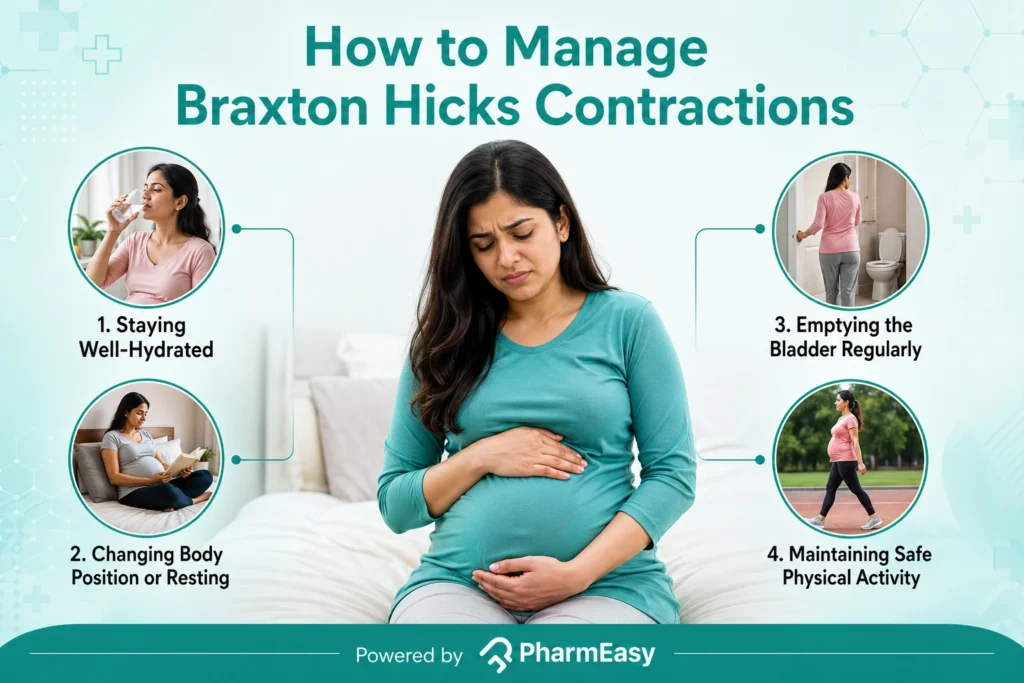
How to Manage Braxton Hicks Contractions?

Braxton Hicks contractions usually do not require medical treatment, but certain simple measures may help reduce discomfort or make them less noticeable1

  • Staying well-hydrated: Dehydration is a commonly reported trigger for Braxton Hicks contractions. Drinking adequate fluids throughout the day may help reduce their frequency or intensity1
  • Changing body position or resting: If contractions occur during prolonged standing, walking, or physical activity, resting or changing position may help them settle1,3
  • Emptying the bladder regularly: A full bladder may increase uterine irritability in some cases. Passing urine regularly may help minimise discomfort1,2
  • Maintaining safe physical activity: Regular, moderate physical activity during pregnancy is generally associated with improved overall wellbeing and may help the body adapt to the physical changes of pregnancy. Supervised resistance-based exercises may be better tolerated than prolonged endurance activities (running, hiking) in later pregnancy, as they may cause less discomfort while still supporting strength and functional fitness1,6. However, exercise routines should always be tailored to individual comfort and medical advice, especially as pregnancy progresses. 

When Should You Contact Your Doctor?

While Braxton Hicks contractions are usually harmless and irregular, it is important to seek medical advice if contractions become persistent, regular, or are associated with other concerning symptoms. Recognising warning signs can help ensure timely medical evaluation and appropriate care during pregnancy1,3,4

You should contact the doctor if: 

  • Contractions become regular, increasingly painful, or start occurring at shorter intervals. 
  • There is vaginal bleeding or fluid leakage. 
  • You experience severe abdominal pain, pressure, or continuous lower back pain. 
  • Your water breaks. 
  • Any of your contractions last longer than 2 minutes. 
  • There is a noticeable decrease in foetal movements, which is an important warning sign and requires prompt medical evaluation. 
  • Symptoms do not improve despite rest, hydration, or position changes1,3,7,9

Also Read: How To Know If You’re Pregnant?

Conclusion

Braxton Hicks contractions are a common and usually harmless part of pregnancy. These tightening sensations reflect the natural activity of the uterine muscles as the body gradually prepares for labour. Although they may sometimes cause discomfort or concern, they typically remain irregular and do not lead to cervical changes1,7,8

Understanding how Braxton Hicks contractions differ from true labour contractions can help pregnant individuals recognise and respond to the situation appropriately and seek medical advice when necessary. Simple measures such as staying hydrated, resting, and adjusting daily activities may help manage these sensations2

However, any contractions that become regular, increasingly painful, or are associated with symptoms such as bleeding, fluid leakage, or reduced foetal movements should be evaluated by a doctor3

Frequently Asked Questions (FAQs)

Does having frequent Braxton Hicks contractions indicate anything serious? 

Frequent Braxton Hicks contractions are not always a cause for concern and may occur as the uterus becomes more sensitive later in the pregnancy. However, if they become regular or painful, medical advice should be sought to rule out true labour1,2,5,7

How early can Braxton Hicks contractions start? 

Some pregnant women may begin noticing these contractions during the second trimester, although they are often more noticeable in the third trimester1,2

Do early Braxton Hicks contractions mean early labour? 

Early Braxton Hicks contractions do not usually indicate the onset of labour. True labour contractions typically become regular, stronger, and closer together over time1

Is experiencing Braxton Hicks contractions a good sign? 

They are generally considered a normal physiological response as the uterus prepares for childbirth. Their presence alone does not necessarily predict when labour will begin1

Is it normal to have Braxton Hicks contractions every day? 

Some individuals may notice them daily, especially as pregnancy progresses. The frequency can vary depending on activity levels, hydration, and individual uterine sensitivity1

Can constipation cause Braxton Hicks contractions? 

Straining or abdominal discomfort associated with constipation may sometimes make uterine tightening more noticeable. Maintaining hydration and fibre intake may help improve comfort during pregnancy10

References

  1. Raines DA, Cooper DB. Braxton Hicks Contractions. [Updated 2023 Aug 8]. In: StatPearls [Internet]. Treasure Island (FL): StatPearls Publishing; 2026 Jan-. Available from: https://www.ncbi.nlm.nih.gov/books/NBK470546/ 
  2. Cunningham FG, Leveno KJ, Bloom SL, Spong CY, Dashe JS, Hoffman BL, et al. Williams obstetrics. 26th ed. New York: McGraw-Hill Education; 2022. Available from : https://repository.stikesrspadgs.ac.id/44/1/Williams%20Obstetrics-1376hlm.pdf 
  3. Signs that labour has begun [Internet]. NHS. [cited 2026 Mar 19]. Available from: https://www.nhs.uk/pregnancy/labour-and-birth/signs-that-labour-has-begun/ 
  4. McEvoy A, Sabir S. Physiology, Pregnancy Contractions. [Updated 2022 Sep 19]. In: StatPearls [Internet]. Treasure Island (FL): StatPearls Publishing; 2026 Jan-. Available from: https://www.ncbi.nlm.nih.gov/books/NBK532927/ 
  5. Dunn PM. John Braxton Hicks (1823–97) and painless uterine contractions. Archives of Disease in Childhood-Fetal and Neonatal Edition. 1999 Sep 1;81(2):F157-8. Available from: https://pmc.ncbi.nlm.nih.gov/articles/PMC1720982/pdf/v081p0F157.pdf 
  6. Mountjoy M. Strong bodies, unclear guidelines: navigating pregnancy and postpartum without tailored resistance exercise guidelines. Available from: https://nva.sikt.no/registration/019cb9ee3855-362253d7-4852-413c-8efb-51cb8eb3f5a6 
  7. Amr H. Braxton Hicks contractions in second and third trimester (Doctoral dissertation, Khnmu). Available from: https://repo.knmu.edu.ua/server/api/core/bitstreams/eba52fc0-7509-44be-9f98-7b3ea7888486/content 
  8. El Gammal AA. Differentiating True from False Labour in Term Patients Using Sonographic Cervical Length . JJOAS-N [Internet]. 2022 Dec. 30 [cited 2026 Mar. 23];16(1):5-8. Available from: https://jjoas.asu.edu.jo/index.php/jjoas-n/article/view/1835 
  9. What are the symptoms of preterm labor? [Internet]. Eunice Kennedy Shriver National Institute of Child Health and Human Development. [cited 2026 Mar 19]. Available from: https://www.nichd.nih.gov/health/topics/preterm/conditioninfo/symptoms 
  10. Cullen G, O’Donoghue D. Constipation and pregnancy. Best Pract Res Clin Gastroenterol. 2007;21(5):807-18. Available from: https://pubmed.ncbi.nlm.nih.gov/17889809/#:~:text=Abstract,fully%20evaluated%20after%20the%20puerperium

Disclaimer: The information provided here is for educational/awareness purposes only and is not intended to be a substitute for medical treatment by a healthcare professional and should not be relied upon to diagnose or treat any medical condition. The reader should consult a registered medical practitioner to determine the appropriateness of the information and before consuming any medication. PharmEasy does not provide any guarantee or warranty (express or implied) regarding the accuracy, adequacy, completeness, legality, reliability or usefulness of the information; and disclaims any liability arising thereof.

Links and product recommendations in the information provided here are advertisements of third-party products available on the website. PharmEasy does not make any representation on the accuracy or suitability of such products/services. Advertisements do not influence the editorial decisions or content. The information in this blog is subject to change without notice. The authors and administrators reserve the right to modify, add, or remove content without notification. It is your responsibility to review this disclaimer regularly for any changes.

Advertisement

Comments

Leave your comment...