Last updated: Sep 1, 2026Published on: Apr 27, 2026
Table of Contents
Introduction
Have you ever felt a sudden twist or a sharp pain in your leg while walking on an uneven road, running, or while playing sports? Sprained ankles are one of the most common musculoskeletal injuries which commonly occur in physically active individuals1.
While these are often classified as minor injuries, improper or delayed management may lead to pain, and a higher risk of repeated sprains. In this blog, we will understand what is a sprained ankle, the causes of a sprained ankle, the symptoms you may face and sprained ankle treatment.
What is a Sprained Ankle?
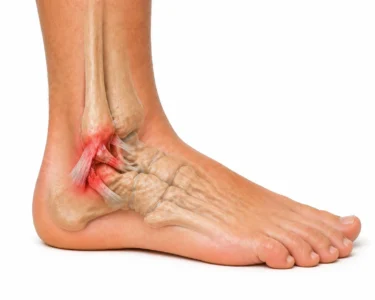
A sprained ankle, one of the most common injuries in athletes, occurs when the ligaments in the ankle joint of your legs are stretched or torn. This may lead to pain and a restricted range of movements2.
Advertisement
These injuries commonly occur when your ankle twists too far inward or outward, putting more force on the ligaments. These movements may cause your ligaments to stretch, partially tear, or completely tear1.
Types of Ankle Sprains
Based on the ligaments involved, the types of ankle sprains include1,3:
1. Lateral Ankle Sprain
This is the most common type of ankle sprain occurring due to inversion of the foot (inward turning of foot) which places excessive stress on the lateral ligament complex, particularly the anterior talofibular ligament, which is the most frequently injured ligament, followed by the calcaneofibular ligament. The posterior talofibular ligament is rarely injured except in severe trauma. It is found that injuries to the lateral ligament complex of the ankle occur in about 1 in 10,000 people per day, accounting for 25% of all injuries in athletes4.
2. Medial Ankle Sprain
A medial ankle sprain results from eversion (outward turning) of the foot leading to injury of the deltoid ligament complex on the medial (inward) side of the ankle. These are relatively less common compared to lateral sprains.
3. High Ankle Sprain (Syndesmotic Ankle Sprain)
A high ankle sprain involves injury to the distal tibiofibular ligaments, which stabilize the tibia and fibula above the ankle joint. High ankle sprains are less common and are often associated with long recovery periods5.
4. Combined or Complex Ankle Sprain
These types of ankle sprains occur when more than one ligament group is injured simultaneously.
Advertisement
Grades of Sprained Ankle
Sprained ankles are graded based on their severity into 3 grades1,6:
Grade
Description
Symptoms
Grade I (Mild)
Involves slight stretching of your ligament and may involve microscopic tears
Mild pain and mild swelling.
Grade II (Moderate)
Involves a partial or incomplete ligament tear
Moderate pain, swelling, bruising, tenderness over the affected area.
Grade III (Severe)
Involves a complete tear of one or more ligaments.
Severe pain with widespread swelling and bruising.
Hence, identifying the grade of an ankle sprain can help you to determine the right sprained ankle treatment approach, recovery time, and understand whether immobilisation or surgery may be required.
Causes of Sprained Ankle
A sprained ankle occurs when the ankle rolls in an abnormal direction, overstretching or damaging the supporting ligaments causing your foot to twist downward and inward. Common ankle sprain causes include7:
Stepping into a hole or uneven surface while walking causing your ankle to roll suddenly.
Sudden change in direction while running, placing an excessive stress on the ankle before it stabilizes, increasing the risk of a sprain.
High-paced sports that involve jumping or rapid movements and sudden turns, such as tennis, rugby, and volleyball make ankle sprains more likely.
Previous history of ankle sprain, which weakens the ligaments and reduce stability, can increase the chances of recurrent injury.
Wearing inappropriate footwear can increase ankle instability and the risk of sprain.
Symptoms of a Sprained Ankle
The most commonly noticed sprained ankle symptoms include1,7:
Swelling of your leg
Discomfort/Pain especially while placing weight on your ankle
Bruising and discolouration
Difficulty in movement of your ankle and walking
If you notice any of these sprained ankle symptoms, it is best to speak to your doctor and get medical care1,7.
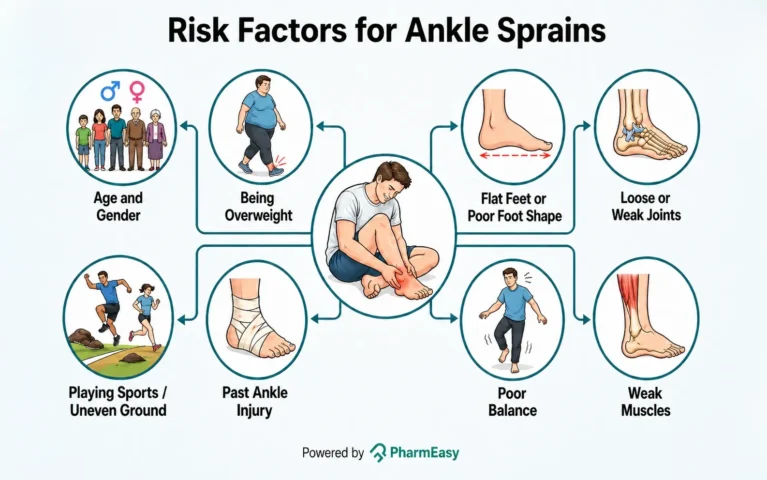
Age and gender: It is found that the risk of ankle sprain is highest in individuals aged 10–19 years. Males between 15 and 24 years are more commonly affected than women, while in older adults, women above 30 years show a higher risk than men9.
Body weight and body mass index: Factors such as being overweight may place an increased stress on the ankle joint and may be associated with a higher risk of ankle sprains.
Foot type and alignment: Certain foot structures and alignment issues, such as excessive foot pronation, may increase the risk of ankle instability.
Joint laxity: Generalized looseness of the ankle joint can reduce joint stability and increase the likelihood of sprains.
Muscle weakness and delayed muscle reaction time: Weak supporting muscles or slow muscle responses can impair the ankle’s ability to stabilize during sudden movements.
Poor balance and proprioception: Impaired balance and reduced joint position sense make it harder to maintain ankle stability, especially during dynamic activities.
Previous ankle sprain: A history of ankle sprain is commonly associated with the risk of future sprains, particularly if rehabilitation was incomplete.
Sport-related and external factors: The type of sport, level of competition, playing surface, footwear, inadequate warm-up, and improper landing technique after jumping can all increase the risk of ankle sprains.
Understanding and addressing these risk factors can play a key role in preventing ankle sprains and reducing the chances of recurrent injury8.
Diagnosis of Sprained Ankle
A sprained ankle is usually diagnosed based on a combination of clinical evaluation and imaging studies, depending on the severity of the injury1,7.
Physical examination: The diagnosis begins with a detailed physical examination by your doctor. The ankle is checked to identify areas of tenderness, pain, and instability. Your doctor may ask how the injury occurred, as the mechanism (twisting, rolling, or impact) may help to identify which ligaments may be injured.
Assessment of symptoms: Swelling, bruising, and warmth around the ankle are carefully assessed. Your doctor will also check the range of motion to see how well your ankle can move and whether the movement causes pain.
Weight-bearing ability: The ability to stand or walk on the affected foot is evaluated. Difficulty or inability to bear weight may indicate a more severe sprain or raise suspicion of an associated fracture.
X-rays: X-rays are commonly used, especially if there is significant pain, swelling, or difficulty bearing weight. They help to rule out fractures or bone avulsions that can mimic or accompany ankle sprains.
Advanced imaging (if needed): In cases where symptoms persist, the injury is severe, or there is concern for complex damage, advanced imaging such as MRI or ultrasound may be used. These tests help visualize ligaments, tendons, cartilage, and other soft tissues to confirm the extent of injury and guide further treatment.
Hence, by following these steps, your doctor can accurately diagnose a sprained ankle and determine its severity, which may help for planning sprained ankle treatment1,7.
How to Manage a Sprained Ankle at Home?
If you have suffered an ankle injury, using some home remedies for sprained ankle may help reduce pain, control swelling, and promote healing7.
Rest: Avoid activities that cause pain and limit movement to prevent further injury.
Ice: Apply ice packs for 10 minutes every 1–2 hours. This may help reduce pain and swelling. You may use a cloth between ice and skin to prevent ice burns.
Compression: Use a compression bandage or elastic wrap as it may help to control swelling and provide support.
Elevation: Keep the ankle raised above heart level. It is recommended to keep your leg elevated as long as needed to reduce swelling.
No Alcohol: Alcohol can increase swelling and bleeding.
No Running or similar activities: Avoid high-impact movements.
No Massage: Massage can worsen swelling in the early phase.
2. After 48 hours, gentle movement and exercises may be initiated
Gentle exercises and light walking may be started when the swelling subsides, as tolerated7.
Try to walk as normally as possible without forcing movement7.
If swelling does not subside or weight bearing is painful/difficult, it is important to consult a doctor7
These home remedies for sprained ankles may help deal with low impact/less serious types of injuries, however, if your symptoms don’t improve or worsen, you must seek medical attention immediately.
Treatment for Sprained Ankle (in case of serious injury)
Treatment of a sprained ankle depends on the severity, the ligaments involved, and the patient’s activity level. Your doctor may recommend the following.
Medications: Pain relievers such as paracetamol or non-steroidal anti-inflammatory drugs such as Ibuprofen may be given to reduce pain and inflammation1.
Immobilization and Support: The type of support depends on the severity of the sprain1,6:
Mild (Grade I): Light stretching ankle sprain exercises may be suggested
Moderate (Grade II): May require the use of a splint or any other immobilisation device
Severe (Grade III): May require the use of a brace, splint, or cast for several weeks
Physiotherapy: A structured program can help in sprained ankle treatment, especially for grade II and III sprains. Rehabilitation typically progresses in phases1.
Phase 1 (acute/early): The initial goal is to control pain and swelling using measures such as the RICE protocol, NSAIDs when required, and protected or light weight-bearing. At the same time, gentle ankle sprain exercises are started to gradually restore ankle range of motion.
Phase 2 (subacute): Once swelling has reduced and movement is improving, strengthening exercises are added, with emphasis on the peroneal muscles and calf. Resistance-based activities such as eversion exercises, toe and heel raise, and stationary cycling are commonly introduced during this stage.
Phase 3 (advanced): This phase focuses on restoring proprioception and function through balance and coordination training. Ankle sprain exercises may include single-leg standing, wobble or balance board activities, agility drills, and sport-specific movements to retrain neuromuscular control.
Surgical Treatment (Rare): Surgery is considered only when no other conservative treatment option is feasible or in specific severe injuries such as1:
Complete ligament rupture with persistent instability
Associated fractures or cartilage injuries
Chronic ankle instability despite rehabilitation
In such cases, your doctor may recommend ligament repair (or reconstruction) or arthroscopic evaluation and repair of associated injuries.
The sprained ankle treatment goals are to reduce pain and swelling, promote ligament healing, and restore movement and strength. Following your doctor’s instructions properly can help better manage your condition and promote timely recovery.
You can reduce your risk of ankle sprains by following these simple steps7,10,11:
Warming up before any physical activity: This should include stretching, strengthening, and balance training to prepare the ankle muscles and ligaments for movement.
Walking and playing mindfully: Being aware of uneven surfaces and avoiding careless or sudden movements can reduce your chances of twisting your ankle and ankle sprains.
Using ankle support when needed: Wearing an ankle brace or using athletic taping can help stabilize the ankle, especially for athletes who have previously sprained their ankle.
Wearing appropriate footwear: Choose well-fitting, supportive shoes that provide good ankle stability and cushioning to reduce the risk of twisting or rolling the ankle.
Strengthening exercises for the ankle: Regular exercises that improve muscle strength and stability around the ankle can help prevent any further injuries10.
Simple activities such as calf raises (standing and lifting your heel off the ground) and single-leg balance (standing on one foot) exercises help build muscle strength and enhance coordination.
Resistance band exercises can further target different ankle movements by pointing the foot and turning it inward or outward.
These ankle sprain exercises should be performed slowly and in a controlled manner following a doctor’s advice and under the guidance of a trained professional.
Ankle sprain recovery depends on severity. Grade 1 (mild) sprains heal in 1–2 weeks, Grade 2 (moderate) take 3–6 weeks, and Grade 3 (severe) can require 6–12 weeks or longer for full recovery1.
Should I walk on a sprained ankle?
It is important to follow the RICE protocol and avoid walking for the first 24–72 hours to allow swelling to subside. Following this period, you should gradually weight-bear as tolerated to speed recovery. If you cannot bear any weight or suspect a fracture, consult a doctor immediately1,7.
What is the first aid for a sprained ankle?
The first aid for a sprained ankle follows the RICE protocol (Rest, Ice, Compression, and Elevation) to minimize swelling and pain in the first 24 to 48 hours1,7.
Should I wrap a sprained ankle?
Wrapping a sprained ankle provides compression to reduce swelling and helps to support injured ligaments. It is recommended to use an elastic bandage in a figure-eight pattern, ensuring it is snug. Consult a doctor if you cannot bear weight or if pain is severe1.
What is the best medicine for a sprained ankle?
Over-the-counter non-steroidal anti-inflammatory drugs (NSAIDs) like ibuprofen or naproxen may be recommended to reduce both pain and inflammation in ankle injuries. Additionally, topical NSAID gels such as diclofenac are also effective with fewer systemic side effects. If NSAIDs aren’t suitable, acetaminophen may help manage pain12. However, it is best to consult a doctor rather than starting any medication on your own.
What are four signs an ankle sprain is bad?
The 4 signs of a severe ankle sprain include the inability to bear weight or walk, swelling or bruising, severe pain and joint instability. If you are facing any of these signs and symptoms, it is important to consult your doctor immediately1.
Golanó P, Vega J, de Leeuw PAJ, Malagelada F, Manzanares MC, Götzens V, et al. Anatomy of the Ankle ligaments: a Pictorial Essay. Knee Surgery, Sports Traumatology, Arthroscopy [Internet]. 2010 Mar 23;18(5):557–69. Available from: https://pmc.ncbi.nlm.nih.gov/articles/PMC2855022/
Molinari A, Stolley M, Amendola A. HIGH ANKLE SPRAINS (SYNDESMOTIC) IN ATHLETES: DIAGNOSTIC CHALLENGES AND REVIEW OF THE LITERATURE. The Iowa Orthopaedic Journal [Internet]. 2024;29:130. Available from: https://pmc.ncbi.nlm.nih.gov/articles/PMC2723709/
Halabchi F, Hassabi M. Acute Ankle Sprain in athletes: Clinical Aspects and Algorithmic Approach. World Journal of Orthopedics [Internet]. 2020 Dec 18;11(12):534–58. Available from: https://pmc.ncbi.nlm.nih.gov/articles/PMC7745493/
Waterman CBR, Owens MBD, Davey CS, Zacchilli CMA, Belmont LCPJ. The Epidemiology of Ankle Sprains in the United States. The Journal of Bone and Joint Surgery-American Volume [Internet]. 2010 Oct;92(13):2279–84. Available from: https://pubmed.ncbi.nlm.nih.gov/20926721/
Xiong Y, Liu Y, Zhou J, Shang X, He H, Li G, et al. Clinical Practice Guidelines for Topical NSAIDs in the Treatment of Sports Injuries. Journal of Evidence-Based Medicine [Internet]. 2025 Jan 10;18(1). Available from: https://onlinelibrary.wiley.com/doi/full/10.1111/jebm.12661
Disclaimer: The information provided here is for educational/awareness purposes only and is not intended to be a substitute for medical treatment by a healthcare professional and should not be relied upon to diagnose or treat any medical condition. The reader should consult a registered medical practitioner to determine the appropriateness of the information and before consuming any medication. PharmEasy does not provide any guarantee or warranty (express or implied) regarding the accuracy, adequacy, completeness, legality, reliability or usefulness of the information; and disclaims any liability arising thereof.
Links and product recommendations in the informationprovided here are advertisements of third-party products available on the website. PharmEasy does not make any representation on the accuracy or suitability of such products/services. Advertisements do not influence the editorial decisions or content. The information in this blog is subject to change without notice. The authors and administrators reserve the right to modify, add, or remove content without notification. It is your responsibility to review this disclaimer regularly for any changes.













































Comments