




Shoulder Blade Pain: Causes, Symptoms, Treatment & More
By Dr. Parth Mehta +2 more

Medically reviewed by Dr. Parth Mehta
Last updated: May 4, 2026 Published on: Mar 27, 2026


Get,

to manage your symptom
Get your,

4 Cr+ families
benefitted

OTP sent to 9988776655



You’ve successfully subscribed to receive
doctor-approved tips on
Whatsapp

Get ready to feel your best.


Register to Avail the Offer
Send OTPBy continuing, you agree with our Privacy Policy and Terms and Conditions
Hi There,
Sign up on PharmEasy now!!


Trusted by 4 crore+ families

OTP sent to 9988776655
You have unlocked 25% off on medicines


Code: NU25

By Dr. Parth Mehta +2 more
Table of Contents
Ever felt discomfort or stiffness between your shoulder blades after sitting too long, working on a laptop, or carrying a heavy bag? That uncomfortable feeling is quite common, especially with poor posture or repeated strain1. Shoulder pain may range from mild (sore muscles) to more intense and long lasting. In some cases, it may even indicate some underlying conditions such as nerve damage, joint problems, or even issues with internal organs like the heart1.
In this article, we will discuss what shoulder blade pain is, its causes and symptoms, how it is diagnosed, some home care tips and medical treatment available. These will help you understand how to better manage shoulder blade pain.

The shoulder blade is a flat, triangular bone at the back of the shoulder, and the muscles that help move the upper arm are attached to it2. The discomfort felt around, between (intrascapular)3 or under the shoulder blade is called shoulder blade pain. The pain may feel dull, aching, sharp, or like muscle tightness, and it may occur on one side or both sides. The most common causes of this pain include poor posture, prolonged sitting, repetitive use of arms or shoulders, nerve injury, neck problems, etc1.
Shoulder pain can significantly affect a person’s quality of life and daily functioning. People with shoulder related pains can often experience reduced shoulder movement and poorer physical function, making it harder to perform everyday activities such as reaching, lifting, or dressing. It might also affect a person’s physical and emotional health, making it more difficult to stay independent and maintain overall well-being4.
Shoulder blade pain causes may range from simple to severe. The following are some of them.
Symptoms of shoulder blade pain mainly depend on its cause. Following are some common symptoms.
To identify the exact cause of shoulder blade pain, doctors will take a thorough history, do a proper check-up and advise some diagnostic tests. Following is the course of action for diagnosing should blade pain.
To help manage or reduce your shoulder blade pain, you may try some home care methods. Following are some tips that might help you in shoulder blade pain relief.

Applying a cold pack for 15 minutes may help reduce shoulder pain, inflammation or strain1,7. Cold works by the narrowing blood vessels in the region, reducing swelling and providing a temporary sensation of numbness. It is best to place a cloth between the skin and cold pack/ice to avoid excessive risk of frostbite.

Applying heating pads might also help relax muscles and reduce neck stiffness or inflammation7. However, always be careful and not use high heating levels to avoid risk of burns.

Gentle stretching exercises for neck, shoulders, and upper back might help you ease muscle tightness and improve mobility. It might also strengthen rotator cuff tendons and shoulder muscles1.

Gentle massage or foam rolling might help you reduce pain and improve shoulder movement7,13 by relaxing tight muscles and improving the blood flow.
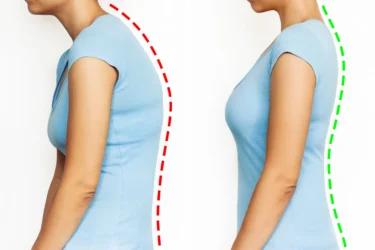
Correcting the rounded upper back (thoracic kyphosis) and strengthening the shoulder muscles might help you keep the shoulder blades properly aligned14. Also, maintaining proper posture while sitting, standing, and using electronic devices can reduce strain on the shoulder blade muscles, thereby helping ease should blade discomfort.
Note: The above given homecare tips are meant for temporary or mild problems only. It is advised not to over-do these techniques in order to avoid further strain or injury. Please consult a doctor if your shoulder issues do not resolve or worsen.
If even after following home care tips you are still experiencing shoulder discomfort and not sure how to relieve shoulder blade pain, consult a doctor for proper diagnosis and treatment. Here are some medical management options that your doctor may suggest.
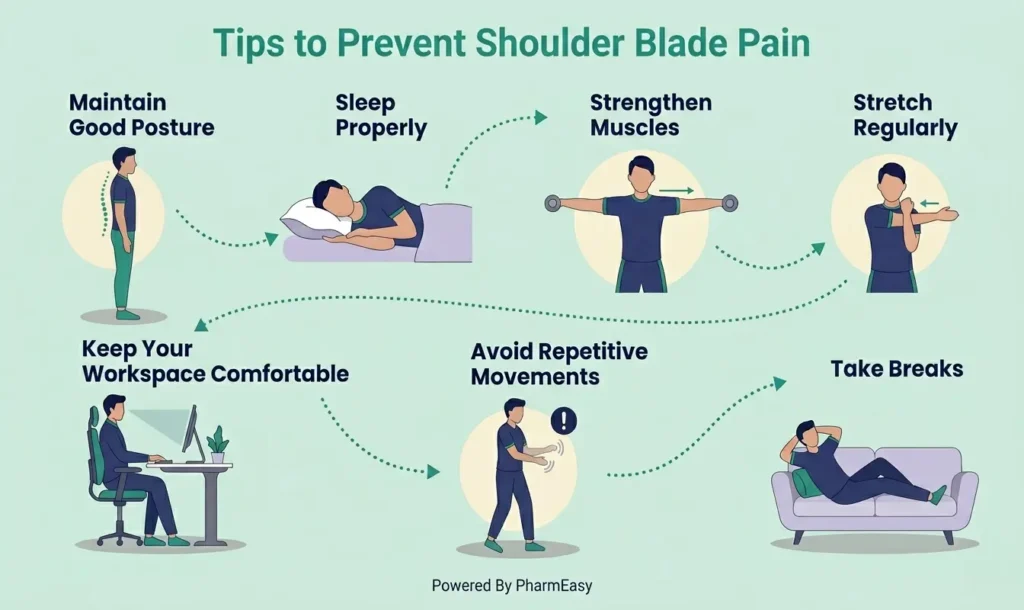
Adopting practical options may be more helpful in reducing shoulder blade pain than seeking therapies or management. Following are some safety tips that you may follow.
Also Read: Home Remedies For Knee Joint Pain By Dr. Siddharth Gupta
Though home care tips and medical management approaches might alleviate your shoulder issues, there are some instances which you should not ignore. You should seek immediate medical attention:
Also Read: Right Shoulder Pain in Women: Causes, Symptoms, Treatment & More
Shoulder blade pain is a common problem that can range from mild discomfort to more serious issues. Most cases may be manageable with early intervention, proper posture, regular stretching, and strengthening exercises for a period of time. But always notice the changes your body shows; consult a doctor if pain is severe, persistent, or accompanied by other symptoms to ensure proper diagnosis and management.
Also Read: Stabbing Pain on the Left Side Under the Ribs: Possible Causes and Solutions
The painful knot under the shoulder blade is called myofascial trigger points which are found in tight muscles. These are formed when muscle fibres are stressed after sudden injury or repeated strain of small muscles18.
If you have muscular pain, it might worsen with repeated movement or bad posture. But if it is heart related, the shoulder pain may come with chest pain, shortness of breath, sweating, or pain spreading to the left arm or jaw1,5. If you feel any of these symptoms coming along with shoulder pain, immediately consult a doctor.
Yes, shoulder blade pain can often be managed or reduced, especially when it is muscle-related. Home care measures such as cold or heat therapy, massage, and stretching may help. However, if these do not work, or if you experience other symptoms, you should consult a doctor1,7,12,14.
The best positions you may try to avoid shoulder blade pain is by sleeping on your back or on the side where the pain is not affected. Also, rest your painful shoulder area under a soft pillow19.
1. Shoulder Pain. 2025. Available from: https://medlineplus.gov/ency/article/003171.htm
2. In Brief: How Does the Shoulder Work. 2024. Available from: https://www.ncbi.nlm.nih.gov/books/NBK554696/
3. Intrascauplar Pain. Available: https://www.ncbi.nlm.nih.gov/medgen/1778080
4. Jareebi M, Abutaleb Y, Mobarki O, et al. Assessment of the Burden of Chronic Neck and/or Shoulder Pain on Quality of Life Among Saudi Adults: A Cross-Sectional Study. JPR. 2025;Volume 18:6885-6901. doi:10.2147/JPR.S551730. Available from: https://pmc.ncbi.nlm.nih.gov/articles/PMC12724178/
5. Albishi W, Alsabbagh L, Alaseem A, Alrabai HM, Alshaygy I, Alsanawi HA. The Relationship of Poor Posture While Using Electronic Devices and Periscapular Shoulder Pain. Med Sci Monit. 2026;32. doi:10.12659/MSM.950269. Availble from: https://pubmed.ncbi.nlm.nih.gov/41582461/
6. Kibler BW, McMullen J. Scapular Dyskinesis and Its Relation to Shoulder Pain: Journal of the American Academy of Orthopaedic Surgeons. 2003;11(2):142-151. doi:10.5435/00124635-200303000-00008. Avaialble from: https://pubmed.ncbi.nlm.nih.gov/12670140/
7. Cervical Spnodylosis. 2025. Available from: https://medlineplus.gov/ency/article/000436.htm
8. Park SB, Weishuhn LJ, Muhammad Taqi. Winging of Scapula. 2025. Available from: https://www.ncbi.nlm.nih.gov/books/NBK541005/
9. Cabrera‐Cardozo F, Martínez‐Ávila MC, Hernández‐Blanquisett A, Quintero‐Carreño V, Álvarez‐Londoño A. Painful shoulder and scapula as initial presentation of advanced lung adenocarcinoma. Clinical Case Reports. 2022;10(10):e6415. doi:10.1002/ccr3.6415. Available from: https://pmc.ncbi.nlm.nih.gov/articles/PMC9548662/
10. Holmes RE, Barfield WR, Woolf SK. Clinical evaluation of nonarthritic shoulder pain: Diagnosis and treatment. The Physician and Sportsmedicine. 2015;43(3):262-268. doi:10.1080/00913847.2015.1005542. Available from: https://pubmed.ncbi.nlm.nih.gov/25622930/
11. Carvalho SCD, Castro ADAE, Rodrigues JC, Cerqueira WS, Santos DDCB, Rosemberg LA. Snapping scapula syndrome: pictorial essay. Radiol Bras. 2019;52(4):262-267. doi:10.1590/0100-3984.2017.0226. Available from: https://pmc.ncbi.nlm.nih.gov/articles/PMC6696755/
12. Artus M, Holt TA, Rees J. The painful shoulder: an update on assessment, treatment, and referral. Br J Gen Pract. 2014;64(626):e593-e595. doi:10.3399/bjgp14X681577. Available from: https://pubmed.ncbi.nlm.nih.gov/25179075/
13. Treacy JM, Ostrem JD, Davies BL. Improved shoulder flexion in older females following an 8-week daily exercise program on a 36-inch foam roller. Journal of Bodywork and Movement Therapies. 2025;44:714-719. doi:10.1016/j.jbmt.2025.06.028. Available from: https://pubmed.ncbi.nlm.nih.gov/40954650/
14. Yoo W gyu. Effects of thoracic posture correction exercises on scapular position. J Phys Ther Sci. 2018;30(3):411-412. doi:10.1589/jpts.30.411. Available from: https://pmc.ncbi.nlm.nih.gov/articles/PMC5857448/
15. Leung M, Kan MMP, Cheng HMH, et al. Effects of Using a Shoulder/Scapular Brace on the Posture and Muscle Activity of Healthy University Students during Prolonged Typing—A Randomized Controlled Cross-Over Trial. Healthcare. 2023;11(11):1555. doi:10.3390/healthcare11111555. Available from: https://pubmed.ncbi.nlm.nih.gov/37297695/
16. Zenian J. Sleep position and shoulder pain. Medical Hypotheses. 2010;74(4):639-643. doi:10.1016/j.mehy.2009.11.013. Available from: https://www.sciencedirect.com/science/article/abs/pii/S0306987709007701
17. Beltran Martinez K, Nazarahari M, Rouhani H. Breaking the Fatigue Cycle: Investigating the Effect of Work-Rest Schedules on Muscle Fatigue in Material Handling Jobs. Sensors. 2023;23(24):9670. doi:10.3390/s23249670. Available from: https://www.mdpi.com/1424-8220/23/24/9670
18. Hammi C, Schroeder JD, Yeung B. Trigger Point Injection. 2023. Available from: https://www.ncbi.nlm.nih.gov/books/NBK542196/
19. Rotator Cuff-Self Care. 2025. Available from: https://medlineplus.gov/ency/patientinstructions/000358.htm
Disclaimer: The information provided here is for educational/awareness purposes only and is not intended to be a substitute for medical treatment by a healthcare professional and should not be relied upon to diagnose or treat any medical condition. The reader should consult a registered medical practitioner to determine the appropriateness of the information and before consuming any medication. PharmEasy does not provide any guarantee or warranty (express or implied) regarding the accuracy, adequacy, completeness, legality, reliability or usefulness of the information; and disclaims any liability arising thereof.
Links and product recommendations in the information provided here are advertisements of third-party products available on the website. PharmEasy does not make any representation on the accuracy or suitability of such products/services. Advertisements do not influence the editorial decisions or content. The information in this blog is subject to change without notice. The authors and administrators reserve the right to modify, add, or remove content without notification. It is your responsibility to review this disclaimer regularly for any changes.


Comments

Leave your comment...
You may also like

























Comments