




How to Clean Baby Ear Safely
By Dr. Anmol Batra +2 more

Medically reviewed by Dr. Anmol Batra
Last updated: Jun 26, 2026 Published on: Mar 25, 2026


Get,

to manage your symptom
Get your,

4 Cr+ families
benefitted

OTP sent to 9988776655



You’ve successfully subscribed to receive
doctor-approved tips on
Whatsapp

Get ready to feel your best.


Register to Avail the Offer
Send OTPBy continuing, you agree with our Privacy Policy and Terms and Conditions
Hi There,
Sign up on PharmEasy now!!


Trusted by 4 crore+ families

OTP sent to 9988776655
You have unlocked 25% off on medicines


Code: NU25

By Dr. Anmol Batra +2 more
Table of Contents
Ear health is particularly important for babies, as hearing plays a crucial role in their overall development. Yet, many parents are unsure of the best practices and techniques for maintaining their baby’s ear hygiene. In this blog post, we will discuss the importance of proper baby ear cleaning and review safe, effective methods to keep your little one’s ears in excellent health.
From understanding the purpose and production of earwax to debunking common ear hygiene misconceptions, we will cover various aspects of baby ear health. This guide also discusses when to use eardrops and their safety, the factors that may cause earwax buildup, and when to seek professional help for ear-related concerns. Finally, we will explore preventive measures for maintaining your baby’s ear health and address frequently asked questions.
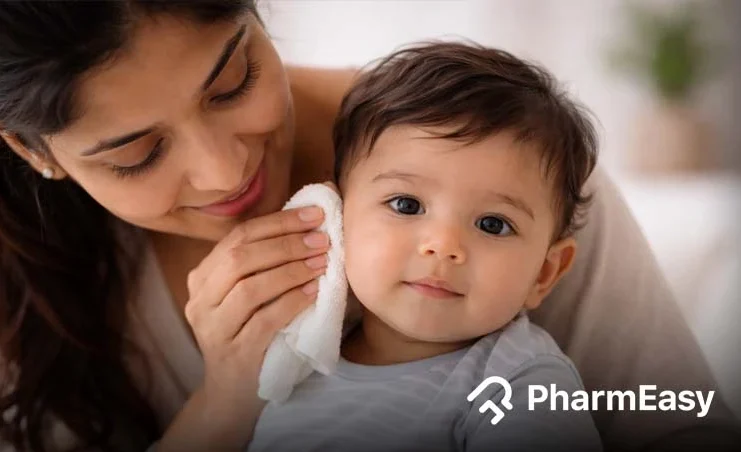
Cleaning your baby’s ears the right way can help prevent infections. It can also avoid discomfort or problems with hearing. Though it may seem scary at first, with some easy steps and keen focus, their little ears can stay clean and pain-free.
There are many wrong ideas about ear cleaning. These can create confusion and lead to mistakes. Let’s clear up some of these:
Knowing the role and production of earwax is vital in caring for your baby’s ears.
Earwax, or cerumen, is a waxy substance that lubricates and has antibacterial properties for the outer ear canal. It protects the eardrum from dirt and bacteria1. It also helps deal with irritation by trapping debris and keeps the ear canal moist to avoid dryness and itching.
Ears make wax as a way of defending itself by trapping debris. The wax has antibacterial properties and keeps water, dust, and germs out. It stops infections and keeps the ear canal healthy3.
Babies usually make the same amount of earwax as adults, but this can vary. It’s key to remember that even a bit of earwax is normal and good for their ear health1.
Keeping your baby’s ears clean and healthy is a must. But you should also avoid cleaning too often or too deep to stay clear of issues or infections3.
There are many wrong beliefs about cleaning baby ears. One is the use of cotton swabs and the idea that all earwax is bad3. Other most common malpractice is putting oil in ear canal which can lead to ear infections. You need to get that these ideas can lead to harmful actions. They may hurt your baby’s eardrum and the delicate ear canal. So, follow safe methods for cleaning their ears given in this blog.
Your baby’s ears can clean itself. It keeps making earwax and removing it from the ear canal. The wax catches and takes out dirt, dust, and bacteria. So, unless there’s too much wax, or signs of pain, or infection, your baby’s ears don’t need extra cleaning.
Regular cleaning of the outer part of your baby’s ears is essential1,3. However, you do not need to clean deep inside the ear canal. In case you see signs of too much wax, discomfort, or swelling, talk to a healthcare professional to figure out what to do next3.
Safe and effective cleaning of your baby’s ears needs the right method. This ensures you do not harm the delicate parts inside the ear.

Use a soft, damp cloth to gently wipe your baby’s ears. Be careful not to put the cloth or bud into the ear canal3. Don’t force it into any tight spots. This can hurt or push the wax further in.
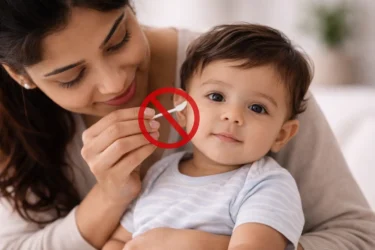
Don’t use cotton swabs or anything else to clean your baby’s ears1,3. These things can push wax deeper into the ear. They can hurt the ear canal and even damage the eardrum2. So, stick to gentle cleaning with a cloth.

Always pay attention to how your baby reacts when you clean their ears. If they are in pain, stop at once. Then, ask a healthcare professional for advice.
Eardrops can sometimes be needed. But it’s key to know when, why, and how to use them the right way.
If your baby has too much earwax, this can cause pain or affect their hearing. In such cases, eardrops may be needed1. But, make sure to use them under the guidance of a healthcare professional1.
It is important to pick the right eardrops for your baby; it won’t work if it is picked wrongly4. Ask your doctor or paediatrician before using any eardrops. Make sure they are safe and ok for your baby.
Follow your healthcare provider’s instructions closely when using eardrops. Here’s how to do it:
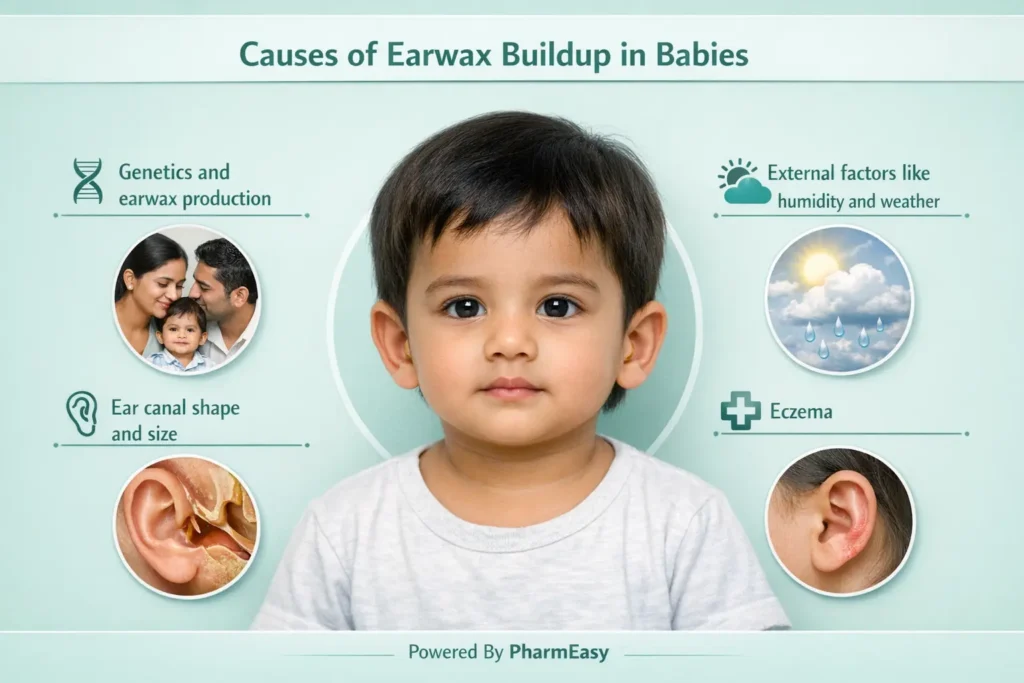
Knowing why babies get too much earwax can help you prevent possible issues.
It Is key to differentiate between normal and excess earwax in babies. Knowing the possible issues that can come from having too much wax is also vital.
A little earwax is healthy for your baby as it safeguards and lubes up the ear canal. But too much wax can cause pain, hearing problems, and can raise the risk of infection1.
Too much wax can lead to problems like short-term hearing loss, pain in the ear, itchiness, ringing sounds (tinnitus), dizziness, and even infection. If not managed, excess wax can even lead to a ruptured eardrum1.
Knowing the signs of earwax overload and other ear-related issues is key. This ensures quick help and proper care.
If your baby shows any of the below signs, ask a healthcare professional for help1:
If you suspect an ear infection or injury in your baby, seek urgent professional help1. Signs can include fever, fluid coming out from the ear, crying a lot, redness and swelling of the ear canal or continuous scratching of ear canal10.
If your baby keeps feeling discomfort or other concerning signs after trying to clean their ears, ask a healthcare professional for advice and further check-up.
Also Read: Effective Baby Care Tips, Parents Must Know
Keeping a regular routine for cleaning the ears and promoting good habits can ensure the ongoing health of your baby’s ears.
Cleaning the ears is key for your baby’s overall health and growth. By knowing the role of earwax, clearing up common false beliefs, and using safe and effective cleaning methods, you can keep your little one’s ears healthy. Also, recognizing the signs of possible issues and when to seek professional help can protect your baby from needless pain or long-term problems. Lastly, setting up a regular routine and promoting good habits will set the road for ear health for your child for life.
Too much earwax can cause short-term hearing issues. However, small to average amounts of earwax are crucial for your baby’s ear health and do not cause hearing issues.
Clean the outside of your baby’s ears gently with a damp cloth during bath time. Avoid cleaning too much and never put things into the ear canal.
Signs of an ear infection can include fever, fluid coming out from the ear, crying a lot, redness and swelling of the ear canal, and pulling at the ear. If any of these happen, ask a healthcare professional for help.
Ask your baby’s doctor or paediatrician before using any over-the-counter ear cleaning solutions. They can tell you if it is safe and ok for your baby.
Ask a professional for advice if your baby shows signs linked to wax buildup, suspected ear infection, injury, or ongoing ear discomfort, even after trying the right cleaning methods.
1. Healthdirect Australia. Ear Wax [Internet]. www.healthdirect.gov.au. 2021. Available from: https://www.healthdirect.gov.au/ear-wax
2. Khan NB, Thaver S, Govender SM. Self-ear cleaning practices and the associated risk of ear injuries and ear-related symptoms in a group of university students. Journal of Public Health in Africa. 2017 Dec 31;8(2). Available from: https://pmc.ncbi.nlm.nih.gov/articles/PMC5812304/
3. Ear wax: MedlinePlus Medical Encyclopedia [Internet]. Medlineplus.gov. 2015. Available from: https://medlineplus.gov/ency/article/000979.htm
4. National Health Service. Ear Infections [Internet]. NHS. 2025. Available from: https://www.nhs.uk/conditions/ear-infections/
5. How to Give Ear Drops [Internet]. HealthyChildren.org. Available from: https://www.healthychildren.org/English/safety-prevention/at-home/medication-safety/Pages/How-to-Give-Ear-Drops.aspx
6. Japanese Map of the Earwax Gene frequency: a Nationwide Collaborative Study by Super Science High School Consortium. Journal of Human Genetics. 2009 Jul 31;54(9):499–503. Available from: https://pubmed.ncbi.nlm.nih.gov/19644513/
7. Horton GA, Simpson MTW, Beyea MM, Beyea JA. Cerumen Management: An Updated Clinical Review and Evidence-Based Approach for Primary Care Physicians. Journal of Primary Care & Community Health. 2020 Jan;11(11):215013272090418. Available from: https://pmc.ncbi.nlm.nih.gov/articles/PMC6990605/
8. Mankowski NL, Raggio BS. Otoscope Exam [Internet]. PubMed. Treasure Island (FL): StatPearls Publishing; 2023. Available from: https://www.ncbi.nlm.nih.gov/books/NBK553163/
9. Developers B. Ear Eczema [Internet]. National Eczema Society. 2020. Available from: https://eczema.org/information-and-advice/types-of-eczema/ear-eczema/
10. National Institute on Deafness and Other Communication Disorders. Ear Infections in Children [Internet]. NIDCD. 2022. Available from: https://www.nidcd.nih.gov/health/ear-infections-children
11. Lieu JEC, Feinstein AR. Effect of Gestational and Passive Smoke Exposure on Ear Infections in Children. Archives of Pediatrics & Adolescent Medicine. 2002 Feb 1;156(2):147. Available from: https://pubmed.ncbi.nlm.nih.gov/11814376/
12. CDC. Preventing Swimmer’s Ear [Internet]. Healthy Swimming. 2024. Available from: https://www.cdc.gov/healthy-swimming/prevention/preventing-swimmers-ear.html
Disclaimer: The information provided here is for educational/awareness purposes only and is not intended to be a substitute for medical treatment by a healthcare professional and should not be relied upon to diagnose or treat any medical condition. The reader should consult a registered medical practitioner to determine the appropriateness of the information and before consuming any medication. PharmEasy does not provide any guarantee or warranty (express or implied) regarding the accuracy, adequacy, completeness, legality, reliability or usefulness of the information; and disclaims any liability arising thereof.
Links and product recommendations in the information provided here are advertisements of third-party products available on the website. PharmEasy does not make any representation on the accuracy or suitability of such products/services. Advertisements do not influence the editorial decisions or content. The information in this blog is subject to change without notice. The authors and administrators reserve the right to modify, add, or remove content without notification. It is your responsibility to review this disclaimer regularly for any changes.


Comments

Leave your comment...
You may also like























Comments