




Vaginal Burning After Sex: Causes and Management Options
By Dr. Charmi Shah +2 more

Medically reviewed by Dr. Charmi Shah
Last updated: Mar 25, 2026 Published on: Jan 4, 2024


Get,

to manage your symptom
Get your,

4 Cr+ families
benefitted

OTP sent to 9988776655



You’ve successfully subscribed to receive
doctor-approved tips on
Whatsapp

Get ready to feel your best.


Register to Avail the Offer
Send OTPBy continuing, you agree with our Privacy Policy and Terms and Conditions
Hi There,
Sign up on PharmEasy now!!


Trusted by 4 crore+ families

OTP sent to 9988776655
You have unlocked 25% off on medicines


Code: NU25

By Dr. Charmi Shah +2 more
Table of Contents
Vaginal burning after sex can leave you worried about your health. It may also affect your joy in close bonds. Let us explore why it happens and look at ways to ease this discomfort. This includes treatments at home and the clinic. It also includes things you can do before the fact. With this knowledge, you can make sound choices about your health.

Did you know?
The main causes of vaginal burning after sex include:
Foreplay and sexual arousal play a significant role in a good sex life. Arousal leads to “wetness”, which helps prevent burning during or after sex. Factors that can negatively affect arousal are:
Dryness can make the burning sensation more intense. Lack of wetness can increase friction and lead to unease and pain2. Let us check what can cause dryness.
Changes in hormones during menopause can cause vaginal dryness and thinning, which may lead to pain and burning during sex20.
Dr. Siddharth Gupta, BAMS, M.D (Ayu)
Irritation can play a big role in vaginal burning after sex.
Small cuts or damage to the vagina or vulva can cause pain and a burning sensation9. This is more likely when there’s not enough wetness.
Different infections can cause burning sensation after sex.
In my experience, vaginal infections, such as yeast infections, bacterial vaginosis, and trichomoniasis may also cause burning after sex. These infections may cause inflammation and irritation of the vagina, resulting in a burning sensation after sex21.
Dr. Rajeev Singh, BAMS
Vaginismus makes the vagina muscle clamp up during sex. This leads to pain and unease and can also lead to burning sensation after sex1.
This can cause pain and burning at the entry to the vagina due to extra sensitive nerve endings in the region. This is a long-term pain condition that might benefit from treatments such as medicines, strengthening of pelvic floor muscles, physical therapy, and counseling13.
Also known as bladder pain syndrome, this brings on bladder ache and pelvic pain. These feelings may increase the discomfort during sex14.
In a small number of people, the partner’s semen can cause an allergy. This results in redness, swelling, and a burning sensation after sex15; however, this is extremely rare.
Burning sensation after sex may be caused by the following:
You can ease or manage vaginal burning after sex with the following options:
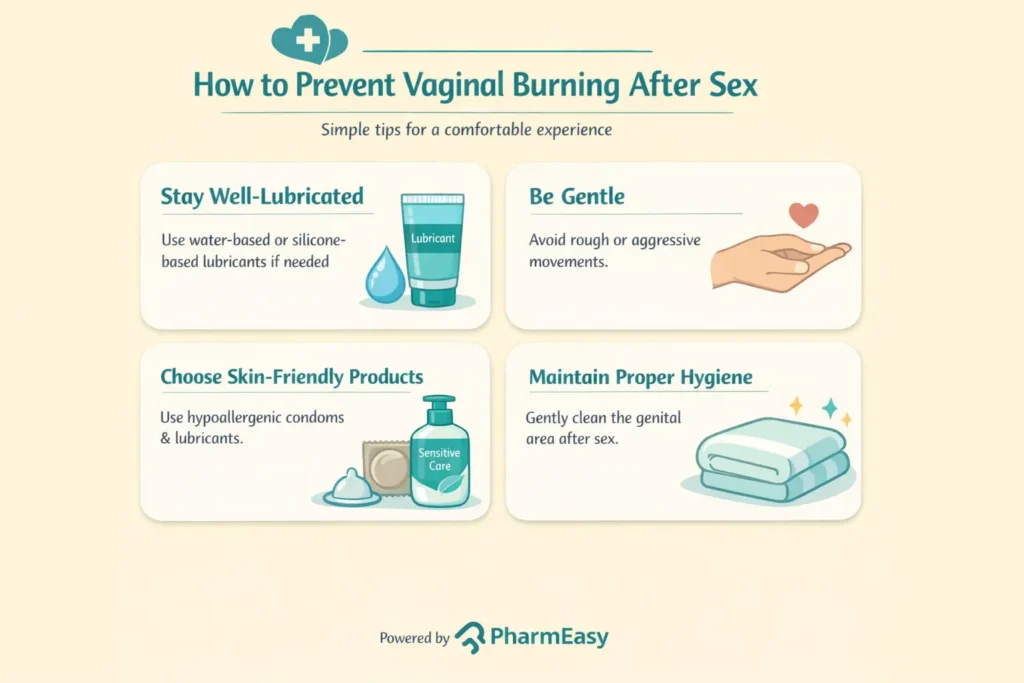
To reduce the risk of burning sensation after sex, think about the following tips:
It is key to seek advice from a doctor in these cases:
Also Read: Home Remedies For Vaginal Itching
A burning sensation during or after sex can affect your sex life and overall life. By understanding the causes and how you can treat it, you can manage your health better.
Self-diagnosis in such instances can be unsafe. Consulting your doctor and undergoing tests like a vaginal swab or pH test may be needed for an accurate diagnosis of the cause. This is especially true when symptoms do not go away, worsen, indicate an infection, or you have a new sexual partner. Armed with the right information and support, you can try to manage this symptom and take back control of your sex health.
Lack adequate lubrication during sex, irritation from items used during sex, damage caused by rough sex, infections, or hormonal swings could all lead to vaginal burning after sex.
Over-the-counter medications, cold compresses, topical salves, anti-fungal medicines, antibiotics, and hormone treatment are some ways that may help relieve vaginal burning. It’s best to consult your healthcare provider to understand the right management plan.
Yes, a water-based lubricant may help increase the wetness during sex, which can help reduce the burning sensation.
If the burning sensation does not resolve soon, is severe, may indicate an infection, or happens after having sex with a new sexual partner, you need to see a doctor.
Yes, vaginal burning after sex might signal an underlying yeast or bacterial infection.
Vaginal burning before your period can occur due to hormonal changes that affect the vaginal pH and moisture levels. It may also be linked to increased sensitivity to progesterone and oestrogen fluctuations during this time. Hormonal changes can also increase the risks of yeast infections or irritation. Since the burning sensation is not a premenstrual symptom, consulting a healthcare provider can help identify the specific cause and help you understand appropriate measures for the condition.
1. Kao A, Binik YM, Kapuscinski A, Khalifé S. Dyspareunia in Postmenopausal Women: A Critical Review. Pain Research and Management. 2008;13(3):243–54. Available from: Dyspareunia in postmenopausal women: A critical review – PMC
2. Sex and Menopause: Treatment for Symptoms [Internet]. National Institute on Aging. 2021. Available from: https://www.nia.nih.gov/health/menopause/sex-and-menopause-treatment-symptoms
3. Casado-Espada NM, de Alarcón R, de la Iglesia-Larrad JI, Bote-Bonaechea B, Montejo ÁL. Hormonal Contraceptives, Female Sexual Dysfunction, and Managing Strategies: A Review. J Clin Med. 2019 Jun 25;8(6):908. Available from: https://pmc.ncbi.nlm.nih.gov/articles/PMC6617135/
4. Perelmuter S, Burns R, Shearer K, Grant R, Anantha Soogoor, Jun S, et al. Genitourinary syndrome of lactation: a new perspective on postpartum and lactation-related genitourinary symptoms. Sexual medicine reviews. 2024 May 16. Available from: https://pubmed.ncbi.nlm.nih.gov/38757214/
5. World Health Organization. Polycystic Ovary Syndrome [Internet]. World Health Organization. 2025. Available from: https://www.who.int/news-room/fact-sheets/detail/polycystic-ovary-syndrome
6. Iglesias P. An Update on Advances in Hypopituitarism: Etiology, Diagnosis, and Current Management. Journal of Clinical Medicine. 2024 Oct 16;13(20):6161–1. Available from: https://pmc.ncbi.nlm.nih.gov/articles/PMC11508259/
7. Ryleigh Vanderschee, Kostov S. Approach to lubricant use for sexual activity. Canadian Family Physician [Internet]. 2025 Jul. Available from: https://pmc.ncbi.nlm.nih.gov/articles/PMC12312864/
8. Fisher AA. Condom Dermatitis in Either Partner. Cutis [Internet]. 1987 Apr 1;39(4):281, 284–5. Available from: https://pubmed.ncbi.nlm.nih.gov/3581900/
9. Berlit C, Sütterlin M, Yen K, Weiß C, Heinze S, Tuschy B, et al. Female genital injury—which findings have to be considered physiological using colposcopy with and without toluidine blue dye? Forensic Science, Medicine and Pathology. 2021 Oct 6;17(4):634–42. Available from: https://pmc.ncbi.nlm.nih.gov/articles/PMC8629788/
10. Bacterial Vaginosis [Internet]. Available from: https://www.nichd.nih.gov/health/topics/factsheets/bacterialvaginosis
11. Urinary Tract Infections | Office on Women’s Health [Internet]. OASH | Office on Women’s Health. 2017. Available from: https://womenshealth.gov/a-z-topics/urinary-tract-infections
12. Eunice Kennedy Shriver National Institute of Child Health and Human Development – NICHD [Internet]. www.nichd.nih.gov. Available from: https://www.nichd.nih.gov/health/topics/factsheets/stds
13. Eunice Kennedy Shriver National Institute of Child Health and Human Development – NICHD [Internet]. Nih.gov. 2016. Available from: https://www.nichd.nih.gov/health/topics/factsheets/vulvodynia
14. Lim Y, O’Rourke S. Interstitial Cystitis [Internet]. Nih.gov. StatPearls Publishing; 2021. Available from: https://www.ncbi.nlm.nih.gov/books/NBK570588/
15. Marfatia YS, Patel D, Menon DS, Smriti Naswa. Genital contact allergy: A diagnosis missed. Indian Journal of Sexually Transmitted Diseases and AIDS [Internet]. 2016 Jan [cited 2025 Nov 13];37(1):1. Available from: https://pmc.ncbi.nlm.nih.gov/articles/PMC4857673/
16. Health S. After sex- Things You Should Know [Internet]. Sexualhealthsthelens.nhs.uk. 2025 [cited 2025 Nov 13]. Available from: https://www.sexualhealthsthelens.nhs.uk/adult—after-sex
17. Wireko S, Ofosu M, Agyemang F, Dankluvi HE, Cobbina AE. Vaginal douching and health risks among young women. Health science reports [Internet]. 2024 Feb 1;7(2). Available from: https://www.ncbi.nlm.nih.gov/pmc/articles/PMC1086527516.
18. Vulvodynia: MedlinePlus Medical Encyclopedia [Internet]. Medlineplus.gov. 2016 [cited 2025 Jul 14]. Available from: https://medlineplus.gov/ency/article/007699.htm
19. Milani M, Iacobelli P. Vaginal Use of Ibuprofen Isobutanolammonium (Ginenorm): Efficacy, Tolerability, and Pharmacokinetic Data: A Review of Available Data. ISRN Obstetrics and Gynecology. 2012 Jul 9;2012:1–6. Available from: https://pmc.ncbi.nlm.nih.gov/articles/PMC3400361/
20. Better Health Channel. Menopause and sex [Internet]. Victoria (AU): Better Health Channel; [cited 2026 Mar 25]. Available from: https://www.betterhealth.vic.gov.au/health/healthyliving/menopause-and-sexual-issues
21. Cleveland Clinic. Vaginitis [Internet]. Cleveland (OH): Cleveland Clinic; 2024 Jun 18 [cited 2026 Mar 25]. Available from: https://my.clevelandclinic.org/health/diseases/9131-vaginitis
Disclaimer: The information provided here is for educational/awareness purposes only and is not intended to be a substitute for medical treatment by a healthcare professional and should not be relied upon to diagnose or treat any medical condition. The reader should consult a registered medical practitioner to determine the appropriateness of the information and before consuming any medication. PharmEasy does not provide any guarantee or warranty (express or implied) regarding the accuracy, adequacy, completeness, legality, reliability or usefulness of the information; and disclaims any liability arising thereof.
Links and product recommendations in the information provided here are advertisements of third-party products available on the website. PharmEasy does not make any representation on the accuracy or suitability of such products/services. Advertisements do not influence the editorial decisions or content. The information in this blog is subject to change without notice. The authors and administrators reserve the right to modify, add, or remove content without notification. It is your responsibility to review this disclaimer regularly for any changes.
 9
9 
Comments

Leave your comment...
You may also like
















Comments