




GLP-1 Patches: What are They, How They Work, Effectiveness & Myths
By Dr. Vishesh Bharucha +2 more

Medically reviewed by Dr. Vishesh Bharucha
Last updated: Mar 17, 2026 Published on: Mar 12, 2026


Get,

to manage your symptom
Get your,

4 Cr+ families
benefitted

OTP sent to 9988776655



You’ve successfully subscribed to receive
doctor-approved tips on
Whatsapp

Get ready to feel your best.


Register to Avail the Offer
Send OTPBy continuing, you agree with our Privacy Policy and Terms and Conditions
Hi There,
Sign up on PharmEasy now!!


Trusted by 4 crore+ families

OTP sent to 9988776655
You have unlocked 25% off on medicines


Code: NU25

By Dr. Vishesh Bharucha +2 more
Table of Contents
In today’s busy life, many people are looking for “easy” or “no effort” ways for weight reduction. Products like detox teas and fat-burning supplements are becoming popular as they promise the results without any strict diet or exercise. As obesity and metabolic disorders are getting worse, anything that claims reduced appetite and fat reduction is gaining more attention. One such product trending these days is GLP-1 skin patches.
Glucagon-like-peptide-1 (GLP-1) agonists are a group of drugs approved for use in management of type-2 diabetes and obesity. These drugs, such as semaglutide, liraglutide etc., mimic the effects of a natural hormone (GLP-1 hormone) produced by the body, such as reducing appetite, improving insulin activity and supporting metabolism1. However, as of now, the FDA has approved GLP-1 drugs only in the form of injections and pills1,2, and there are no approved form of GLP-1 transdermal (skin) patches which are in medical use.
So, what are the GLP-1 patches available in market that claim to cause weight loss? Well, although they are popularised by the name GLP-1, these patches actually don’t contain GLP-1 agonist drugs; instead they are known to have certain natural ingredients which the manufacturers claim to have similar effects as GLP-1 drugs3.
Before you use any such products, it’s important to know what they contain, how they work, and whether there is real scientific evidence that they actually help. Knowing the facts can help you make safer and smarter health decisions. We’ll have a detailed look at these GLP-1 patches in this blog.
The so-called GLP-1 patches available in the market are adhesive patches containing an active substance that are applied directly to the skin, known as transdermal patches. They deliver the active ingredient through the skin layers to enter the bloodstream which can potentially work throughout the body. However, it is not clearly known how much of these ingredients actually pass through the skin and reach the bloodstream to produce noticeable effects.
These patches usually contain natural products like berberine, pomegranate, cinnamon, green tea, etc and not actual GLP-1 drugs like semaglutide, liraglutide, as the name claims. Some of these products are said to improve the secretion of the GLP-1 hormone produced by the body, which in turn might help in reducing appetite and cravings, managing blood sugar level and helping in weight management. Since the GLP-1 agonist drugs, which are approved by the FDA, are known to regulate this natural hormone and provide the same effects, the GLP-1 patches are named after these drugs. However, these are not actual GLP-1 drug patches and there is no strong clinical evidence that transdermal patches with these herbal ingredients can increase the body’s natural GLP-1 levels3.
It is important to note that unlike prescription GLP-1 drugs, these patches are typically sold as supplements, and are not approved as GLP-1 medications by FDA for weight loss or diabetes management3. Their ingredients and effectiveness may be very different from actual GLP-1 agonist drugs, as they only hold natural ingredients and no medications.
Although there are some experimental skin patches where GLP-1 agonist medicines like semaglutide are used as active ingredients, these are still under trial and not yet approved for use. Once approved, they may prove to be a simpler, more cost-effective alternative for traditional injectable medication as claimed in the trials4.
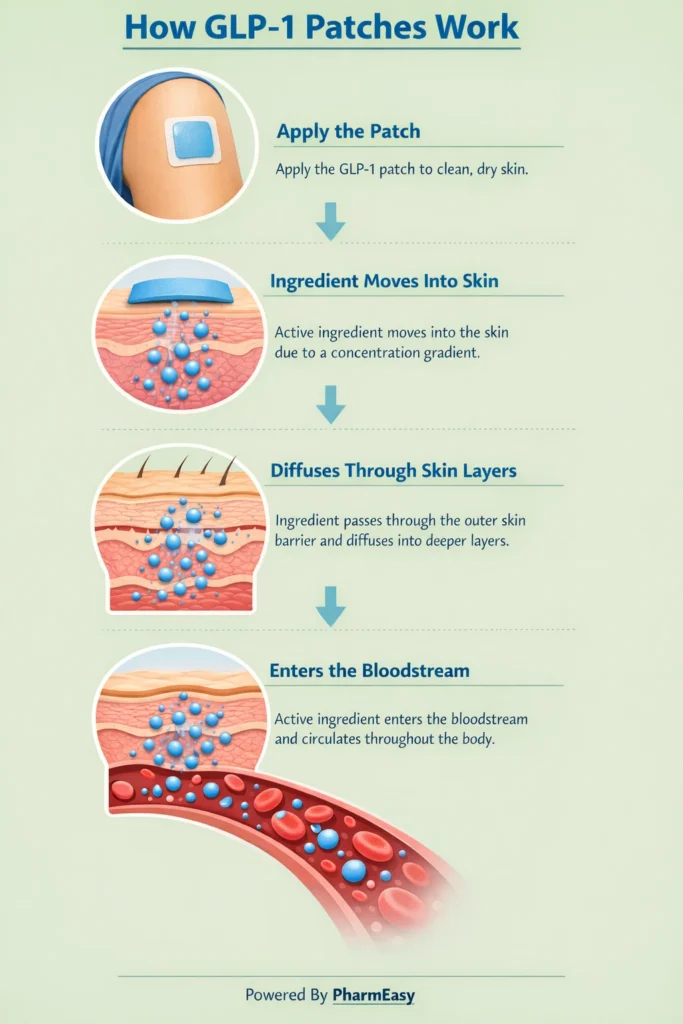
The following describes the basic method by which a transdermal patch works:
While this method is non-invasive and painless and avoids metabolism of active substance in the stomach and liver as in case of oral products6, the effectiveness of this method can vary among individuals, and many over-the-counter patches may not have clear study evidence showing how well they work7.
The so-called GLP-1 patches also release their active ingredients through the skin into the bloodstream by this mechanism. As mentioned earlier, these patches, which contain natural ingredients3, are said to work by activating the GLP-1 hormone, which might in turn reduce appetite and cravings and manage blood sugar level. However, there is no clear evidence suggesting that the ingredients in the natural GLP-1 patches activate the GLP-1 hormone when delivered transdermally.
Note: There are no approved or commercially available patches that contain semaglutide. Weekly delivery of semaglutide through a skin patch is not an approved or established method. Semaglutide is currently approved only as a weekly injection under the skin or as an oral tablet.
The so-called GLP-1 patches available in the market contain only natural ingredients. The following are used to make these patches:
Note: The actual GLP-1 agonist drug patches containing semaglutide are still under trial are known to reduce appetite, manage cravings and hunger, and give a feeling of fullness4.
While there are no actual types of GLP-1 patches, for the ease of understanding we may divide them into those claiming to be GLP-1 patches (herbal patches) and those actually containing a GLP-1 drug (which are still under trial).
These patches are known to contain some natural products. These may have ingredients like berberine, cinnamon, garcinia, etc., which claim to help manage appetite, reduce insulin resistance, manage blood sugar levels and support overall wellness9,10,12. Other ingredients that might be present include caffeine, green tea extract, etc. They claim to increase metabolism by raising the fat-burning mechanism, thereby contributing to weight reduction12,14.
Most of these ingredients have been studied when taken orally, and their effects when delivered through the skin are not well understood.
Note: The FDA does not approve these herbal weight loss patches; they lack proper experimental studies and evidence.
While still in trials, there are different types of delivery systems been studied for GLP-1 drug transdermal patches. One of these is microneedle patches. Microneedles are very tiny needles that are strong enough to gently pierce the outer layer of the skin. When a microneedle patch is applied, it creates microscopic channels in the skin, allowing medicines or biological substances to pass through15.
Programmable scheduled release microneedle patches (dissolvable) containing the GLP-1 drug semaglutide are under trial. Known to have microneedles made from biodegradable materials, the GLP-1 drug is said to be embedded inside the needles. After application, the needles might get dissolved and release the drug into the skin4.
Note: These GLP-1 drug patches are only studied during trials; they lack real-world evidence.
Manufacturers often claim that these herbal patches can reduce appetite, boost metabolism, and cause weight loss, but there is little proof that they actually work. Most patches contain herbs, minerals, or plant-based ingredients in varying amounts and combinations. They are rarely tested in large human studies, and small short-term studies do not provide strong evidence16.
Although some of the natural ingredients used in these patches, such as berberine, have shown in some studies to slightly increase GLP-1 levels, regulate blood sugar levels and promote weight loss8, their efficiency through transdermal methods is not yet proven and needs to be studied further3.
Hence, there are no strong clinical trials showing that herbal GLP-1 patches are effective for diabetes or weight loss. Manufacturers often promote such products as highly effective, but the real-world benefits may be far less than advertised.
Caution should be taken against the promising marketing strategies of GLP-1 patches, like fat reduction without lifestyle modification. Current scientific evidence does not support ideas such as losing weight automatically or melting fat without effort. Real effects, like diabetes control and weight management, might only be possible when combined with a healthy lifestyle, like a proper diet with reduced-calorie intake, regular exercise and other healthy habits17,18.
On the other hand, the actual GLP-1 microneedle patches with GLP-1 analogues like semaglutide are said to show results like reduced appetite and cravings, feelings of fullness and delayed gastric emptying4. However, there are only a few trial studies being done in this regard, and they are still approved to be used only as injections or pills and not skin patches.
Therefore, GLP-1 drug patches containing semaglutide might be a promising innovation, but they are still under research. They might become a beneficial tool in the future; however, they are still not approved for use and available in the market.
While the efficacy of herbal GLP-1 patches is doubtful and GLP-1 drug patches are still under trial, this delivery system through skin is said to have some potential benefits like6:
Note: The benefits mentioned above are only theoretical as there are no GLP-1 patches which are FDA approved. The mentioned potential benefits hold true in general for any transdermal delivery system and not GLP- patches specifically, as these still lack real-world evidence.
Herbal GLP-1 patches might have these potential benefits, but their effectiveness is questionable19. Further studies are required to confirm the actual effects of herbal patches. Hence, you are recommended to take such products only under the guidance of your doctor.
There are no commercially available GLP-1 agonist containing patches. The GLP-1 patch side effects mentioned here are referring to the herbal patches available in market and, might be associated with the natural ingredients used in these patches.
Note: Many people trapped in advertisements are getting attracted to these GLP-1 patches. These patches lack scientific evidence and have provided potential results only in certain trial-based studies, which cannot be considered safe. They are also not approved by the FDA or any other government agencies3. Stopping the prescribed medication by replacing it with these kinds of supplements might be of no use, and on the other hand it might also affect your health. Only choose such products under the supervision of a medical practitioner to avoid possible adverse reactions.
There are several myths spreading about GLP-1 patches. Following are a few among them.
1. Myth: GLP-1 patches work instantly for weight reduction.
1. Fact: This is not true. GLP-1 patches are said to have ingredients that reduce appetite and cravings and manage blood sugar levels. However, these effects alone might not provide weight reduction, but they are said to be combined with a calorie- deficit diet and regular exercise to get results1,3.
2. Myth: GLP-1 patches are FDA approved.
2. Fact: This is false. The FDA does not approve GLP-1 patches. The only GLP-1 analogues approved by the FDA are injections and semaglutide pills1,2. The so-called GLP-1 patches contain some herbal ingredients that are claimed to have effects similar to these drugs, however, there is very limited scientific evidence to support these.
3. Myth: Patches deliver medicines as effectively as injections.
3. Fact: This is not true. The patches are said to be less effective at delivering GLP-1 agonist drugs, as they are large molecules; it might be difficult for them to effectively cross the skin due to poor permeability23. Therefore, injections might deliver the medicines more effectively, as they are directly injected into the body.
4. Myth: GLP-1 patches can completely replace diet and exercise.
4. Fact: This is false. Any treatment aimed to manage diabetes or support weight loss works only along with a proper diet and exercise. Even GLP-1 agonist drugs like semaglutide are indicated to work with healthy diet and regular exercise1. These herbal patches, that are said to reduce appetite and manage weight still have questionable efficacy. They cannot replace healthy lifestyle habits which forms the core of any diabetes management or weight loss program.
5. Myth: GLP-1 patches do not have side effects.
5. Fact: False; patches are said to have side effects either due to the materials used in them or due to the effect of ingredients used3,4,21.
You are suggested to consult your doctor:
Also Read: What is Natural Mounjaro?
The GLP-1 drug patches containing semaglutide are still in their experimental stage. Although shown to have good results, at present, authorities such as the FDA have approved GLP-1 medicines only as injections or tablets, not patches. The so-called GLP-1 patches available in the market containing herbal ingredients, may seem like a convenient option for weight management or diabetes control, but scientific evidence supporting their effectiveness is still limited. Sustainable results still depend mainly on healthy eating, regular physical activity, long-term lifestyle changes and following medical treatment, if needed. Therefore, it is important to be cautious about quick-fix solutions and consult a healthcare professional before opting for such products.
GLP-1 patches are claimed to have several potential benefits. However, they need further evidence-based studies. The current results might only be based on trial studies3,4.
The current GLP-1 patches in market contain natural ingredients which are generally not tested in breastfeeding women. Hence, it is better to avoid them or do as recommended by a doctor.
Herbal GLP-1 patches are said to support weight management due to the presence of the ingredients they hold3,9. However, these ingredients are not tested as transdermal patches and further research is needed in this regard. Moreover, these alone might not cause desired effects; it requires proper diet and regular physical activity.
Herbal GLP-1 patches available in market are generally less recommended as they are not FDA approved3. Therefore, it might be better to choose more scientific options than these less effective supplements.
Yes, the herbal GLP-1 patches might be worn even during nights, as they are said to be designed to deliver active ingredient for extended periods.
1. Collins L, Costello RA. Glucagon-Like Peptide-1 Receptor Agonists. [Updated 2024 Feb 29]. In: StatPearls [Internet]. Treasure Island (FL): StatPearls Publishing; 2026 Jan. https://www.ncbi.nlm.nih.gov/books/NBK551568/
2. Kommu S, Whitfield P. Semaglutide. [Updated 2024 Feb 11]. In: StatPearls [Internet]. Treasure Island (FL): StatPearls Publishing; 2026 Jan. https://www.ncbi.nlm.nih.gov/books/NBK603723/
3. White CM, Tai Z, Nuzi K. Transdermal “Natural GLP-1” Dietary Supplements Violate Law and Place Patients at Risk. Ann Pharmacother. Published online January 2, 2026:10600280251407145. doi:10.1177/10600280251407145. https://pubmed.ncbi.nlm.nih.gov/41480958/
4. Singh P, Vinikoor T, Sharma N, et al. Single‐Administration Self‐Boosting Microneedle Patch for the Treatment of Obesity. Advanced Therapeutics. 2024;7(9):2400028. doi:10.1002/adtp.202400028. https://pubmed.ncbi.nlm.nih.gov/39429250/
5. Wong WF, Ang KP, Sethi G, Looi CY. Recent Advancement of Medical Patch for Transdermal Drug Delivery. Medicina. 2023;59(4):778. doi:10.3390/medicina59040778. https://pubmed.ncbi.nlm.nih.gov/37109736/
6. Karthikeyan E, Sivaneswari S. Advancements in transdermal drug delivery systems: Enhancing medicine with pain-free and controlled drug release. Intelligent Pharmacy. 2025;3(4):277-295. doi:10.1016/j.ipha.2024.09.008. https://www.sciencedirect.com/science/article/pii/S2949866X24001072
7. Sánchez MB, Callaghan MJ, Selfe J, Twigg M, Smith T. Efficacy of transdermal anti-inflammatory patches for musculoskeletal pain: a systematic review and meta-analysis. Pain Management. 2024;14(10-11):557-569. doi:10.1080/17581869.2024.2421153. https://pubmed.ncbi.nlm.nih.gov/39574250/
8. Araj-Khodaei M, Ayati MH, Azizi Zeinalhajlou A, et al. Berberine-induced glucagon-like peptide-1 and its mechanism for controlling type 2 diabetes mellitus: a comprehensive pathway review. Archives of Physiology and Biochemistry. 2024;130(6):678-685. doi:10.1080/13813455.2023.2258559. https://pubmed.ncbi.nlm.nih.gov/37921026/
9. Ilyas Z, Perna S, Al-thawadi S, et al. The effect of Berberine on weight loss in order to prevent obesity: A systematic review. Biomedicine & Pharmacotherapy. 2020;127:110137. doi:10.1016/j.biopha.2020.110137. https://pubmed.ncbi.nlm.nih.gov/32353823/
10. Allen RW, Schwartzman E, Baker WL, Coleman CI, Phung OJ. Cinnamon Use in Type 2 Diabetes: An Updated Systematic Review and Meta-Analysis. The Annals of Family Medicine. 2013;11(5):452-459. doi:10.1370/afm.1517. https://pubmed.ncbi.nlm.nih.gov/24019277/
11. Abboud KY, Reis SK, Martelli ME, et al. Oral Glutamine Supplementation Reduces Obesity, Pro-Inflammatory Markers, and Improves Insulin Sensitivity in DIO Wistar Rats and Reduces Waist Circumference in Overweight and Obese Humans. Nutrients. 2019;11(3):536. doi:10.3390/nu11030536. https://pubmed.ncbi.nlm.nih.gov/30832230/
12. Jurgens TM, Whelan AM, Killian L, Doucette S, Kirk S, Foy E. Green tea for weight loss and weight maintenance in overweight or obese adults. Cochrane Metabolic and Endocrine Disorders Group, ed. Cochrane Database of Systematic Reviews. 2012;2012(12). doi:10.1002/14651858.CD008650.pub2. https://pubmed.ncbi.nlm.nih.gov/23235664/
13. Garcinia Cambogia. 2025. Doi: https://www.nccih.nih.gov/health/garcinia-cambogia
14. Acheson KJ, Zahorska-Markiewicz B, Pittet P, Anantharaman K, Jéquier E. Caffeine and coffee: their influence on metabolic rate and substrate utilization in normal weight and obese individuals. The American Journal of Clinical Nutrition. 1980;33(5):989-997. doi:10.1093/ajcn/33.5.989. https://pubmed.ncbi.nlm.nih.gov/7369170/
15. Faraji Rad Z, Prewett PD, Davies GJ. An overview of microneedle applications, materials, and fabrication methods. Beilstein J Nanotechnol. 2021;12:1034-1046. doi:10.3762/bjnano.12.77. https://pubmed.ncbi.nlm.nih.gov/34621614/
16. Dietary Supplements for Weight Loss. 2021. Doi: https://ods.od.nih.gov/factsheets/WeightLoss-Consumer/
17. Weightloss Common Myths. 2024. Doi: https://www.betterhealth.vic.gov.au/health/healthyliving/weight-loss-common-myths
18. Steps for Losing Weight. 2025. Doi: https://www.cdc.gov/healthy-weight-growth/losing-weight/index.html
19. Pulipati S, Puttagunta SB, S KV, et al. Exploring The Insights And Innovations Of Herbal Transdermal Patches: A Comprehensive Review. Journal of Dental and Medical Sciences. 2025;24(3). Doi: https://www.iosrjournals.org/iosr-jdms/papers/Vol24-issue3/Ser-3/J2403036475.pdf
20. Golen T. Can berberine help me lose weight? 2024. Doi: https://www.health.harvard.edu/staying-healthy/can-berberine-help-me-lose-weight
21. Stickel F, Kessebohm K, Weimann R, Seitz HK. Review of liver injury associated with dietary supplements. Liver International. 2011 Jan 11;31(5):595–605. doi: 10.1111/j.1478-3231.2010.02439.x. Epub 2011 Jan 11. https://pubmed.ncbi.nlm.nih.gov/21457433/
22. The Truth Behind Weight Loss Ads. 2025. Doi: https://consumer.ftc.gov/articles/truth-behind-weight-loss-ads
23. Li W, Cai R, Yin B, et al. Transdermal Semaglutide Administration in Mice: Reduces Body Weight by Suppressing Appetite and Enhancing Metabolic Rate. Biology. 2025;14(5):575. doi:10.3390/biology14050575. https://pubmed.ncbi.nlm.nih.gov/40427764/
Disclaimer: The information provided here is for educational/awareness purposes only and is not intended to be a substitute for medical treatment by a healthcare professional and should not be relied upon to diagnose or treat any medical condition. The reader should consult a registered medical practitioner to determine the appropriateness of the information and before consuming any medication. PharmEasy does not provide any guarantee or warranty (express or implied) regarding the accuracy, adequacy, completeness, legality, reliability or usefulness of the information; and disclaims any liability arising thereof.
Links and product recommendations in the information provided here are advertisements of third-party products available on the website. PharmEasy does not make any representation on the accuracy or suitability of such products/services. Advertisements do not influence the editorial decisions or content. The information in this blog is subject to change without notice. The authors and administrators reserve the right to modify, add, or remove content without notification. It is your responsibility to review this disclaimer regularly for any changes.


Comments

Leave your comment...
You may also like











Comments