




Turnip: Uses, Benefits, Side Effects By Dr. Rajeev Singh
By Dr Rajeev Singh +2 more

Medically reviewed by Dr Rajeev Singh
Last updated: Mar 2, 2026 Published on: Nov 22, 2022


Get,

to manage your symptom
Get your,

4 Cr+ families
benefitted

OTP sent to 9988776655



You’ve successfully subscribed to receive
doctor-approved tips on
Whatsapp

Get ready to feel your best.


Register to Avail the Offer
Send OTPBy continuing, you agree with our Privacy Policy and Terms and Conditions
Hi There,
Sign up on PharmEasy now!!


Trusted by 4 crore+ families

OTP sent to 9988776655
You have unlocked 25% off on medicines


Code: NU25

By Dr Rajeev Singh +2 more
Table of Contents
The scientific name of turnip is Brassica rapa, belongs to the family Brassicaceae. It is an herbaceous plant grown across the world. Turnip vegetable is indigenous to Europe, America, Russia and Asia. Turnip is believed to have been cultivated around 4000 years back and its domestication has various ancient origins. It played an important role during slavery in America and Africa. Turnip is thought to be native to the Mediterranean region. Turnip is an economically important crop worldwide and is vividly cultivated for its tender growing tops, forage, fleshy roots and oilseeds. It is usually grown in a temperate climate in the early spring or winter. Turnips can be found in a mixture of purple, white and yellow and are bulbous in shape. It contains several organic acids, has a strong aroma, and is a crop with nutritional and medicinal value1. Let us look at some of the health benefits of turnip.
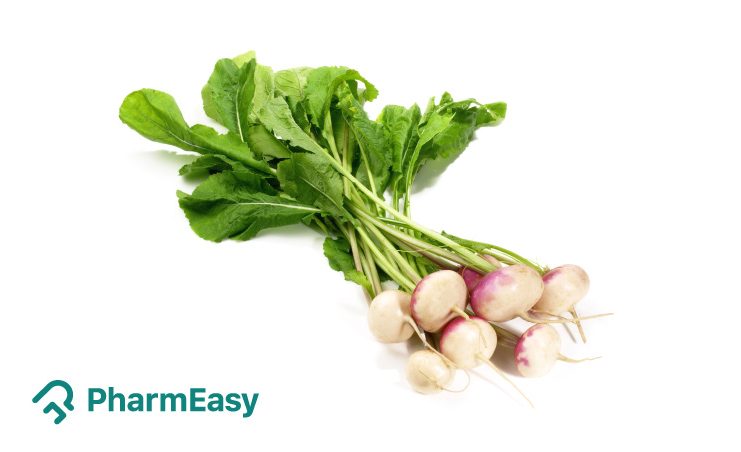
Turnip contains several organic compounds like glycosinolates, isothiocyanates, flavonoids, indoles, sulfur compounds, phenolics, carbohydrates, and volatiles1. It has the following nutritional components:
Nutritional contents of turnips2
Studies have shown that turnip may possess the following properties:
Some of the potential health benefits of turnip are given below.

Consumption of herbs and vegetables in case of liver diseases has drawn great attention. Turnip contains several organic compounds like glucosinolates, isothiocyanates, flavonoids, phenols, indoles, volatiles and sulfur compounds that may possess antioxidant activity. The compounds present in turnip may reduce the risk of liver damage and might help maintain its structure and function. However, more studies are needed to check the action of turnip to protect the liver1.

Turnip may help to protect against kidney damage. It contains compounds like flavonoids, which may possess antioxidant activity and reduce oxidative stress in kidneys, thereby protecting it. However, more studies are needed to check the activity of turnips to protect the kidney. You must seek proper treatment if you have been diagnosed with kidney disorders1.

Turnip may be used in case of diabetes. Turnip contains several constituents like quercetin, indole, alkaloids, etc. These constituents may be responsible for the anti-diabetic activity of turnip. A study1 on mice showed that turnip might show its anti-diabetic activity against type-2 diabetes. However, these studies were conducted on animals therefore, more studies are required on humans to check the anti-diabetic effect. You must check your sugar levels regularly and seek medical advice in case of high sugar levels.
Turnip is readily available and has multiple health benefits. Among all other bioactive compounds, the presence of phenolic compounds and the antioxidant abilities of turnip might be useful for reducing hepatic damage being caused by diabetes4.
Dr. Rajeev Singh, BAMS

Turnip may reduce the risk of cancer. It contains several compounds that may inhibit DNA damage and reduce the risk of tumours and cancers in the body. It may allow the body to detoxify the harmful chemicals better. Further studies are required on the human body to confirm the anti-cancer activity of turnips. Cancer is a serious disease therefore, you must consult your doctor if you have been diagnosed1.
Based on my observations, including turnip in your diet has several benefits. Many studies show that it contains antitumor, anti-inflammatory, antioxidant, antihypertensive, antidiabetic, and hepatoprotective properties. Due to these properties, turnips might be useful in managing many diseases such as cancer, diabetes, inflammatory diseases, etc3.
Dr. Siddharth Gupta, B.A.M.S, M.D (Ayu)

The use of natural products as antimicrobial agents has increased because of increased resistance and side effects of drugs. Turnip may be used in fungal and bacterial infections due to its presence on constituents like quercetin, glucosinolates, isothiocyanates, flavonoids, phenols, indoles, volatiles, sulfur compounds, and other biological compounds. However, more research is required to confirm the antimicrobial activity of turnips1.

Turnip may be used to alleviate pain. Turnip consists of several natural analgesics like flavonoids (substances that reduce pain). A study1 on mice showed that turnips might possess analgesic properties. Swelling in the body may be caused due to various reasons like external stimuli, irritants, foreign organisms, etc. Flavonoids present in turnip may help reduce swelling too. However, further studies are needed on humans to check these effects. You must consult your doctor for a proper diagnosis and treatment related to any kind of pain.

Turnip may reduce bad cholesterol levels due to its antioxidant activity. The natural antioxidants like quercetin, tocopherols, ascorbic acid and beta carotene present in turnip may help breakdown the LDL (low-density lipoproteins). This may lead to lower LDL levels in the body. More research is required to confirm the activity of turnips in lowering cholesterol levels. You must check your cholesterol levels and consult your doctor in case of abnormal cholesterol levels1.
Though studies show the benefits of turnips in various conditions, these are insufficient, and there is a need for further studies to establish the true extent of the benefits of turnips on human health.
Turnips can be included in the diet in the following way:
You must consult a qualified doctor before taking any herbal supplements. Do not discontinue or replace an ongoing treatment of modern medicine with an ayurvedic/herbal preparation without consulting a qualified doctor.
Turnip, a natural product, has no specific side effects. However, if any reaction is noticed on using it, seek immediate medical attention. Consult your ayurvedic physician who has prescribed it to you they will be able to identify the cause and treat it effectively.
General precautions should be taken while having turnips, as in any other general medicine. Pregnant women and lactating mothers should take special care. You must consult your doctor before having turnips. Precaution should be taken before giving turnips to the elderly or children. In such cases, you must have turnips only if your doctor prescribes them.
There is not enough evidence on the interaction of turnips with other drugs. Further studies on the interaction of turnips are required. Therefore, you must consult your doctor if you are on any other medication before consuming turnips.
Also Read: Peanut Butter: Uses, Benefits, Side Effects By Dr. Rajeev Singh
Turnips may be used in case of diabetes, cancer or antimicrobial infections. It may help relieve pain and reduce swelling. It may be used to protect the liver and kidneys. Additionally, it may also lower bad cholesterol levels. However, further studies are required to check the effect of turnip on the given diseases. You must consult a doctor if you suspect any disease instead of self-medicating1.
Turnip may be used to manage diabetes. Turnip contains several constituents like quercetin, indole, alkaloids, etc. These constituents may be responsible for the anti-diabetic activity of turnip by lowering high blood sugar levels However, you must check your sugar levels regularly and seek medical advice in case of high sugar levels1.
Turnip contains several organic compounds like glycosinolates, isothiocyanates, flavonoids, indoles, sulfur compounds, phenolics, carbohydrates, and volatiles. It also contains carbohydrates, fibres and minerals like calcium, iron, magnesium, phosphorus, potassium and many more. Vitamin C is also present in turnips. These compounds possess several properties like antioxidant, anticancer, antibacterial and antifungal properties which may benefit the human health1,2.
No, there are no studies that suggest the use of turnips for jaundice.
Turnip, a natural product, has no specific side effects. However, if any reaction is noticed on using it, seek immediate medical attention. Consult your ayurvedic physician who has prescribed it to you they will be able to identify the cause and treat it effectively.
Disclaimer: The information provided here is for educational/awareness purposes only and is not intended to be a substitute for medical treatment by a healthcare professional and should not be relied upon to diagnose or treat any medical condition. The reader should consult a registered medical practitioner to determine the appropriateness of the information and before consuming any medication. PharmEasy does not provide any guarantee or warranty (express or implied) regarding the accuracy, adequacy, completeness, legality, reliability or usefulness of the information; and disclaims any liability arising thereof.
Links and product recommendations in the information provided here are advertisements of third-party products available on the website. PharmEasy does not make any representation on the accuracy or suitability of such products/services. Advertisements do not influence the editorial decisions or content. The information in this blog is subject to change without notice. The authors and administrators reserve the right to modify, add, or remove content without notification. It is your responsibility to review this disclaimer regularly for any changes.
 11
11  0
0Comments

Leave your comment...
You may also like























Comments