




Pear (Nashpati): Uses, Benefits, Side Effects and More!
By Dr Anuja Bodhare +2 more

Medically reviewed by Dr Anuja Bodhare
Last updated: Mar 2, 2026 Published on: Jun 3, 2022


Get,

to manage your symptom
Get your,

4 Cr+ families
benefitted

OTP sent to 9988776655



You’ve successfully subscribed to receive
doctor-approved tips on
Whatsapp

Get ready to feel your best.


Register to Avail the Offer
Send OTPBy continuing, you agree with our Privacy Policy and Terms and Conditions
Hi There,
Sign up on PharmEasy now!!


Trusted by 4 crore+ families

OTP sent to 9988776655
You have unlocked 25% off on medicines


Code: NU25

By Dr Anuja Bodhare +2 more
Table of Contents
Pear is scientifically known as Pyrus communis L. It belongs to the family Rosaceae. The pear is considered the second most nutritious fruit after the apple. It is a good source of vitamins, dietary fibre, amino acids, and quercetin. The pear fruit is widely famous for its sweetness, aroma, crispness and distinct fragrance. Pear is native to North America, Western Europe, Asia, China, and Pakistan1,3.
Pear is described as a ‘gift of God’ by the Greek poet Homer. Pear fruit is called Bagu Gosha in Hindi and Amritphale in Sanskrit because of its beneficial impact on human health. Pears may help in wound healing, skin brightening, immunity-boosting and also managing urinary tract infections1,4.
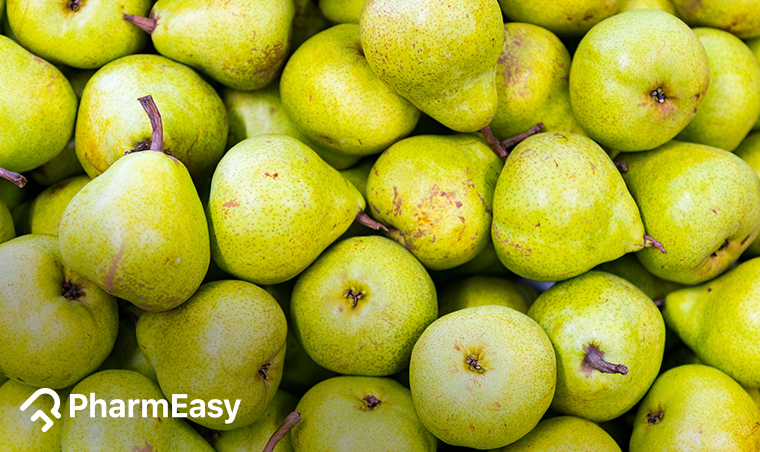
Let’s read along to know more about pears. In this blog, you will find the potential uses, benefits and side effects of pear on human health.
Did you know?
All parts of the pear tree have good nutritional value1. Below is the nutritional value of pear per 100 grams3
Pears also contain vitamins and amino acids. Following are the Vitamins and amino acids per 100 grams of pear3.
Vitamins:
Amino Acids:
Pear for obesity! Pear is believed to be rich in dietary fibres and hence might aid in weight loss6.
Dr. Siddharth Gupta, B.A.M.S, M.D (Ayu)
Pear has been considered a medicinal plant since prehistoric times1. Pear may have beneficial properties such as:
Did you know pear might aid in asthma? Researchers believe that due to its anti-inflammatory nature, pear might be helpful in lung diseases such as asthma and COPD (Chronic Obstructive Pulmonary Disease)6.
Dr. Rajeev Singh, BAMS
Pear may have beneficial properties that might be good for the health and may be used to deal with many ailments2.

Pear has antioxidants that might show a beneficial effect on liver health. In an animal study1 conducted by Ajilore B et al. 2016, the seed extract of pear fruit showed a decrease in oxidative stress on the liver. These results were due to the phytochemicals, antioxidant, and anti-inflammatory properties of pear. This might show that the pear has increased antioxidant activity. Pear might also benefit against liver injury caused due to heavy metals.
This information is insufficient. These studies are not performed on humans. Therefore, more human trials are necessary to provide the true extent of pear on liver health. Consequently, it is better to consult a doctor before using pear as a herb.

An animal study1 by Bhargav A. et al. 2013 showed a significant result in managing blood sugar levels by using pear. The oral administration of the pear fruit extract may help to reduce blood glucose levels because of its phytochemicals. The extract may have some effect on the plasma insulin or pancreatic insulin secretion.
This data is not sufficient as these studies are conducted on animals. Therefore, more human studies are necessary to support the scope of pear on blood sugar management. Therefore, it is important to consult a doctor before using a pear for lowering blood sugar.

A study1 by Guven K et al., 2006 suggested that pear when tested on the urinary tract causing bacteria, extract showed an antimicrobial effect. Pear may have a defense mechanism against bacterial invasion. It may also have an antimicrobial action to reduce infection. The pear leaf extract may act as an uro-disinfectant that may be helpful in dealing with urinary tract infections4.
However, the available data is insufficient to establish the mentioned benefits of pear for managing UTIs in humans and more studies are needed to validate this potential use of pear further. Consult a qualified doctor for better advice.

The wound-healing activities of pear extract were studied in an animal model by Bhargava A 2014. The results showed a significant reduction in scar formation and increased collagen fiber production that provided strength to the skin1.
The pear extract showed potential wound-healing activity because of its antimicrobial activity. Also, there may be an effect on the formation of new tissue and contraction of the wound. Pear also may show antioxidant properties and connective tissue formation1.
This information is not sufficient as these studies are not conducted on humans. However, human trials are required to suggest the benefits of pear for wound healing. Therefore, it is important to first speak to your concerned doctors and only use pear as a herb.

Though there are studies that show the benefits of pear in various health conditions. This information is insufficient and there is a need for further studies to establish the true scope of the benefits of pear on human health.
Other than lungs, pear might take care of your heart as well! Researchers believe that due to its anti-oxidant and anti-inflammatory nature, pear might aid in heart illnesses. Pear contains chlorogenic acid that is believed to protect the cells of the heart from oxidative damage6.
Dr. Smita Barode, B.A.M.S, M.S.
The whole fruit is healthy and nutritious.
You should consult a professional doctor before having any herbal preparations made of pear. They will recommend the proper form and dosage of pear according to your health condition. We advise you to not replace or discontinue your present medications with herbal preparations without consulting a qualified physician.
Also Read: Turmeric (Haldi): Uses, Benefits, Side Effects, and More!
Some side effects of pear fruit are related to the digestive system and development may be seen in children and infants.
If any such side effects are seen after having pears, please consult an Ayurvedic physician who advised you to have it. They will provide the appropriate treatment to deal with the side effects.
Also Read: Grapes (Angur): Uses, Benefits, Side Effects By Dr. Smita Barode
General precautions and extra care need to be taken before giving pear to young children and older people.
Kindly do not use tamarind to self-medicate, replace, alter or discontinue any ongoing treatment on your own. Consult a doctor if you are facing any health-related problems.
Also Read: Grapefruit (Chakotra): Uses, Benefits, Side Effects and More!
Drug reactions of pear fruit with any other drug have not been reported. However, people should not assume that there are no interactions at all.
There is not enough information regarding the harmful interaction between medicines and pear or pear products. However, if any symptoms or complications are observed, please connect with your doctor.
Pear (Nashpati) contains folic acid, which might be beneficial during pregnancy1,4. However, this information is insufficient as no studies on humans support this claim. Therefore, it is essential to consult a doctor and only use pear as a herb.
Pear contains vitamin A, vitamin B6, and vitamin C, which might provide health benefits1.
Pear fruit and the bark and leaves of the pear tree are used to prepare a decoction, which is full of dietary fibre. This might act as a gentle laxative that might help regulate bowel movements and help combat constipation. However, people should first seek medical advice from a doctor and only use pear decoction as this information is insufficient2,4.
Pear may be used to manage hangover symptoms. Eating pear before a big alcoholic drink might effectively lower blood alcohol levels. It might also affect specific enzymes in a way that solubilizes alcohol molecules. However, more studies on humans are needed to support this claim. People should not consume pears to self-medicate without consulting a doctor1.
Regular consumption of pear might reduce the risk of age-related macular degeneration (loss of vision), a major concern of older adults. However, this information is insufficient to say the beneficial effect of pear on loss of vision in humans1.
Disclaimer: The information provided here is for educational/awareness purposes only and is not intended to be a substitute for medical treatment by a healthcare professional and should not be relied upon to diagnose or treat any medical condition. The reader should consult a registered medical practitioner to determine the appropriateness of the information and before consuming any medication. PharmEasy does not provide any guarantee or warranty (express or implied) regarding the accuracy, adequacy, completeness, legality, reliability or usefulness of the information; and disclaims any liability arising thereof.
Links and product recommendations in the information provided here are advertisements of third-party products available on the website. PharmEasy does not make any representation on the accuracy or suitability of such products/services. Advertisements do not influence the editorial decisions or content. The information in this blog is subject to change without notice. The authors and administrators reserve the right to modify, add, or remove content without notification. It is your responsibility to review this disclaimer regularly for any changes.
 10
10 
Comments

Leave your comment...
You may also like






















Comments