




Nipah Virus: All You Need to Know
By Dr. Nikita Toshi +2 more

Medically reviewed by Dr. Nikita Toshi
Last updated: Sep 11, 2026 Published on: May 23, 2018


Get,

to manage your symptom
Get your,

4 Cr+ families
benefitted

OTP sent to 9988776655



You’ve successfully subscribed to receive
doctor-approved tips on
Whatsapp

Get ready to feel your best.


Register to Avail the Offer
Send OTPBy continuing, you agree with our Privacy Policy and Terms and Conditions
Hi There,
Sign up on PharmEasy now!!


Trusted by 4 crore+ families

OTP sent to 9988776655
You have unlocked 25% off on medicines


Code: NU25

By Dr. Nikita Toshi +2 more
Table of Contents
The Nipah virus cases have been confirmed in India. This infection is dangerous because of its high rate of transmission, risk of serious neurological complications. Originating in bats, the virus can pass to humans through contaminated food, infected animals or close contact with an infected person, making early detection critical. With no approved vaccine or specific treatment, prevention, rapid diagnosis, and strict infection control remain our strongest defenses1.
India has confirmed two cases of Nipah virus in West Bengal. Both patients—25-year-old nurses working at the same private hospital in Barasat, North 24 Parganas—developed symptoms in late December 2025 that rapidly progressed to neurological complications2. They were placed in isolation in early January 2026. All identified contacts have tested negative. As per news reports, suspected contacts have been traced and put in quarantine-underscoring the importance of swift action when dealing with high-risk infections like Nipah.
Learn how the Nipah Virus or NiV spreads, the symptoms, and its treatment below:
Symptoms usually show up between 4 to 14 days after being exposed to the virus3. At the start, the illness can appear within 3 to 14 days with few or more of the following symptoms.
The Nipah Virus features in the WHO 2018 list of viruses that have the potential to create an epidemic or a huge health scare in the world.
The Nipah Virus was first found in pigs in Kampung Sungai Nipah, in Malaysia in the year 1998. This is the seventh time when India has reported Nipah Virus cases and third occurrence in West Bengal, following Nipah virus outbreaks in Siliguri (2001) and Nadia (2007). The affected districts border Bangladesh, where Nipah outbreaks occur almost annually4.
Per the WHO, the NiV aka Nipah Virus disease, is a viral infection, an emerging zoonosis that can be transmitted to human beings who come in contact with infected animals. It is a deadly disease for both humans and animals. Fruit bats are this virus’s natural hosts. These bats belong to the Pteropodidae family of the Pteropus genus5.
In 2018, in the case of the Nipah virus in Kerala, the disease was reported to be spreading due to human-to-human transmission. The first reported case of NiV was reported in Siliguri district in the year 2001, of which of the 66 cases reported, 45 people died from the disease1.
Nipah virus infection can spread to humans by the following means:
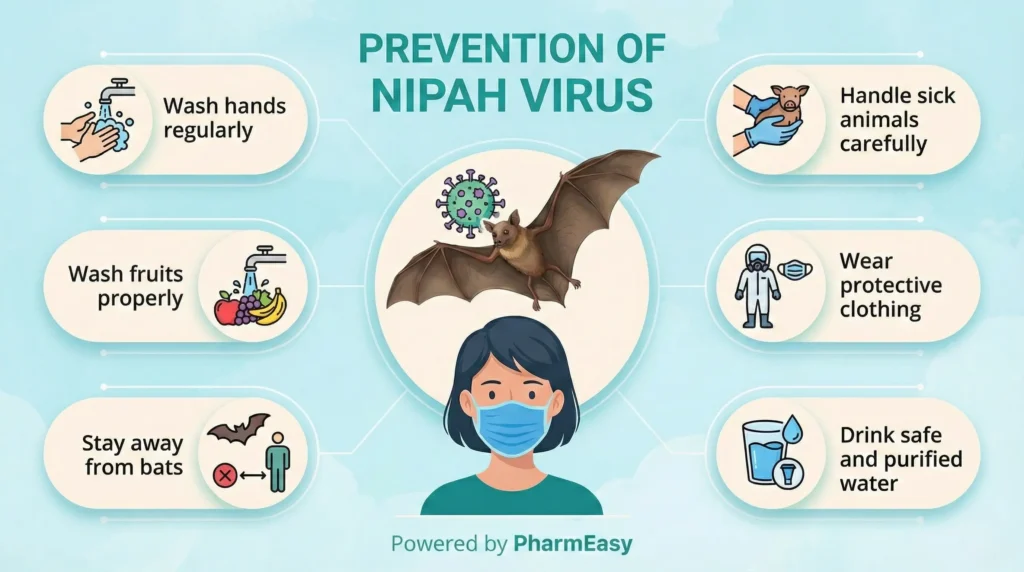
Vaccine for Nipah Virus prevention is not available yet. Following measures to reduce the risk of exposure to Nipah virus can help in reducing the spread of the virus in places with active cases3:
These simple steps can help protect you and others from getting exposed to Nipah virus.
Nipah virus has a fatality rate between 40% and 75% depending on the strain, death rates after contracting the infection are thus very high, so prevention is the most suitable option for this disease5.
Dr. Ashish Bajaj ,M.B.B.S., M.D. in Clinical Pharmacology and Toxicology
One or more of the following tests can be advised to check if someone has NiV infection:
Also Read: What Is Hantavirus? Symptoms, Causes, & Effective Prevention
The treatment for Nipah Virus focuses on containing the fever and the neurological symptoms. Treatment should not be delayed and suspected patients must be managed under expert supervision.
Also Read: Human Papillomavirus (HPV): What Is It, Causes, Symptoms, and Prevention
Nipah virus infection is a serious and potentially deadly infection that demands our attention and vigilance. While outbreaks are relatively rare, understanding the symptoms, preventive measures, and early diagnosis is crucial to curbing its spread and saving lives. Staying informed and taking necessary precautions can help protect ourselves and our communities from this formidable viral threat.
Disclaimer: The information provided here is for educational/awareness purposes only and is not intended to be a substitute for medical treatment by a healthcare professional and should not be relied upon to diagnose or treat any medical condition. The reader should consult a registered medical practitioner to determine the appropriateness of the information and before consuming any medication. PharmEasy does not provide any guarantee or warranty (express or implied) regarding the accuracy, adequacy, completeness, legality, reliability or usefulness of the information; and disclaims any liability arising thereof.
Links and product recommendations in the information provided here are advertisements of third-party products available on the website. PharmEasy does not make any representation on the accuracy or suitability of such products/services. Advertisements do not influence the editorial decisions or content. The information in this blog is subject to change without notice. The authors and administrators reserve the right to modify, add, or remove content without notification. It is your responsibility to review this disclaimer regularly for any change


Comments

Leave your comment...
You may also like

























Comments