
Introduction
Have you ever experienced a sharp stiffness or pain while lifting your arm, reaching a high shelf, or even turning in bed to sleep on one side? Simple daily movements can suddenly become difficult and frustrating. This is called frozen shoulder, a common condition seen in many people, which causes pain, stiffness, and reduced movement in the shoulder joint1.
Although this seems worrying, frozen shoulder is common and might improve with proper care and management. The condition typically develops gradually and goes through different stages1, but with the right approach, most people regain normal shoulder movement.
One of the most effective methods considered to manage this condition is exercise. This article can be considered as a guide to safe and effective frozen shoulder exercises that might help reduce pain, improve flexibility, and gradually restore shoulder mobility.
Advertisement
What is Frozen Shoulder?
A musculoskeletal condition characterised by stiffness and pain in the shoulder joints is called a frozen shoulder. It happens when the tissues around the shoulder joint become inflamed and tight, making it difficult to move the arm normally. Over time, the shoulder may feel very stiff, and even simple movements like lifting the arm or reaching behind the back can become painful. It usually develops gradually and can last longer, but may improve with proper care and exercises1.
Frozen shoulder is most commonly seen in people around 40 years of age and more frequently in women than men. It can occur from injury, trauma, prolonged immobilisation, certain types of surgeries (open-hearted, shoulder surgery, etc.), conditions like thyroid, diabetes, Parkinson’s, cardiovascular diseases, or can even be idiopathic (without a clear reason)1.
Frozen shoulder generally occurs in three stages, which we will be discussing in the following section.
Stages of Frozen Shoulder
A person with frozen shoulder passes through three different stages1:
1. Freezing Stage
- The early phase where the pain starts and gets worse over time due to movement and makes it hard to keep a position, especially while sleeping1. This phase can range from 6 weeks to 9 months2.
- Exercise goal: Maintain gentle, pain-free mobility within the tolerated range.
- Suitable exercises: Passive exercises (carried out with the help of a therapist or a machine or an object without requiring any muscle effort) such as supine forward elevation (assisted overhead arm raise in lying position). external rotation (assisted outward arm rotation) and other light assisted movements along with Pendulum exercises for frozen shoulder3
2. Frozen Stage
- The second phase where the pain symptoms might reduce but pain may still be felt while moving arms (backward movement)1. The shoulder becomes very stiff with limited movement, even to perform daily activities, during 4 to 6 months of this stage2.
- Exercise goal: Gradually improve flexibility with gentle stretching and slowly rebuild strength.
- Suitable exercises: Outward shoulder stretch, strength exercises such as scapular retraction (shoulder blade squeeze), posterior capsule stretch (back shoulder stretch), isometric shoulder external rotation (outward shoulder press against a wall or other immovable object, without moving the arm)3.
3. Thawing Stage
- The final phase where the stiffness and pain of the shoulder start improving and finally there’s no pain. The normal strength and motion can usually be regained between 6 months and 2 years1,2.
- Exercise goal: Restore normal range of motion and focus on strengthening.
- Suitable exercises: Active range-of-motion exercises using resistance band and free weights eventually, also including rotatory shoulder muscles and chest muscles, along with continued stretching to regain full mobility3.
Frozen shoulder duration varies between individuals and may take 1-3 years to improve without treatment.
Is Exercise Safe for Frozen Shoulder
Frozen shoulder physical exercises are generally considered safe, but only when done gently and correctly, without being forceful4. It plays a key role in reducing stiffness and improving shoulder movement3. Also, regular, controlled exercises might help keep the shoulder joint moving. Doctors and physiotherapists recommend a pain-free range of motion and stretching exercises, especially during the early stages3.
Advertisement
The role of exercise in frozen shoulder includes improving mobility, reducing pain, enhancing flexibility and maintaining strength3. All these together might restore the normal shoulder movement. However, exercises should be done slowly and within a pain-free range. For best results, they are often recommended under the guidance of a physiotherapist.
Benefits of Frozen Shoulder Exercises
Exercises might bring about some positive changes to our body when performed with care. Following are some potential benefits of frozen shoulder physical exercises3.
- Mobility Improvement: Gentle exercises help the shoulder joint move better and avoid further stiffness.
- Pain Reduction: Slow movements may reduce inflammation and pain over time.
- Flexibility Improvement: Stretching exercises help keep the shoulder tissues flexible.
- Strength Maintenance: Strengthening exercises aid in maintaining the shoulder muscle strength.
- Daily Function Improvement: Shoulder exercise can make everyday activities like dressing, lifting, or reaching easier to do.
- Speedy Recovery: Consistent exercise may help speed up recovery time.
Though frozen shoulder exercises at home might provide these potential benefits, proper guidance and care are mandatory to achieve them and to avoid unnecessary adverse effects.
Best Exercises for Frozen Shoulder at Home
Performing some simple at-home exercises may help ease your condition and improve your difficulties to an extent. The following are some of the best exercises for frozen shoulder you may perform at home.
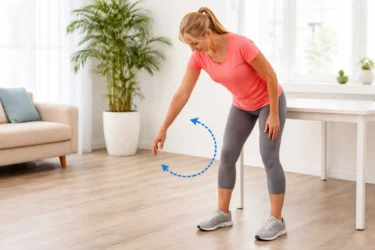
1. Pendulum Stretch
- How to perform
- Relax your shoulders
- Stand beside a table or chair and support yourself with the unaffected arm
- Let the affected arm hang down freely
- Slowly rotate the arm in a small circle
- Repeat the movement
- Repetition/Duration: Perform 10 circles in each direction, once a day5
- Best time to perform: Freezing stage3
2. Towel Stretch
- How to perform
- Hold one end of a towel behind your back with the affected arm
- Hold the other end with your unaffected arm
- Retain the towel in a horizontal position at your back
- Gently pull the towel upward with your unaffected arm to stretch the affected arm
- Hold the stretch for a few seconds and relax
- Repetition/Duration: Perform 10 to 20 times a day5
- Best time to perform: Frozen and thawing phase3
3. Finger Walk
- How to perform
- Stand facing the wall with a small distance
- Place your affected hand’s fingertips on the wall at waist height
- Keep the elbow slightly bent and slowly walk your fingers up the wall like a spider
- Continue to move the fingers till the height you are comfortable to move it to
- Slowly lower the arm (use the other arm for support if needed)
- Repeat the exercise
- Repetition/Duration: Repeat this exercise 10-20 times per day5
- Best time to perform: Thawing phase
4. Armpit Stretch
- How to perform
- Use your healthy arm to lift the affected arm onto a shelf at chest height
- Relax your arm on the shelf gently bend your knees and stretch the armpit area
- Then straighten the knees slowly
- Bend your knees again to deepen the stretch slightly do not force the stretch
- Repeat the movement gently
- Repetition/Duration: Perform 10-20 everyday5
- Best time to perform: Frozen and thawing phase3
5. Scapular Retraction
- How to perform
- Sit or stand with your back straight
- Gently squeeze your shoulder blades together
- Hold for 5 seconds relax slowly3
- Repeat the exercise
- Repetition/Duration: Two sets of 20 repetitions, 2-4 times a day6
- Best time to perform: Frozen phase3
Precautions to be taken: Before starting exercises, always warm up your shoulders; you may take a warm bath or use a moist heating pad. Stretch until you feel slight tension; stop beyond it. Do not force5. You may avoid using weights or giving a significant range of motion. Also, avoid rapid, jerky movements.
If you have any doubts regarding these exercises, it’s best to learn them from a trained professional first.
Other Exercises for Frozen Shoulder with the Help of a Physiotherapist
Physiotherapy exercises for frozen shoulder are usually introduced after basic home exercises, when the shoulder starts improving. A physiotherapist supervises the movements, ensures correct posture, and manages the stretching intensity. This might help avoid injury, improve range of motion, and gradually build shoulder strength.
1. Passive Stretch (External Rotation)
- How to perform
- The therapist will suggest you stand in a doorway
- He will help you bend the elbow of the affected arm to 90° and place the hand on the door frame
- He will ask you to keep the hand still and help you to gently turn your body away and hold it for 30 seconds and then let you relax and repeat
- Repetition/Duration: The therapist may advise performing the exercise 10-20 times a day for 30 seconds2
- Best time to perform: He might suggest it during the freezing or frozen phase3
2. Cross Body Reach
- How to perform
- The therapist will ask you to sit or stand comfortably
- He will help support the affected arm at the elbow and ask you to apply a light pressure to feel a stretch in the shoulder
- He will then gently move your arm across your chest and will ask you to hold it for 15-20 seconds
- Repetition/Duration: The therapist might suggest performing the exercise for 10-20 times a day5
- Best time to perform: He might suggest performing it during the frozen and thawing phase
3. Forward Flexion (Supine Position)
- How to perform
- The therapist will ask you to lie on your back, legs fully extended
- He will help you lift your affected arm until it stretches
- He will ask to retain the pose for 15 seconds and then help you slowly bring the hand to a normal position2
- Repetition/Duration: The therapist might suggest performing 10-15 repetitions of the exercise, several times a day
- Best time to perform: He might recommend performing it during freezing phase3
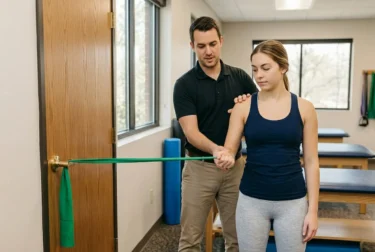
4. Resistance Band Pull
- How to perform
- The therapist will ask you to stand near a closed door
- He will attach one end of the exercising band to the door handle
- He will help you hold the other end with the affected arm, with the elbow bent at 90 degrees
- He will guide you to slowly pull your arm towards your body, about 2-3 inches, and ask you to hold it for 5 seconds and then relax
- Repetition/Duration: The therapist might recommend performing the exercise 15-20 times once a day5
- Best time to perform: He might suggest performing the exercise during the freezing phase3
5. Resistant Band External Rotation
- How to perform
- The therapist will ask you to hold a rubber exercise band with both your hands
- Then ask you to keep your elbows close to your sides and then help you bend at 90 degrees
- He will guide you to slowly move the lower part of the affected arm outward about 2-3 inches and then ask you to retain this position for 5 seconds
- Repetition/Duration: The therapist might ask to repeat the exercise 10-15 times every day
- Best time to perform: He might recommend performing the exercise during the freezing and frozen phase
Note: These exercises should be performed only under the guidance of a doctor or physiotherapist. He might provide you with a frozen shoulder exercises handout. Remember to not stretch beyond limits or overdo the exercises to avoid risk of further injury.
Also Read: Right Shoulder Pain in Women: Causes, Symptoms, Treatment & More
Common Exercise Mistakes to Avoid
Following are some common mistakes you might avoid while performing exercises for frozen shoulder.
- Stretching too far or forcing the shoulder
- Poor posture during exercises3
- Skipping warm-up5
- Doing too many repetitions too soon
- Not choosing stage specific exercises3
- Ignoring pain during stretch5
- Skipping exercise progression
- Not resting between sessions
Care should be taken to avoid these mistakes while performing frozen shoulder exercises and reduce the risk of any further injury.
Also Read: Sprained Ankle: What Is It, Causes, Symptoms & More
When to Seek Medical Help?
Seek immediate medical attention for the following:
- The pain is getting severe even after proper management
- The frozen shoulder gets reinjured
- Frozen shoulder making you feel low or depressed7
Conclusion
Frozen shoulder can make simple movements painful and frustrating, but with gentle exercises and proper care, most people gradually regain normal shoulder movement. Doing exercises slowly, within a comfortable range, and following a proper routine can help reduce pain, improve flexibility, and maintain strength. Always listen to your body, avoid forcing movements, and seek medical help if pain gets worse, the shoulder is injured again, or you feel very low. With patience and guidance, recovery is possible.
Also Read: Shoulder Blade Pain: Causes, Symptoms, Treatment & More
Frequently Asked Questions (FAQs)
Can yoga help frozen shoulder?According to some studies, there are some asanas for frozen shoulder (yoga frozen shoulder exercises), which might help manage the difficulties due to a frozen shoulder. These include sukshama vyayama, pranayama, chakkichalanasana, shashankasana, tadasana, and several other asanas8.
Do women experience frozen shoulder differently?Yes. Women are more likely to have frozen shoulder than men due to differences in the nervous system and hormone effects. They might also be more at risk of developing neck and shoulder pain from daily activities or work, which can contribute to frozen shoulder symptoms9.
How long does frozen shoulder take to recover?Frozen shoulder usually recovers within 1 to 2 years, although in some cases, full recovery may take up to 3 years1,3.
What is a natural remedy for frozen shoulder?The natural approaches include applying hot packs3,5 warm oil massage, as well as gentle stretching and shoulder exercises for frozen shoulder5.
What not to eat if you have frozen shoulder?Eating foods high in fats and carbohydrates, such as meat, naan, and dairy, along with a poor lifestyle can lead to hypertension, diabetes, and obesity. According to some studies, these might elevate the risk of frozen shoulder. Although, more research is needed to confirm this9.
Which deficiency causes frozen shoulder?The frozen shoulder is not directly linked to any deficiencies. It can be associated with metabolic and endocrine dysfunctions such as diabetes and thyroid problems10. However, there is no nutrient deficiency as such that is attributed towards causing frozen shoulder.
What sleeping position is best for frozen shoulder?Sleeping on your back or unaffected side by placing a pillow below it might be a suitable position for frozen shoulder1.
References
- Frozen Shoulder. 2024. doi: Available from: https://www.healthdirect.gov.au/frozen-shoulder
- Diseases and Conditions: Frozen Shoulder. doi: Available from: https://orthoinfo.aaos.org/en/diseases–conditions/frozen-shoulder/
- Chan H, Pua P, How C. Physical therapy in the management of frozen shoulder. smedj. 2017;58(12):685-689. doi:10.11622/smedj.2017107. Available from: https://pubmed.ncbi.nlm.nih.gov/29242941/
- Frozen shoulder: Learn More-Frozen shoulder: What can help? 2022. doi: Available from: https://www.ncbi.nlm.nih.gov/books/NBK328458/
- 7 stretching & strengthening exercises for a frozen shoulder. doi: Available from: https://www.health.harvard.edu/stretching-exercises-frozen-shoulder
- Bowser A, Swanson BT. Evaluation and Treatment of a Patient Diagnosed With Adhesive Capsulitis Classified as a Derangment Using The Mckenzie Method: A Case Report. International Journal of Sports Physical Therapy. 2016;11(4):627-636. doi: Available from: https://pmc.ncbi.nlm.nih.gov/articles/PMC4970852/
- Frozen Shoulder-Aftercare. 2024. doi: Available from: https://medlineplus.gov/ency/patientinstructions/000550.htm
- Nitu Tegta, Prerna Thakur. Role of Traditional Therapy (Yoga) in Avabahuka (Frozen Shoulder). ayush. Published online April 4, 2022:68-73. doi:10.47070/ayushdhara.v9i1.899. Available from: https://ayushdhara.in/index.php/ayushdhara/article/view/899
- Abudula X, Maimaiti P, Yasheng A, et al. Factors associated with frozen shoulder in adults: a retrospective study. BMC Musculoskelet Disord. 2024;25(1):493. doi:10.1186/s12891-024-07614-8. Available from: https://pubmed.ncbi.nlm.nih.gov/38926699/
- De La Serna D, Navarro-Ledesma S, Alayón F, López E, Pruimboom L. A Comprehensive View of Frozen Shoulder: A Mystery Syndrome. Front Med. 2021;8:663703. doi:10.3389/fmed.2021.663703. Available from: https://pubmed.ncbi.nlm.nih.gov/34046418/
Disclaimer: The information provided here is for educational/awareness purposes only and is not intended to be a substitute for medical treatment by a healthcare professional and should not be relied upon to diagnose or treat any medical condition. The reader should consult a registered medical practitioner to determine the appropriateness of the information and before consuming any medication. PharmEasy does not provide any guarantee or warranty (express or implied) regarding the accuracy, adequacy, completeness, legality, reliability or usefulness of the information and disclaims any liability arising thereof.
Links and product recommendations in the information provided here are advertisements of third-party products available on the website. PharmEasy does not make any representation on the accuracy or suitability of such products/services. Advertisements do not influence the editorial decisions or content. The information in this blog is subject to change without notice. The authors and administrators reserve the right to modify, add, or remove content without notification. It is your responsibility to review this disclaimer regularly for any changes.
















































Comments