
Get,

Free Doctor Tips

to manage your symptom

Get your,

FREE Doctor Tips Now!!

4 Cr+ families

benefitted

Enter your Phone Number

+91

|

Enter a valid mobile number

Send OTP

Verify your mobile number

OTP sent to 9988776655

CONGRATULATIONS!!!

You’ve successfully subscribed to receive

doctor-approved tips on Whatsapp


Get ready to feel your best.

Hi There,

Download the PharmEasy App now!!

AND AVAIL

AD FREE reading experience
Get 25% OFF on medicines
Banner Image

Register to Avail the Offer

Send OTP

By continuing, you agree with our Privacy Policy and Terms and Conditions

Success Banner Image
Verify your mobile number

OTP sent to 9988776655

Comments

Subscribe
Notify of
guest
0 Comments
Inline Feedbacks
View all comments

Leave your comment here

Your email address will not be published. Required fields are marked *

25% OFF on medicines

Collect your coupon before the offer ends!!!

COLLECT

Eye Yoga Exercise for Better Vision and Healthier Eyes

By Dr. Poonam Rai +2 more

Join Health Talk by PharmEasy on WhatsApp

Introduction

Keeping your eyes healthy is essential as it supports not just good eyesight but also overall health. Eye yoga (ocular yoga) exercises, which are believed to help relax and strengthen the eye muscles, have been gaining attention in recent years. These exercises may help improve your vision and support eye health1.

In this article, we will explore eye yoga by discussing its origins, potential benefits, and what current research suggests. We will also outline some common eye yoga exercises and address some frequently asked questions on this topic.

eye yoga exercise

Did you know?

  • Yoga eye exercises have been shown to reduce eye fatigue in undergraduate nursing students. source: PMC
  • Eye yoga practices can improve visual perceptual sensitivity and the ability to discriminate flickering stimuli. source: PMC
  • Yogic eye exercises consist of various steps, including palming, blinking, and rotational viewing. source: PMC
  • Eye fatigue scores may significantly reduces after 8 weeks of yogic eye exercises. source: PMC
  • Yoga ocular exercises can reduce eye fatigue symptoms by increasing the efficiency of extraocular muscles. source: PMC
Advertisement

What Is Eye Yoga, and How Does It Work?

Eye yoga is an old yogic practice that may help give your eye health a natural, gentle boost.

Eye yoga definition

Eye yoga involves simple eye movements, such as focusing on objects near and far and moving the eyes in different directions, without moving the head or neck. These movements may help strengthen the eye muscles and may also promote relaxation and better focus.

Ancient origins

Eye yoga is rooted in traditional Indian practices, like Hatha yoga, and focuses on physical poses, breathing techniques, and mental relaxation2.

Modern interpretations 

In today’s digital world, more time is spent looking at screens, due to which an increase in problems like eye strain (digital eye strain) is observed. As a result, eye yoga has recently made a comeback. Modern approaches to eye yoga are based on traditional practices, but have been adapted to address the new issues arising from prolonged screen use.

Potential Benefits of Eye Yoga

Eye yoga may have many benefits ranging from helping improve eyesight to helping manage eye strain and promoting relaxation.

1. Help Improve Eyesight

Eye yoga is believed to help improve eyesight by strengthening and nourishing the eye muscles1. It could also help reduce the dependency on glasses or contacts. It is also believed that techniques like focus-shifting or pencil push-ups might improve eyesight, especially near vision, which in turn may contribute to better focusing (accommodation) and coordination (convergence) of the eyes3.

Advertisement
  • Helping avoid vision deterioration

Doing eye yoga regularly may stop your vision from getting worse1. It might do this by helping keep the eye muscles flexible and strong. This may lead to fewer vision issues like being nearsighted, farsighted, or having astigmatism.

  • Helping reduce the dependency on glasses or contact lenses

Eye yoga might help improve how well the eyes focus naturally1. This might make you less dependent on glasses or contacts. While evidence is limited and further research is needed, some individuals report benefits from practicing eye yoga regularly.

2. Help in Glaucoma Management

Glaucoma occurs due to high pressure inside the eye (intraocular pressure or IOP) and can lead to loss of vision. Eye yoga is believed to help provide some relief for individuals with glaucoma4:

  • Helping reduce intraocular pressure

One study hinted that eye yoga might help lower IOP4 and might also help slow down its progression.

  • Supporting traditional therapies

As undetected glaucoma can cause loss of vision, you should get your IOP checked regularly for glaucoma. Eye yoga may be used as an add-on to the management options recommended by your eye doctor. More scientific studies are needed to corroborate the proposed benefits of eye yoga for glaucoma4,5.

3. Help Relieve Dry Eye 

Dry eyes occur when your eyes don’t make enough tears or they evaporate too fast6. Eye yoga may help in several ways described below.

  • Helping moisten the eye surface

Eye exercises like eye yoga might help soothe dry eyes by allowing the proper functioning of tear film in the eyes, thus helping keep the eyes moist and giving short-term relief from dryness7,8.

  • Helping promote tear production

Some studies suggest that eye exercises like eye yoga may lead to an increase in tear volume and help provide relief for dry eye symptoms. However, further research is necessary8.

4. Help in Recovery Post Cataract Surgery

Eye yoga might help in recovery after cataract surgery however, more research is needed to confirm this effect.

  • Helping strengthen eye muscles

Doing eye yoga after cataract surgery might help strengthen eye muscles. It may also tone them, aid stability, and provide comfort.

  • Helping reduce recovery time

It is believed that doing eye yoga after cataract surgery could help speed up the recovery period. However, it’s crucial to consult an eye doctor before trying any new exercise after surgery.

5. Help Manage Dark Circles and Under Eye Bags 

Eye yoga mainly works on the eye muscles. However, it may also help improve blood flow around the eyes1, which in turn may improve the appearance of dark under-eye circles or under-eye bags.

  • Helping improve circulation

Eye yoga movements may help improve blood flow around the eyes. It might lower dark circles or bags caused by fluid buildup1,9.

  • Helping reduce puffiness

Eye yoga may help reduce puffiness under the eyes by helping lower inflammation and fluid collection under the eyes.

However, further research is needed in this area.

6. Help in the Management of Eye Strain

Eye strain is an increasing issue in recent years due to the increased use of digital screens. Eye yoga might help in several ways:

  • Helping reduce screen-time effects

Eye yoga may help reduce digital eye strain as it helps you give your eyes a break and exercise the eye muscles1.

  • Helping enhance focus and relaxation

Doing eye yoga exercises with care and intent might help improve focus and relaxation7. This balance could ease eye strain. It may also reduce related problems like headaches, blurred vision, and dry eyes by reducing eye fatigue1,10.

Recently I came across a study that stated patients who practised Trataka Yoga Kriya, a simple and inexpensive relaxation exercise, noticed a slight improvement in their ability to see, distinguish contrasts, and see fine details, compared to those who did not practise the exercise. Though more research is needed in this area, this suggests that such non-drug methods can help improve vision and slow down eye problems.

Dr. Siddharth Gupta, B.A.M.S, M.D

Research on Eye Yoga

Research on eye yoga or exercises is still limited. However, it may benefit certain eye issues3,5.

Scientific Evidence

Studies have shown mixed results on eye yoga and its impact on eye health. Some studies have shown that it may help manage eye strain, improve focus, and help you relax by reducing eye fatigue1,10. However, further research is needed for its effect on vision improvement and other eye issues.

Limitations of Studies

Research on eye yoga suggests that it may help manage eye strain; however, existing studies are limited by small sample sizes and lack of control groups. Larger, well-designed studies are needed to confirm these findings.

Though eye exercises may help some conditions, it may not reduce myopia or short-sightedness. Studies have found that eye yoga or exercises were not successful in reducing nearsightedness (myopia). After trying these methods, there wasn’t any noticeable improvement in vision or refractive errors for either group.

Dr. Rajeev Singh, BAMS

Eye Yoga Exercises

You can practice these eye yoga exercises at home or in the office with ease.

1. Focus Shifting (Sideways Viewing)

Focus Shifting

This move may improve flexibility, balance, and teamwork of eye muscles. It may reduce eye fatigue and strain during near vision and middle-distance tasks.

Potential Benefits

  • Focus shifting is believed to:
    • Strengthen eye muscles so they can focus better.
    • Reduce tired eyes and eye strain when doing tasks that require near vision11.

Step By Step Guide 

  • Sit up straight and lift the arms with fists closed and thumbs up.
  • Keep your head still and look straight ahead.
  • Focus on between your eyebrows and then shift your focus in this order: Between your eyebrows → left thumb → between eyebrows → right thumb → between eyebrows.
  • Repeat this 10 to 20 times, pause, and rest your eyes once you finish12.

2. Eye Rolling (Eye Movement)

eye roling

This movement may help ease tightness in the eye muscles and relieve eye strain.
Potential Benefits

  • This movement is proposed to help:
    • Relieve eye strain and release tight eye muscles, improving flexibility.
    • Strengthen the muscles around the eye7.
    • Promote rest and lower stress.

Step By Step Guide 

  • Sit in a comfortable position and take a deep breath.
  • Look up, trying to gaze at an object above without moving your head.
  • Slowly roll your eyes clockwise while continuing to breathe deeply7.
  • Pause and look straight ahead, then roll your eyes in the opposite direction.
  • Perform multiple repetitions of the exercise.

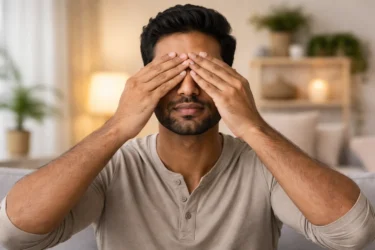
3. Palming

Palming

Palming may help create a calming and relaxing effect. It may also help improve focus and ease eye strain.

Potential Benefits

  • Palming may help:
    • Ease eye strain by enhancing the focusing ability.
    • Achieve relaxation, stress relief, and refreshment of the eye muscles11.
    • Relax the optic nerve and nervous system7.
    • Increase oxygen and nutrient supply to the eye tissues by increasing blood flow to the eyes7,10.

Step By Step Guide 

  • Sit comfortably and rub your hands together for about 10 seconds to warm your palms.
  • Close your eyes and place your palms over your eyes without applying any pressure7.
  • Rest the fingers on your forehead and the lower part of your palms on your cheeks.
  • Take deep breaths, focusing on the darkness when you cover the eyes.
  • Relax in this position for a few minutes or until it makes you feel calmer and more relaxed.

4. Blinking

blinking

Blinking may help moisten the eyes by stimulating tear production, thus reducing the discomfort of dry eyes7. It may also help in the even spreading of the tear film to the eye surface.

Potential Benefits

  • Blinking may help:
    • Stimulate natural tear production, thus soothing dry eyes.
    • Achieve alertness and comfort for long-screen use.
    • Relax crossed eyes (squint eyes)7.
    • Strengthen the eye muscles that open and close the eyelid, thereby improving the natural blinking reflex7,10,11.

Step By Step Guide

  • Sit up straight and open your eyes as wide as possible.
  • Blink one eye at a time; when the right eye closes, blink the left eye.
  • Check your forehead to make sure it stays relaxed and you are not frowning.
  • Lightly massage your forehead above the left and right eyes, one side at a time.
  • Repeat this exercise for a few minutes7.

5. Figure of Eight

Figure eight

The figure-of-eight exercise helps improve the flexibility and teamwork of the eye muscles. It may be an excellent way to reduce eye strain.

Potential Benefits

  • The figure-of-eight exercise may help:
    • Improve the flexibility and range of movement of eye muscles.
    • Support better vision by improving clarity and focus.
    • Reduce digital eye strain13.

Step By Step Guide 

  • Sit or stand comfortably with your back straight.
  • Think about a big figure-of-eight on the floor about 10 feet away from you.
  • Follow the imaginary figure-of-eight path with your eyes in a clockwise direction.
  • Repeat the exercise in an anticlockwise direction as well.
  • Repeat a few times while continuing to switch directions.

6. Near and Far Focus

This exercise is believed to strengthen eye muscles and improve focus. It can be helpful for near vision and long-distance visual tasks.

Potential Benefits

  • This exercise is believed to help:
    • Improve focus for near and far objects.
    • Reduce eye strain when performing close-up tasks for long durations.
    • Reduce or correct eye misalignment (squint).
    • Coordinate the activity of the eyes7.
    • Reduce eye fatigue, thus improving eye strain and eye irritation10.

Step By Step Guide 

  • Sit or stand comfortably and hold one arm out with your thumb pointing upwards.
  • Focus both eyes on the thumb while taking a deep breath.
  • Slowly move the arm to the nose, with the head still and eyes focused on the thumb.
  • Pause when your eyes can no longer see just one thumb image.
  • Return to the beginning position and repeat the exercise 10 to 20 times.

7. Focusing

Near and Far Focus

This eye exercise might improve the accuracy of near and distant vision by training the eyes to focus more effectively.

Potential Benefits

  • This eye yoga exercise may help:
    • Improve the strength and flexibility of eye muscles.
    • Enhance focus during tasks that require near and far vision.

Step By Step Guide 

  • Sit up straight and stretch one arm out in the front with the thumb pointing upwards.
  • Focus on the thumb, then take a deep breath and move it toward the face.
  • Keep following the thumb with your eyes as it moves closer. Stop when you lose focus7.
  • Repeat this process 5 to 10 times.

8. Concentrated Gazing (Trataka)

Trataka involves focusing on a single point until the eyes start watering.
Potential Benefits

  • Trataka may help:
    • Enhance attention and focus.
    • Reduce mental distractions.
    • Improve memory, attention, and cognitive skills.
    • Enhance vision.

Step By Step Guide

  • Sit straight and place a lighted candle in front of you.
  • Focus on the flame with both eyes open; do not blink.
  • Stay steady, calm, and focused for about 2 to 3 minutes.
  • Gently close your eyes for a minute.
  • Visualise the image of the flame in your mind and focus between your eyebrows.
  • Now gently open your eyes repeat the exercise three times.
  • After completing three cycles, relax and defocus your gaze1,14.

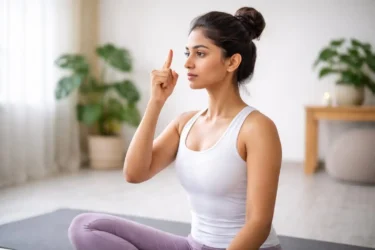
9. Preliminary Nose-Tip Gazing (Nasikagra)

Nasikagra

Nose tip gazing involves focusing on the thumb near the nose tip. This is known to help improve focus.

Potential Benefits

  • This exercise may help improve:
    • Eye focusing (accommodation).
    • Strength of the eye muscles.

Step By Step Guide

  • Sit straight with the legs crossed.
  • Lift the right hand and place it in front of your nose.
  • Curl all your fingers of the right hand inward to form a fist, while keeping your thumb straight up.
  • Start focusing on the tip of the thumb.
  • Now slowly bring the thumb near the nose tip while being focused on the thumb tip.
  • Retain the position for some time, while continuing to focus on the thumb tip placed near the nose tip.
  • Keep focusing on the thumb, then slowly straighten the arm and shift the focus. This marks the completion of a single round.
  • Now, repeat the exercise four more times12.

Additional Tips for Eye Health

Apart from eye yoga, there are other ways to support eye health and help with vision-related issues.

1. Get Regular Eye Exams

eye checkup
Image Source: freepik.com

Regular eye exams can detect eye problems early and ensure your glasses or contacts are well-suited to your needs. Consult an eye care expert for how often to have an eye exam.

2. Wear Sunglasses and Protective Eyewear

sunglasses to prevent dust

Protect your eyes from harmful UV rays by wearing sunglasses that block out all UVA and UVB rays. Always wear protective eyewear during risky activities or jobs15.

3. Reduce Eye Strain

eye strain

Remember the 20-20-20 rule for every 20 minutes, look at an object that’s 20 feet away for 20 seconds. This can lower eye strain caused by prolonged screen time or close-up tasks16.

4. Quit Smoking

quit smoking

Smoking increases the chance of issues like age-linked macular degeneration (which affects central vision) and cataracts. Consider stopping smoking to lower your risks6,17.

5. Follow a Healthy Diet and Hydration

Hydration

Eating a diet rich in nutrients like vitamins A, C, and E, zinc, and omega-3 fatty acids may help improve eye health18. Stay well hydrated to maintain adequate moisture levels in your eyes.

Conclusion

Eye yoga exercises may help ease eye strain, improve focus, and promote relaxation. Although stronger scientific evidence is needed to support these benefits, the exercises are simple, easy to include in your daily routine, and may offer benefits for overall eye health.

By performing eye yoga, getting regular eye exams, wearing sunglasses and protective gear, eating a healthy diet, staying hydrated, and quitting smoking, you may be able to maintain your eye health for a longer duration. Always discuss with your eye doctor before starting these exercises.

Also Read: Eye Pain: Causes, Treatment & Home Remedies

Frequently Asked Questions (FAQs)

How long does it take to see improvements with eye yoga? 

How quickly you see changes with eye yoga differs from person to person. Some people might see changes in weeks, while others may need to do it often for months or more to see any change. Some may not see any changes, so then it is advisable to consult your eye doctor before you start eye yoga..  

Are there any potential risks or side effects of eye yoga? 

Eye yoga is generally considered safe and poses low risks. But if you have eye pain, worsening visual symptoms, or other discomfort while doing eye yoga, stop the exercises and consult an expert immediately.

How often should I practice eye yoga for the best results? 

Performing eye yoga exercises daily may maximise any potential benefits. Begin by adding a few exercises to your routine. Then slowly add more exercises and increase their repetitions as they become easier.

Can children or elderly people practice eye yoga? 

Yes, kids and elderly people can do eye yoga. But they should be observed and guided while doing so. Eye yoga is a low-impact activity suited to most ages. But be sure to ask an eye care expert before starting any new eye exercises.

Can eye yoga replace professional medical care for eye conditions? 

No. Although eye yoga may support normal management methods, it does not replace medical care for any eye issues. Always consult an eye care expert for a full check-up and management of eye issues.

References

  1. S.Deogade DrA, D. Tundalwar DrG, Dhawale DrK. The Impact of Yoga Practices on Ocular Health and NetraRoga : A Review. International Journal of Pharmaceutical Research and Applications [Internet]. 2025;10(2):624–7. Available from: https://ijprajournal.com/issue_dcp/The%20Impact%20Of%20Yoga%20Practices%20On%20Ocular%20Health%20And%20NetraRoga%20%20A%20Review.pdf
  2. Basavaraddi IV. Yoga: Its Origin, History and Development [Internet]. Ministry of External Affairs: Government of India; 2015. Available from: https://www.mea.gov.in/search-result.htm?25096/Yoga:_su_origen
  3. Lee JS, Lee SU, Lee SJ, Kim CZ. Effectiveness of Pencil Push-up Exercises in Patients with Convergence Insufficiency-type Exotropia with Receded Near Point of Convergence. Korean Journal of Ophthalmology : KJO [Internet]. 2025;446–53. Available from: https://pmc.ncbi.nlm.nih.gov/articles/PMC12531088/
  4. Zhou W, Fricke L, Sabel BA. Eye Yoga for Glaucoma: Recovery of Vascular Dysregulation and Visual Field Function—a Randomized Controlled Trial. The EPMA Journal [Internet]. 2024;16(1):37–49. Available from: https://pmc.ncbi.nlm.nih.gov/articles/PMC11842685/
  5. Abraham L, George S, Bhat R. Yoga for Eye Disorders-A Systematic Review. Advances in mind-body Medicine [Internet]. 2025; Available from: https://pubmed.ncbi.nlm.nih.gov/41217898/
  6. Dry Eye Disease [Internet]. Healthdirect Australia. 2024. Available from: https://www.healthdirect.gov.au/dry-eye-disease
  7. Rizanti AP. Yoga Ocular Exercises to Maintain Eye Health during Work and Distance Learning in the New Normal Era. Jurnal Berita Ilmu Keperawatan [Internet]. 2021;14(1):1–9. Available from: https://www.researchgate.net/publication/368054687_Yoga_Ocular_Exercises_to_Maintain_Eye_Health_During_Work_and_Distance_Learning_in_the_New_Normal_Era
  8. Navarro-Lopez S, Moya-Ramón M, Gallar J, Carracedo G, Aracil-Marco A. Effects of Physical Activity/Exercise on Tear Film Characteristics and Dry Eye-Associated Symptoms: A Literature Review. Contact Lens and Anterior Eye [Internet]. 2023; Available from: https://pubmed.ncbi.nlm.nih.gov/37173175/
  9. P A, Harti SH, Rao M. Study to Know the Impact of Ayurvedic Lifestyle on Dark Circles around Eyes [Internet]. Current Traditional Medicine; 2021. Available from: https://www.benthamdirect.com/content/journals/ctm/10.2174/2215083806999201211214329
  10. Gupta S, S A. Effect of Yoga Ocular Exercises on Eye Fatigue. International Journal of Yoga [Internet]. 2020;13(1):76–9. Available from: https://pmc.ncbi.nlm.nih.gov/articles/PMC6937872/
  11. Kim SD. Effects of Yogic Eye Exercises on Eye Fatigue in Undergraduate Nursing Students. Journal of Physical Therapy Science [Internet]. 2016;28(6):1813–5. Available from: https://www.ncbi.nlm.nih.gov/pmc/articles/PMC4932063/
  12. Thool DrAS. Yoga and Exercise for Eyes to Improve Vision [Internet]. Available from: https://knowledgeresonance.com/wp-content/uploads/2021/09/Phy-4.pdf
  13. Zahid I, Amjad F, Riaz MU, Hussain R, Tariq H, Altaf F, et al. Effect of Eye Exercises on Vision-Related Symptoms in Young Adults: Eye Exercises and Vision Symptoms in Young Adults. Journal of Health and Rehabilitation Research [Internet]. 2024;4(3). Available from: https://jhrlmc.com/index.php/home/article/view/1555
  14. P. S. S, Bhat R, Saoji AA. Effect of Trataka (Yogic Visual Concentration) on the Performance in the Corsi-Block Tapping Task: a Repeated Measures Study. Frontiers in Psychology [Internet]. 2021 Dec 17;12. Available from: https://pmc.ncbi.nlm.nih.gov/articles/PMC8718544/
  15. Tips to Stay Safe in the Sun: from Sunscreen to Sunglasses. FDA [Internet]. 2024; Available from: https://www.fda.gov/consumers/consumer-updates/tips-stay-safe-sun-sunscreen-sunglasses
  16. Talens-Estarelles C, Cerviño A, García-Lázaro S, Fogelton A, Sheppard A, Wolffsohn JS. The Effects of Breaks on Digital Eye strain, Dry Eye and Binocular vision: Testing the 20-20-20 Rule. Contact Lens and Anterior Eye [Internet]. 2023;46(2):101744. Available from: https://pubmed.ncbi.nlm.nih.gov/35963776/
  17. How Smoking Can Contribute to Vision Loss and Blindness. FDA [Internet]. 2022; Available from: https://www.fda.gov/tobacco-products/health-effects-tobacco-use/how-smoking-can-contribute-vision-loss-and-blindness
  18. Diet and Nutrition [Internet]. American Academy of Ophthalmology. 2025. Available from: https://www.aao.org/eye-health/tips-prevention/diet-nutrition

Disclaimer: The information provided here is for educational/awareness purposes only and is not intended to be a substitute for medical treatment by a healthcare professional and should not be relied upon to diagnose or treat any medical condition. The reader should consult a registered medical practitioner to determine the appropriateness of the information and before consuming any medication. PharmEasy does not provide any guarantee or warranty (express or implied) regarding the accuracy, adequacy, completeness, legality, reliability or usefulness of the information; and disclaims any liability arising thereof.

Links and product recommendations in the information provided here are advertisements of third-party products available on the website. PharmEasy does not make any representation on the accuracy or suitability of such products/services. Advertisements do not influence the editorial decisions or content. The information in this blog is subject to change without notice. The authors and administrators reserve the right to modify, add, or remove content without notification. It is your responsibility to review this disclaimer regularly for any changes.

Likes 18
Dislikes 1
Advertisement

Comments

Leave your comment...