




Castor Oil: Uses, Benefits, Precautions & More!
By Dr Ashok Pal +2 more

Medically reviewed by Dr Ashok Pal
Last updated: Apr 15, 2026 Published on: Feb 17, 2022


Get,

to manage your symptom
Get your,

4 Cr+ families
benefitted

OTP sent to 9988776655



You’ve successfully subscribed to receive
doctor-approved tips on
Whatsapp

Get ready to feel your best.


Register to Avail the Offer
Send OTPBy continuing, you agree with our Privacy Policy and Terms and Conditions
Hi There,
Sign up on PharmEasy now!!


Trusted by 4 crore+ families

OTP sent to 9988776655
You have unlocked 25% off on medicines


Code: NU25

By Dr Ashok Pal +2 more
Table of Contents
Castor oil, derived from the seeds of Ricinus communis, is a vegetable oil that is used in different preparations due to its medicinal properties. It is pale yellow in colour. The contents of castor oil include palmitic acid, stearic acid, oleic acid, linoleic acid, ricinoleic acid, and linolenic acid. Major castor oil-producing countries are Brazil, India, and China. India accounts for approximately 90% of the global castor oil export. Castor oil is considered important in the global chemical industry1.
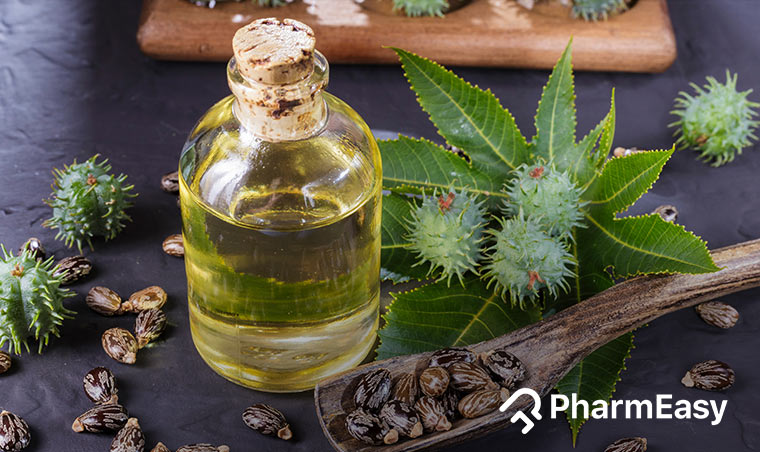
Castor oil contains different beneficial properties like:

Castor oil functions as a laxative. It might help to relieve constipation. It can also be helpful to empty and prepare the bowel for surgery2. However this effect of castor oil needs further research to validate and provide scientific evidence to the claim.

Castor oil contains omega-6 fatty acids that can have some effect on hair loss. These benefits are not proven thus, you must consult an ayurvedic physician for help regarding the use of castor oil for hair loss3.

According to animal studies4, applying castor oil to the skin might help in reducing pain and inflammation due to its ricinoleic acid content. The studies related to castor oil for benefits in humans are insufficient. Before using castor oil for these properties for diabetic conditions, make sure you consult your healthcare provider and get a proper diagnosis and treatment. Avoid using castor oil or any other herb as medicine without consulting your physician.
Though various studies show the potential uses of castor oil in various conditions, these are insufficient and there is a need for further studies to establish the true extent of benefits of castor oil on human health.
Based on my observations and many studies I came across, castor oil possesses antibacterial and wound healing properties. Due to the presence of these properties, castor oil might be useful in preparing dressings for wound healing7.
Dr. Siddharth Gupta, B.A.M.S, M.D (Ayu)
You must consult a qualified doctor before taking any herbal supplements. Do not discontinue or replace an ongoing treatment of modern medicine with an ayurvedic/herbal preparation without consulting a qualified doctor.
Based on my past experiences, castor oil has many medicinal properties. Due to its anti-inflammatory properties, castor oil might be useful for reducing eye infections, sexually transmitted diseases, and liver diseases. Additionally, castor oil might be effective as a disinfectant, germicidal agent, antifungal agent, etc8.
Dr. Rajeev Singh, BAMS
Moreover, every herb may react differently in every individual. Therefore, if you experience any of such side effects, seek immediate medical help from your doctor who has prescribed it to you. They will be the best guide for providing proper treatment to overcome side effects.
Also Read: Camphor – Uses, Benefits, Precautions & Side Effects
Castor oil is unsafe to use in the following medical conditions:
Also Read: Palash Tree – Uses, Benefits & Side Effects
It is essential to keep in mind not to use castor oil with laxatives. Taking other laxatives with castor oil can lead to severe dehydration. It is advised to drink plenty of water to prevent dehydration5. You must take advice from a qualified doctor before consuming any herb. Please discuss your ongoing medication with your doctor for better advice.
Also Read: Kalmegh – Uses, Benefits & Precautions
Major castor oil-producing countries are Brazil, India and China. India accounts for approximately 90% of the global castor oil export6.
Side effects to report to a doctor or health care professionals soon as possible are allergic reactions like skin rash, hives or itching, swelling of the face, tongue, or lips. Side effects that usually do not require medical attention (report to your doctor or health care professional if they continue or are bothersome) are nausea, vomiting, diarrhoea, and stomach pain5. Therefore, if you experience any of such side effects, seek immediate medical help from your doctor who has prescribed it to you.
Ricinus communis (castor oil plant) contains the toxin ricin. Seeds or beans swallowed whole with the hard outer shell intact usually prevent absorption of significant toxin, whereas purified ricin derived from the castor bean is extremely toxic and lethal in minute doses. It is advisable to consult your Ayurvedic physician to understand dosage, uses and precautions as per your health condition.
Disclaimer: The information provided here is for educational/awareness purposes only and is not intended to be a substitute for medical treatment by a healthcare professional and should not be relied upon to diagnose or treat any medical condition. The reader should consult a registered medical practitioner to determine the appropriateness of the information and before consuming any medication. PharmEasy does not provide any guarantee or warranty (express or implied) regarding the accuracy, adequacy, completeness, legality, reliability or usefulness of the information; and disclaims any liability arising thereof.
Links and product recommendations in the information provided here are advertisements of third-party products available on the website. PharmEasy does not make any representation on the accuracy or suitability of such products/services. Advertisements do not influence the editorial decisions or content. The information in this blog is subject to change without notice. The authors and administrators reserve the right to modify, add, or remove content without notification. It is your responsibility to review this disclaimer regularly for any changes.
 3
3  0
0Comments

Leave your comment...
You may also like





















Comments