




Essential Vitamins That Support Eye Health
By Dr. Poonam Rai +2 more

Medically reviewed by Dr. Poonam Rai
Last updated: Mar 9, 2026 Published on: Mar 9, 2026


Get,

to manage your symptom
Get your,

4 Cr+ families
benefitted

OTP sent to 9988776655



You’ve successfully subscribed to receive
doctor-approved tips on
Whatsapp

Get ready to feel your best.


Register to Avail the Offer
Send OTPBy continuing, you agree with our Privacy Policy and Terms and Conditions
Hi There,
Sign up on PharmEasy now!!


Trusted by 4 crore+ families

OTP sent to 9988776655
You have unlocked 25% off on medicines


Code: NU25


By Dr. Poonam Rai +2 more
Table of Contents
Eyes are among the most important sense organs, which are necessary for learning, working, and connecting with the world. Good eye health is not only important for vision but also for overall quality of life. However, in today’s digital age, our eyes face more strain than ever before.
The increased use of smartphones, laptops, and tablets has led to longer screen time for people of all ages. This may cause digital eye strain, dry eyes, headaches, blurred vision, and difficulty focusing1. Over time, recurrent strain and unhealthy habits may also increase the risk of vision problems and age-related eye conditions.

Along with regular eye check-ups and healthy screen habits, proper nutrition also plays a significant role in keeping eye health. Nutrients such as certain vitamins and antioxidants are essential for protecting eyes from damage, improving retinal function, reducing inflammation and keeping the eyes properly moisturised2. A balanced diet rich in these might help reduce the risk of common eye problems and support long-term vision health.
So, in this article we will discuss the importance of nutrients in maintaining eye health. We will learn about which vitamins are good for eyes and foods that can naturally support eye health, and understand some common eye conditions that may occur due to lack of these nutrients.
Proper nutrition is very important for eye health because each part of the eye demands different nutrients to work properly. The following says how vitamins support the different eye parts.
Therefore, proper nutrition plays an important role in the functioning of the eye and is crucial for maintaining long-term healthy vision.
Vitamin deficiencies can harm eye health, as vitamin A deficiency may cause night blindness, lack of vitamins A, C, and D may lead to dry eye syndrome, low dietary antioxidants may increase the risk of age-related macular degeneration (ARMD), etc2,3,7. We will discuss more on these in the coming sections.
Eyes require essential vitamins and nutrients to function properly. The following describes why essential nutrients and vitamins for eye health are important.
Besides vitamins, there are certain other nutrients which are known to be beneficial for eye health; these include omega-3 fatty acids, flavonoids, carotenoids (lutein, zeaxanthin), zinc, selenium, etc. These nutrients are known to protect the eye from oxidative damage, reduce inflammation, maintain retinal health, and aid in vision2,9.
There are several foods that can be included in the diet to support vision and improve eye health. Following are some food sources which might contain vitamins needed for eyes to support vision and overall eye health.
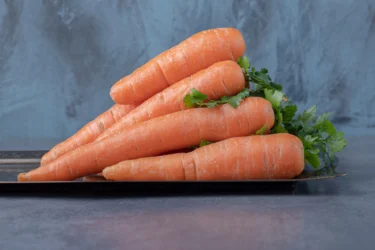
Carrots are known to be rich in vitamin A and carotenoids. Therefore, they might be helpful in promoting good vision, especially during the night3. They are also a fair source of B vitamins10. Hence, they might also support proper optic nerve functioning and maintain overall eye health8.

These include spinach, collard, turnip, kale, etc. They are known to be rich in vitamins like A, C, E and K11. Therefore, they might support eyesight by improving the production of eye pigments2, improve collagen production and maintain eye structure4, and reduce the occurrence of ARED8.

These include salmon, sardine, mackerel, trout, etc. They are known to be a good source of vitamins D and B29. Therefore, they might support the vision by improving retinal health and reducing the occurrence of dry eye disease, diabetic retinopathy and possibly, cataracts8. In addition, they are also a great source of omega-3 fatty acids.
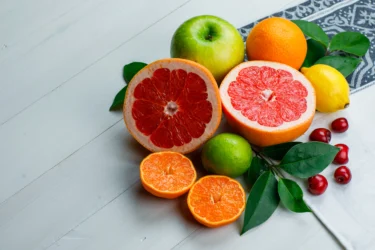
These include oranges, tangerines, grapes, lemons, etc. They are said to have high vitamin C content. Therefore, they might help in tissue repair and reduce the occurrence of ARMD and cataract12.

Eggs are a good source of vitamins A, B12, D and E3,5,13. Therefore, they can support night vision by maintaining a healthy retina, nourish the eyes, improve optic nerve function, and reduce the occurrence of diabetic retinopathy and other ARED3,8.

These include almonds, peanuts, sunflower seeds, etc. They are known to be rich in vitamin E2,8,14. Therefore, they can help support retinal function, reduce oxidative stress by scavenging free radicals and manage ARED2. They also contain omega 3 fatty acids, which are known to be beneficial for the eye health.
Now that we know which vitamin is good for eyes, let us see what eye conditions can occur due to the deficiencies of these vitamins.
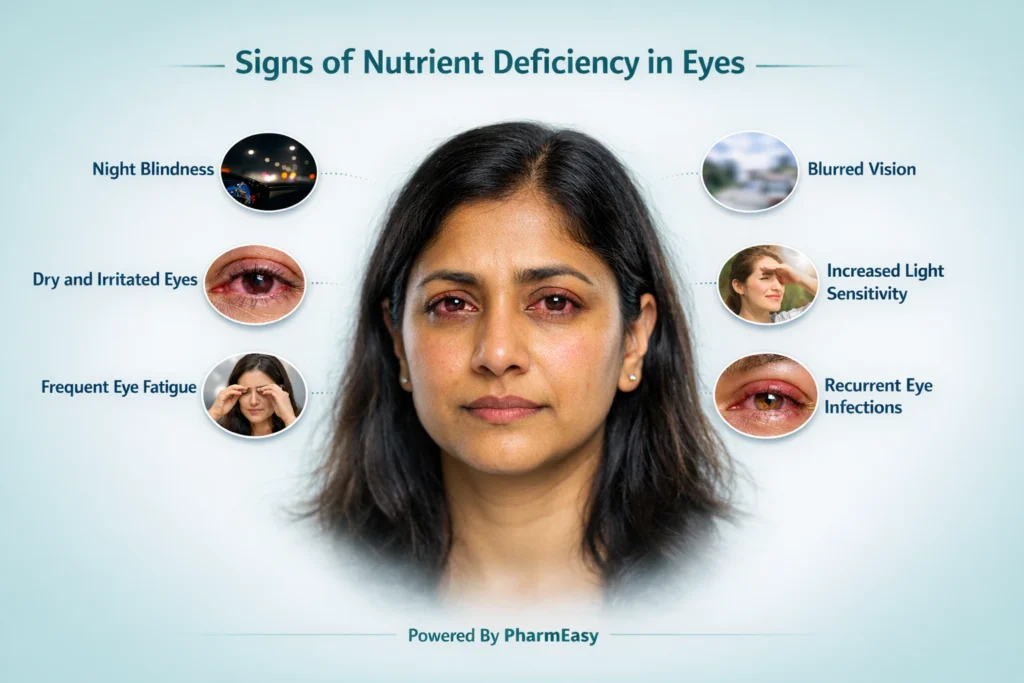
Eyes can bring about several signs regarding the nutritional deficiencies. The following are some eye signs related to nutritional deficiencies.
Night blindness causes difficulty in seeing at night or in dim light, leading to difficulty in driving at night, adjusting to darkness, or walking through a dimply lit area. This condition usually occurs when there is a deficiency in vitamin A3.
Persistent dryness and itching are signs of nutritional deficiency. This may be due to vitamin A deficiency which causes the cornea of the eye to get dry due to lack of moisture and hydration3. Also, vitamin C and D deficiencies can cause dry eyes7, contributing to itching and irritated eyes. Other nutrients like omega-3 fatty acid deficiency may also disrupt the oily layer in tears causing dry eye.
Feeling tiredness of eyes, heaviness around the eyelids, or discomfort after reading or using digital screens may be a sign of severe vitamin deficiencies, like vitamin B1, which can also contribute to a condition called Wernicke’s encephalopathy7.
Blurred vision which is not related to eyesight issues may sometimes be due to nutritional deficiencies, such as vitamin A. If not treated, it can even lead to blindness, especially in children3.
Light sensitivity is related to deficiency of antioxidants2. This can cause the eyes to become more sensitive and uncomfortable in bright conditions.
Recurrent eye infections or minor eye irritations taking time to heal may be associated with nutritional deficiencies like vitamin C, which is important for tissue repair and immune function13. Severe deficiency may cause repeated eye problems.
Note: Ageing naturally causes the eyes to become weak and lose some protection against damage. Unhealthy habits like too much screen time, poor diet, smoking, lack of sleep, and excess sun exposure might also worsen these conditions. Eating a balanced diet and maintaining a healthy lifestyle might reduce the eye damage and support long-term vision.
Proper eye nutrition is essential at every stage of life, but certain age groups require extra attention due to higher risks of vision-related changes and disorders. These include:
Research supports the idea that eye health supplements can be helpful, but primarily for conditions like AMD. The evidence shows an ageage-related eye disease study (AREDS) formula, which is a combination of vitamins A and E, beta-carotene and zinc, may reduce the risk of advanced AMD. There is limited evidence supporting the use of omega-3 supplements for dry eye disease; further research is needed to reach a conclusion. The studies don’t provide any evidence for antioxidant supplementation for conditions like cataracts and glaucoma19.
Eye supplements may be helpful for:
Eye supplements may be taken once daily along with a meal or snack.
Note: Supplements should ideally be taken only after medical advice and as suggested by your doctor, as excessive intake of certain vitamins may be harmful.
Here is a comparison between the food and supplementation:
| Aspects | Food | Supplements |
| Nutrient source | Natural, whole nutrients | Concentrated, isolated nutrients |
| Absorption | Better absorption and utilisation by body | May be less absorbed when compared with food |
| Safety | Low risk of overdose | Overconsumption might raise safety concerns |
| Additional benefits | Provides other nutrients like antioxidants, phytochemicals, etc | Provides only specific nutrients |
Therefore, vitamins from food might be more beneficial when compared to supplements, as they provide other nutrients along with them. However, in conditions where the food alone may not fulfil the requirements or in individuals with dietary restrictions, supplementation might be needed. Under such circumstances, it should be taken only under the guidance of a doctor.
The recognisable changes in your body should not be ignored, as they may be signs of severe nutritional deficiencies. Consult a doctor for the following:
Consult a healthcare professional if you are considering supplementation20 and fall in the high-risk categories mentioned below:
Every consultation might help reduce complications and protect long-term vision health.
Also Read: What Is Eye Strain and How Can You Reduce It in the Digital Age
Good eye health depends on balanced nutrition, healthy habits, and regular eye check-ups. Vitamins like A, C, E, D and B-complex help different parts of the eye function properly. Eating nutrient-rich foods might be the most cost-effective way to protect your eyes. Supplements may help in certain cases, but they should be taken only with a doctor’s advice. Starting healthy eating from an early age might help maintain good vision throughout life.
The best way by which you may improve your eye health is by following a balanced diet comprised of all essential vitamins and other important nutrients. These might keep your eyes healthy and reduce the occurrence of eye diseases or discomforts2.
Blurred vision may be a result of vitamin A or B deficiency3,8. Consuming foods rich in these vitamins might reduce blurred vision. Blurred vision may be a result of vitamin A or B deficiency3,8. Consuming foods rich in these vitamins might reduce blurred vision.
Poor eyesight may be managed by a healthy lifestyle, like following a balanced diet, quitting smoking, managing screen time, staying hydrated and managing the underlying health conditions.
For maintaining a healthy vision, you may choose juices made from citrus fruits or carrots, which might boost your eye health and provide healthy eyesight3,12.
Drinking water can affect axial length and pressure inside the eyeball22. It might be helpful in maintaining and protecting eye health by improving the tear film which reduces dry eye occurrence. This in turn might improve the eyesight. However, it might not change the innate eyesight.
Weak eyesight due to poor nutrition or lifestyle habits may be recovered. However, if it is due to conditions like myopia, hyperopia or astigmatism, it cannot be reversed naturally.
1. Computer Vision Syndrome. doi:https://www.aoa.org/healthy-eyes/eye-and-vision-conditions/computer-vision-syndrome
2. Johnson, Rasmussen H. Nutrients for the aging eye. CIA. Published online June 2013:741. doi:10.2147/CIA.S45399. Available from: https://pubmed.ncbi.nlm.nih.gov/23818772/
3. Alba-Campomanes AG de, Turbert D. What is Vitamin A Deficiency? 2024. doi:https://www.aao.org/eye-health/diseases/vitamin-deficiency
4. Cho YW, Yoo WS, Kim SJ, Chung IY, Seo SW, Yoo JM. Efficacy of Systemic Vitamin C Supplementation in Reducing Corneal Opacity Resulting from Infectious Keratitis. Medicine. 2014;93(23):e125. doi:10.1097/MD.0000000000000125. Available from: https://pubmed.ncbi.nlm.nih.gov/25415664/
5. Roda M, Di Geronimo N, Pellegrini M, Schiavi C. Nutritional Optic Neuropathies: State of the Art and Emerging Evidences. Nutrients. 2020;12(9):2653. doi:10.3390/nu12092653. Available from: https://pubmed.ncbi.nlm.nih.gov/32878163/
6. Traber MG, Stevens JF. Vitamins C and E: Beneficial effects from a mechanistic perspective. Free Radical Biology and Medicine. 2011;51(5):1000-1013. doi:10.1016/j.freeradbiomed.2011.05.017. Available from: https://pubmed.ncbi.nlm.nih.gov/21664268/
7. Serhan HA, Alma’aitah HW, Irshaidat S, Ameer MA, Asghar MS, Tahir MJ. Ophthalmic manifestations of nutritional deficiencies: A mini review. Journal of Family Medicine and Primary Care. 2022;11(10):5899-5901. doi:10.4103/jfmpc.jfmpc_790_22. Available from: https://pubmed.ncbi.nlm.nih.gov/36618247/
8. Pereira A, Adekunle RD, Zaman M, Wan MJ. Association Between Vitamin Deficiencies and Ophthalmological Conditions. OPTH. 2023;Volume 17:2045-2062. doi:10.2147/OPTH.S401262. Available from: https://pubmed.ncbi.nlm.nih.gov/37489231/
9. Health Benefits of Fish. doi: https://doh.wa.gov/community-and-environment/food/fish/health-benefits
10. Carrots. Doi: https://www.hss.gov.nt.ca/en/services/nutritional-food-fact-sheet-series/carrots
11. Dark Green Vegetables. 2023. Doi: https://www.ars.usda.gov/plains-area/gfnd/gfhnrc/docs/news-articles/2013/dark-green-leafy-vegetables/
12. Vimont C. 36 Fabulous Foods to Boost Eye Health. 2024. Doi: https://www.aao.org/eye-health/glasses-contacts/fabulous-foods-your-eyes
13. Vitamins and Minerals. 2024. Doi: https://www.betterhealth.vic.gov.au/health/healthyliving/Vitamins-and-minerals
14. Nutrition and Eye Health. Doi :https://cms.illinois.gov/benefits/stateemployee/bewell/foodforthought/august24-nutrition-and-eye-health.html
15. Ahsan M, Nizami DJ. Metformin-induced eyelid myokymia. Indian Journal of Pharmacology. 2024;56(5):358-360. doi:10.4103/ijp.ijp_284_24. Available from: https://pubmed.ncbi.nlm.nih.gov/39687960/
16. Umfress AC, Brantley MA. Eye Care Disparities and Health-Related Consequences in Elderly Patients with Age-Related Eye Disease. Seminars in Ophthalmology. 2016;31(4):432-438. doi:10.3109/08820538.2016.1154171. Available from: https://pmc.ncbi.nlm.nih.gov/articles/PMC4990069/
17. Adult Vision: 41 to 60 Years of Age. doi: https://www.aoa.org/healthy-eyes/eye-health-for-life/adult-vision-41-to-60-years-of-age
18. Benefits of Healthy Eating for Children. 2024. Doi: https://www.cdc.gov/nutrition/php/resources/healthy-eating-benefits-for-children.html
19. Dietary Supplements for Eye Conditions: What the Science Says. 2024. Doi: https://www.nccih.nih.gov/health/providers/digest/dietary-supplements-for-eye-conditions-science
20. Raiji VR. Vitamins for AMD. American Academy of Ophthalmology 2025. Doi: https://www.aao.org/eye-health/diseases/vitamins-amd
21. Niklewicz A, Smith AD, Smith A, et al. The importance of vitamin B12 for individuals choosing plant-based diets. Eur J Nutr. 2023;62(3):1551-1559. doi:10.1007/s00394-022-03025-4. Available from: https://pubmed.ncbi.nlm.nih.gov/36469110/
22. Akkara JD, Kuriakose A. Commentary: Water, water everywhere; alters eye when you drink. Indian Journal of Ophthalmology. 2022;70(4):1230-1231. doi:10.4103/ijo.IJO_3041_21. Available from: https://pmc.ncbi.nlm.nih.gov/articles/PMC9240575/
Disclaimer: The information provided here is for educational/awareness purposes only and is not intended to be a substitute for medical treatment by a healthcare professional and should not be relied upon to diagnose or treat any medical condition. The reader should consult a registered medical practitioner to determine the appropriateness of the information and before consuming any medication. PharmEasy does not provide any guarantee or warranty (express or implied) regarding the accuracy, adequacy, completeness, legality, reliability or usefulness of the information; and disclaims any liability arising thereof.
Links and product recommendations in the information provided here are advertisements of third-party products available on the website. PharmEasy does not make any representation on the accuracy or suitability of such products/services. Advertisements do not influence the editorial decisions or content. The information in this blog is subject to change without notice. The authors and administrators reserve the right to modify, add, or remove content without notification. It is your responsibility to review this disclaimer regularly for any changes.


Comments

Leave your comment...
You may also like




















Comments