




Baby Crawling Guide: Stages, Types & How to Encourage Crawling
By Dr. Anmol Batra +2 more

Medically reviewed by Dr. Anmol Batra
Last updated: Mar 25, 2026 Published on: Feb 19, 2026


Get,

to manage your symptom
Get your,

4 Cr+ families
benefitted

OTP sent to 9988776655



You’ve successfully subscribed to receive
doctor-approved tips on
Whatsapp

Get ready to feel your best.


Register to Avail the Offer
Send OTPBy continuing, you agree with our Privacy Policy and Terms and Conditions
Hi There,
Sign up on PharmEasy now!!


Trusted by 4 crore+ families

OTP sent to 9988776655
You have unlocked 25% off on medicines


Code: NU25


By Dr. Anmol Batra +2 more
Table of Contents
Parents often feel very happy and excited when their baby crawls for the first time, and quickly go onto recording this special moment. Crawling is an important step in a baby’s growth. Crawling helps babies move independently, explore their surroundings, and learn about the world around them1. Most babies usually start crawling between 7 and 10 months of age2. Reaching movement milestones at the right time shows that a baby is developing well.
In this blog, we will look at the stages of crawling, different types of baby crawling, and simple ways to encourage crawling in babies.
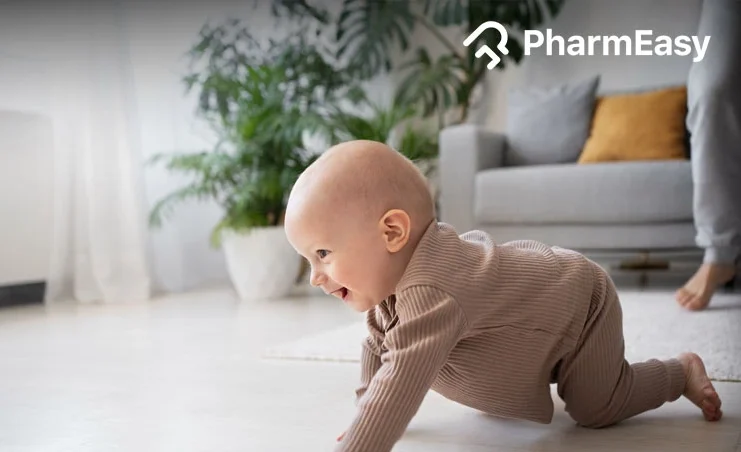
Crawling is an important motor milestone in a baby’s development. It is the stage when babies start crawling on their own using their hands, knees, or sometimes their tummy. Crawling helps in strengthening the muscles, improving balance, and developing coordination between the eyes and hands. It also helps babies understand space and prepares them for future movements like standing and walking3.
According to the World Health Organization (WHO), healthy babies may begin crawling at different ages, and this variation is considered normal. Crawling can start as early as 5 months or as late as 12 months without indicating a developmental problem4. Differences in growth, environment, and opportunities for movement influence baby crawling age, and starting earlier or later is usually normal5.
Babies develop motor skills at their own pace, and the age at which they reach milestones can vary widely. The table below shows typical age ranges for common motor milestones, giving a sense of what many babies do between 5 and 10 months, without implying that any milestone is required by a certain age.
| Motor Milestone | Typical Age Range (months) |
| Sitting without support | 4 – 9 |
| Standing with assistance | 5 – 12 |
| Hands-&-knees crawling | 6 – 12 |
| Walking with assistance | 8 – 14 |
| Standing alone | 9 – 16 |
| Walking alone | 11 – 18 |
Most babies follow a general sequence of motor development. Typically, babies first learn to sit without support, which helps strengthen their back and neck muscles. Around 6 months, many begin hands-and-knees crawling, exploring the world with more freedom. Some babies may pull themselves to stand with support before or after crawling, and others may skip crawling entirely6.
Every baby learns to crawl differently, and there is no single fixed pattern that all babies follow. Most infants use more than one crawling position before learning to walk, and some stages may overlap, appear briefly, or be skipped altogether. This variation is a normal part of development7.
Here are the different baby crawling stages:
Advanced Crawling: Around 8-12 months, different types of crawls are there like bear, crab, bottom scoot, belly, rolling and classic; all these types of crawling are normal8,12.
As babies move through these stages, they gradually develop the strength, coordination, and balance needed to begin crawling independently. Parents can look for specific signs that indicate their baby is ready to start crawling.
When babies start moving around more, you can see some signs that they are ready to crawl.
These signs mean your baby is getting stronger and learning how to move2.
Watching a baby learn to crawl is interesting, and it is exciting to see how they move. Babies can crawl in different ways, and all types are normal. How a baby crawls is not as important as when they start walking because all styles help build strength and coordination. These are some common types of baby crawling:
These types of crawling show how babies try different ways to move, and parents can watch and encourage them to practice crawling safely.
Helping babies learn to crawl can be fun, and there are many ways parents can encourage them to move on their own. These activities also support their muscle development and coordination.
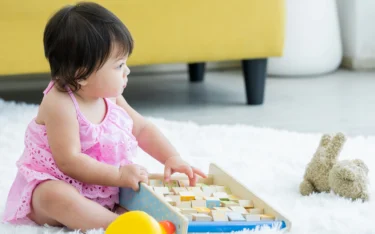
Put toys or objects slightly beyond your baby’s reach. This encourages her to stretch and move forward, which helps her practice crawling.
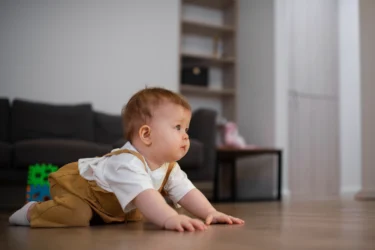
Use pillows, boxes, or sofa cushions to make a mini course. Crawling around these objects helps the baby get stronger and learn to move in different directions.
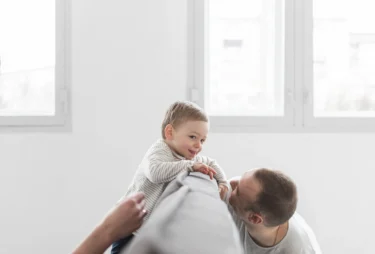
Hide behind a pillow or box and call your baby to come. This makes crawling fun and motivates the baby to move toward you2.
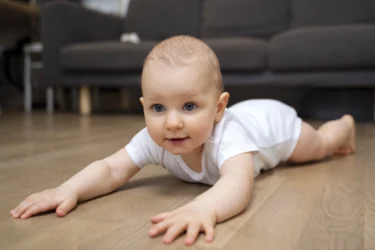
Let your baby spend time on her tummy and on the floor. This helps her build the muscles she needs to crawl and explore safely12. Place a rolled-up towel under your baby’s arms to gently support the upper body while practicing movement13.
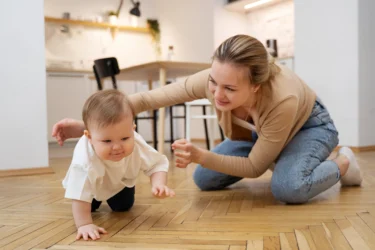
You can get on the floor and show the baby how to move on all four limbs. They will see and want to mimic your actions. If they are in the right position but unable to move, place your hand behind their feet and give a gentle push to help them propel forwards.
These activities help babies build confidence and improve their movement skills. In addition, remember to babyproof the home by removing sharp objects, covering outlets, and keeping small or harmful items out of reach to create a safe crawling space14.
Some babies do not crawl in the usual way, and this can be normal. They may move by scooting on their bottom or sliding on their stomach2. In some cases, babies start walking or moving upright first, and crawling may come later to reach objects or move around10.
Signs parents should watch for:
Even if a baby does not crawl like other children, it is important to watch how she moves and uses both arms and legs. If you notice any of these signs, speak with a paediatrician to make sure your baby is developing safely2.
Crawling is a really important part of a baby’s growth, but it is also different for every child because all babies learn at their own speed. Some babies crawl in the usual way on their hands and knees, while others slide on their tummy, scoot on their bottom, or even start walking first. What really matters is that they are getting stronger, learning to balance, and moving around safely. Parents can help by giving their baby toys to reach for, making little obstacle courses, and letting them spend time on their tummy and floor. If you notice any big delays or unusual movements, it is best to check with a doctor so your baby stays healthy and safe.
Also Read: Breaking Down the Baby’s Growth Stages | 0-5 Years
Crawling at 5 months is early but can be normal. A small number of babies begin crawling around 5 months, while most start between 7 and 10 months6. Babies who crawl early often try many different movements and explore their bodies more, showing good muscle control and coordination3.
Yes, a baby can skip crawling. Some move by scooting, rolling, or slithering instead. What is important is that they use both sides of their body equally and explore. These movements still strengthen muscles for walking2.
Crawling usually starts between 7 and 12 months of age. Some babies may not crawl and move by scooting, which can be normal2. However, in some babies, developmental delay affects the coordination of arms and legs and causes late or unusual crawling17. If this is present along with other signs such as trouble rolling, sitting, or walking, parents should consult a doctor to check for developmental delay16.
Most babies do not crawl at four months. At this age, they are learning to control their hands, move their legs, and explore their body. These actions help build strength and coordination needed for crawling later18.
Small changes in the home can make crawling safer for a baby. Using safety gates on doors and stairs helps prevent falls. Sharp or hard furniture should be removed from play areas. Keeping small objects away avoids choking19. Soft pillows and cushions can make crawling fun, but babies should always be watched during playtime2.
When infant crawl begins, they often show new emotions. They may get angry more easily but also show stronger affection. They play more with their parents, check back with them when unsure, notice things that are far away, and become more aware when their parents leave20.
1. Kretch KS, Dusing SC, Harbourne RT, Hsu L, Sargent B, Willett SL. Early Mobility and Crawling: Beliefs and Practices of Pediatric Physical Therapists in the United States. Pediatric Physical Therapy. 2023 Dec 18. Available from: https://pmc.ncbi.nlm.nih.gov/articles/PMC10873088/
2. American Academy of Pediatrics. Movement: 8 to 12 Months [Internet]. HealthyChildren.org. 2021. Available from: https://www.healthychildren.org/English/ages-stages/baby/Pages/Movement-8-to-12-Months.aspx
3. Yamamoto S, Yonghi L, Matsumura U, Tsurusaki T. Diversity and regularity in infant crawling with typical development. Journal of Physical Therapy Science. 2020;32(8):483–8. Available from: https://pmc.ncbi.nlm.nih.gov/articles/PMC7443550/
4. Percentiles and mean in days and months for six gross motor milestones [Internet]. [cited 2026 Feb 8]. Available from: https://cdn.who.int/media/docs/default-source/child-growth/child-growth-standards/indicators/motor-development-milestones/mm_percentiles_table.pdf?sfvrsn=81f3b60b_5
5. Tupsila R, Siritaratiwat W, Bennett S, Mato L, Keeratisiroj O. Intra-Individual Variability in Gross Motor Development in Healthy Full-Term Infants Aged 0–13 Months and Associated Factors during Child Rearing. Children [Internet]. 2022 May 30 [cited 2022 Aug 11];9(6):801. Available from: https://mdpi-res.com/children/children-09-00801/article_deploy/children-09-00801.pdf?version=1653904852
6. WHO Motor Development Study: Windows of achievement for six gross motor development milestones WHO MULTICENTRE GROWTH REFERENCE STUDY GROUP. Available from: https://cdn.who.int/media/docs/default-source/child-growth/child-growth-standards/indicators/motor-development-milestones/who-motor-development-study-windows-of-achievement-for-six-gross-motor-development-milestones.pdf?sfvrsn=3425c1dc_0
7. Adolph KE, Vereijken B, Denny MA. Learning to crawl. Child Development [Internet]. 1998 Oct 1;69(5):1299–312. Available from: https://pubmed.ncbi.nlm.nih.gov/9839417/
8. Validity of Outcome Measures [Internet]. Nih.gov. Canadian Agency for Drugs and Technologies in Health; 2018. Available from: https://www.ncbi.nlm.nih.gov/books/NBK533982/
9. Ruffin N. Understanding Growth and Development Patterns of Infants. Publication 350‑055. Virginia Cooperative Extension, Virginia Tech; 2019. Available from: https://vtechworks.lib.vt.edu/server/api/core/bitstreams/d2873fcd-c25a-43b5-bb21-0e55c48d4021/content
10. Kretch KS, Willett SL, Hsu LY, Sargent BA, Harbourne RT, Dusing SC. “Learn the Signs. Act Early.”: Updates and Implications for Physical Therapists. Pediatric Physical Therapy [Internet]. 2022;34(4):10.1097/PEP.0000000000000937. Available from: https://journals.lww.com/pedpt/Fulltext/9900/_Learn_the_Signs__Act_Early____Updates_and.20.aspx
11. Adolph KE, Berger SE, Leo AJ. Developmental continuity? Crawling, cruising, and walking. Developmental Science. 2011 Feb 18;14(2):306–18.Available from:https://pmc.ncbi.nlm.nih.gov/articles/PMC3050596/
12. Crawling Styles [Internet]. HealthyChildren.org. Available from: https://www.healthychildren.org/English/ages-stages/baby/Pages/Crawling-Styles.aspx
13. National Institutes of Health. Benefits of Tummy Time | Safe to Sleep® [Internet]. https://safetosleep.nichd.nih.gov/. 2024. Available from: https://safetosleep.nichd.nih.gov/reduce-risk/tummy-time
14. Childproofing Your Home – Several Safety Devices to Help Protect Your Children from Home Hazards [Internet]. U.S. Consumer Product Safety Commission. 2023. Available from: https://www.cpsc.gov/safety-education/safety-guides/kids-and-babies/Childproofing-Your-Home
15. Developmental delay guidance [Internet]. 2019. Available from: https://cambspborochildrenshealth.nhs.uk/services/cambridgeshire-childrens-physiotherapy-service/developmental-delay-guidance/
16. Healthy Children. Is Your Baby’s Physical Development on Track? [Internet]. HealthyChildren.org. 2019. Available from: https://www.healthychildren.org/English/ages-stages/baby/Pages/Is-Your-Babys-Physical-Development-on-Track.aspx
17. Zhang L, Deng CF, Liu Y, Chen L, Xiao N, Zhai SJ, et al. Impacts of Motor Developmental Delay on the Inter-Joint Coordination Using Kinematic Synergies of Joint Angles During Infant Crawling. IEEE Transactions on Neural Systems and Rehabilitation Engineering. 2022 Jan 1;30:1664–74.Available from: https://pubmed.ncbi.nlm.nih.gov/35675252/
18. American Academy of Pediatrics. Movement Milestones: Babies 4 to 7 Months [Internet]. HealthyChildren.org. 2021. Available from: https://www.healthychildren.org/English/ages-stages/baby/Pages/Movement-4-to-7-Months.aspx
19. Safety for Your Child: 6 to 12 Months [Internet]. HealthyChildren.org. 2018. Available from: https://www.healthychildren.org/English/ages-stages/baby/Pages/Safety-for-Your-Child-6-to-12-Months.aspx
20. Whitney PG, Green JA. Changes in infants’ affect related to the onset of independent locomotion. Infant Behavior and Development. 2011 Jun;34(3):459–66.Available from: https://www.sciencedirect.com/science/article/abs/pii/S0163638311000518?utm_source=chatgpt.com
Disclaimer: The information provided here is for educational/awareness purposes only and is not intended to be a substitute for medical treatment by a healthcare professional and should not be relied upon to diagnose or treat any medical condition. The reader should consult a registered medical practitioner to determine the appropriateness of the information and before consuming any medication. PharmEasy does not provide any guarantee or warranty (express or implied) regarding the accuracy, adequacy, completeness, legality, reliability or usefulness of the information; and disclaims any liability arising thereof.
Links and product recommendations in the information provided here are advertisements of third-party products available on the website. PharmEasy does not make any representation on the accuracy or suitability of such products/services. Advertisements do not influence the editorial decisions or content. The information in this blog is subject to change without notice. The authors and administrators reserve the right to modify, add, or remove content without notification. It is your responsibility to review this disclaimer regularly for any changes.


Comments

Leave your comment...
You may also like
























Comments