




8 Unusual Benefits of Eating Ripe Tomatoes Daily
By Dr. Malavika Athavale +2 more

Medically reviewed by Dr. Malavika Athavale
Last updated: Sep 11, 2026 Published on: Mar 15, 2022


Get,

to manage your symptom
Get your,

4 Cr+ families
benefitted

OTP sent to 9988776655



You’ve successfully subscribed to receive
doctor-approved tips on
Whatsapp

Get ready to feel your best.


Register to Avail the Offer
Send OTPBy continuing, you agree with our Privacy Policy and Terms and Conditions
Hi There,
Sign up on PharmEasy now!!


Trusted by 4 crore+ families

OTP sent to 9988776655
You have unlocked 25% off on medicines


Code: NU25

By Dr. Malavika Athavale +2 more
Table of Contents
Is it a fruit or a vegetable? This question has always been debatable for tomatoes, especially when it comes to Indian cuisine. The reason being, tomatoes are used in almost every preparation, irrespective of any cuisine or course. No dish is complete without juicy, plump tomatoes. Scientifically known as ”Solanum Lycopersicum L.” tomatoes are commonly known as ”tamatar” in India1.
Tomatoes were native to Southern and Central America, but now India is their largest producer. Tomatoes are used for various purposes in salads, juices, vegetable curries or soups, etc. Tomatoes are naturally rich in several vitamins and minerals. Daily intake of tomatoes can provide a great lift to wellbeing, along with improving the flavor of food1.
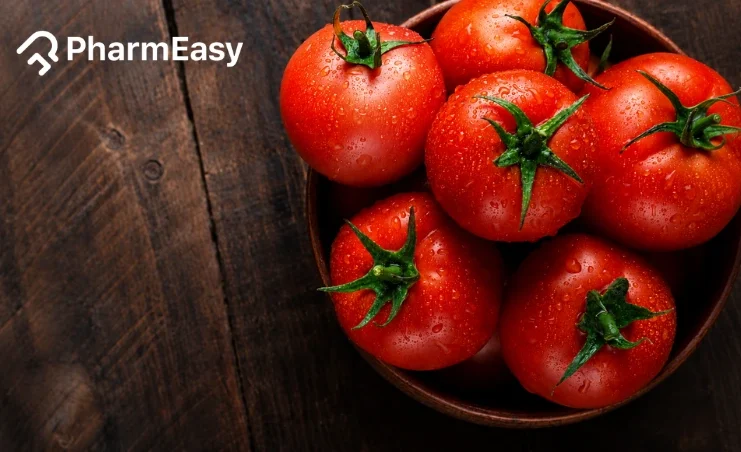
In this blog, we will discuss their nutrient content and the health benefits they are packed with!
Every bite of ripe tomatoes would provide an ample amount of nutrients without adding many calories to your diet. As per USDA, 100 Gms of ripe tomatoes provide2:
Did you know?
There are many benefits that plump tomatoes hold, but few of them are not discussed often let’s cover those benefits today in the article.
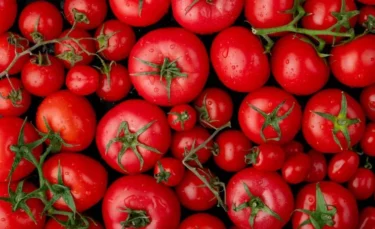
A single tomato gives an extraordinary amount of everyday vitamin C. Vitamin C is a natural antioxidant that may protect you from free radicals affecting the body’s systems. It additionally includes vitamin A, iron, and potassium. Potassium can play a crucial function in keeping nerves healthy, and iron is important for keeping ordinary blood circulation. Vitamin K can also be abundantly found in tomatoes, which is important for blood clotting1,3.

Tomatoes, when applied to the skin in the form of juice, keep the skin hydrated and may also help deal with sunburns. And daily consumption can also keep the skin healthy and glowing. This function is attributed to the presence of innumerable vitamins and minerals present in tomato3.

A recent study4 published indicates that daily consumption of tomatoes can help reduce the oxidative stress of type-2 diabetes. They are also known to reduce inflammation, tissue damage, etc., which are all complications of type-2 diabetes. A direct correlation has been shown in the animal study, but more human studies are needed to confirm this benefit.

No, tomatoes are not the latest way to quit smoking. However, tomatoes can reduce the damage caused by smoking to your body. Tomatoes contain coumaric acid and chlorogenic acid, which can protect the human body from carcinogens caused by cigarette smoke3,5.

Lycopene is the main constituent in tomatoes that can support the health of your heart. It works well with the other antioxidants present in tomatoes, like Vitamin C, Vitamin A, and Vitamin E, to provide compounding benefits. A few studies are being conducted on lycopene and its beneficial effect in reducing bad cholesterol, i.e. LDL cholesterol, and arterial plaque. Also, tomatoes are a rich source of potassium, which can reduce high blood pressure, thus providing complete protection to your heart1,3.
In my experience, I have observed that consuming lycopene-rich foods like tomatoes and tomato-based products can have significant health benefits. Studies have shown that your body can absorb around 23-24% of ingested lycopene, which then circulates and accumulates in your blood plasma, liver, and other tissues9.
Dr Rajeev Singh, BAMS

Tomatoes are rich in lycopene, which is known to bring down blood pressure to its normal level. Lycopene is also known to improve the functioning of blood vessels in general, which can help reduce blood pressure. Tomatoes are also rich in potassium, a mineral that aids in reducing high blood pressure. In fact, it is a fact the more potassium you consume, the more sodium you lose through urine. Apart from this, potassium eases the tension in the walls of your blood vessels, further aiding in the reduction of blood pressure3,6.

As per a study conducted in China, tomato juice was found to help reduce body weight, fat and waist circumference. Apart from being a great source of antioxidants, tomatoes are also rich in fibre and are low in calories7. Hence, they promote satiety and even reduce calorie intake, thereby supporting weight loss.
Over 90% of a tomato is water, making it a refreshing and thirst-quenching treat. But that’s not all! These juicy fruits also pack a punch of natural sugars in the form of glucose and fructose, giving you a quick burst of energy. So next time you bite into a tomato, remember, you’re fueling up with a delicious and low-calorie source of hydration and vitality9!
Dr. Siddharth Gupta, B.A.M.S, M.D (Ayu)

The lycopene in tomatoes is a powerful antioxidant and can help control the growth of cancer cells, especially prostate cancer, stomach cancer, and colon cancer. However, this seems to be a promising benefit, further large-scale human studies are needed in this regard3.
Remember, while tomatoes might have several health benefits, they cannot be a substitute for any medical treatment that you may be taking or requiring for your health issues.
Did you know that more than 80% of the tomatoes grown for commercial purposes are actually used in processed forms? These delicious fruits are commonly transformed into products like tomato juice, soup, and ketchup, which are widely enjoyed around the world9.
Dr Smita Barode, B.A.M.S, M.S.
You will mainly find two types of tomatoes in the Indian market: green and red varieties. The acidity varies with growth conditions and maturity at harvest. Some tomatoes have very few seeds, such as plums, while others have a lot of seeds.
In addition to fresh tomatoes, you can also find canned, diced, chopped, or pureed tomato chunks, which usually have other ingredients, such as added sodium. This can be detrimental to your health and should be avoided as much as possible8.
If tomatoes are not entirely ripened, you can store them at room temperature. Once ripe, you can keep them in the refrigerator for up to three days. Beyond that, you can preserve them by freezing or canning. But the best option would be to consume fresh tomatoes as they are the richest in potassium and can have the best blood pressure-lowering effects.
Tomatoes can be used in a variety of dishes, so try incorporating them as much as you can in your daily diet. Have them in the form of juice every morning or include as dinner soup or as salad. Or, plain, cut them into dice or slice them and enjoy them raw. You may also find small tomatoes commonly known as cherry tomatoes; consume those with pasta or cook them with olive oil and relish the juiciness of these fleshy tomatoes.
Some individuals may have gastric side effects like acidity or bloating with excessive consumption of tomatoes, hence moderation in consumption is key.
Also Read: Are Grits Healthy? Here’s What You Should Know Before Adding Them to Your Diet
Tomatoes make a huge part of Indian cuisines, be it salads, soups or curries, there are several ways these can be included in your routine diet. They do not just add flavour to your dishes but also play an important role in your health. They are a rich source of nutrients and can be great for skin and overall health. But like with any ingredient, moderation in consumption is key to reaping the maximum benefits.
1. Ali MY, Sina AAI, Khandker SS, et al. Nutritional Composition and Bioactive Compounds in Tomatoes and Their Impact on Human Health and Disease: A Review. Foods. 2020;10(1):45. doi:10.3390/foods10010045. https://pubmed.ncbi.nlm.nih.gov/33375293/
2. Tomatoes, red, ripe, raw, year-round average – Nutrients – SR Legacy | USDA FoodData Central. Accessed July 13, 2026. https://fdc.nal.usda.gov/food-details/170457/nutrients
3. Collins EJ, Bowyer C, Tsouza A, Chopra M. Tomatoes: An Extensive Review of the Associated Health Impacts of Tomatoes and Factors That Can Affect Their Cultivation. Biology. 2022;11(2):239. doi:10.3390/biology11020239. https://www.mdpi.com/2079-7737/11/2/239
4. Banihani SA. Tomato (Solanum lycopersicum L.) and type 2 diabetes. International Journal of Food Properties. 2018 Jan 1;21(1):99-105. https://pdfs.semanticscholar.org/e6be/3a25595c9327b1f1e0a3047715c4f4c792d9.pdf?skipShowableCheck=true
5. Diet Rich in Apples and Tomatoes May Help Repair Lungs of Ex-Smokers, Study Suggests | Johns Hopkins | Bloomberg School of Public Health. December 21, 2017. Accessed July 13, 2026. https://publichealth.jhu.edu/2017/diet-rich-in-apples-and-tomatoes-may-help-repair-lungs-of-ex-smokers-study-suggests
6. Hsieh MJ, Huang CY, Kiefer R, Lee SD, Maurya N, Velmurugan BK. Cardiovascular Disease and Possible Ways in Which Lycopene Acts as an Efficient Cardio-Protectant against Different Cardiovascular Risk Factors. Molecules. 2022;27(10):3235. doi:10.3390/molecules27103235. https://pubmed.ncbi.nlm.nih.gov/35630709/
7. Chen CY, Chien YW. Fresh Tomato (Lycopersicon esculentum Mill.) in the Diet Improves the Features of the Metabolic Syndrome: A Randomised Study in Postmenopausal Women. Biology. 2024;13(8):588. doi:10.3390/biology13080588. https://pubmed.ncbi.nlm.nih.gov/39194526/
8. Wu X, Yu L, Pehrsson PR. Are Processed Tomato Products as Nutritious as Fresh Tomatoes? Scoping Review on the Effects of Industrial Processing on Nutrients and Bioactive Compounds in Tomatoes. Adv Nutr. 2021;13(1):138-151. doi:10.1093/advances/nmab109. https://www.sciencedirect.com/science/article/pii/S2161831322005336
9. Collins EJ, Bowyer C, Tsouza A, Chopra M. Tomatoes: An Extensive Review of the Associated Health Impacts of Tomatoes and Factors That Can Affect Their Cultivation. Biology (Basel). 2022 Feb 4;11(2):239. doi: 10.3390/biology11020239. PMID: 35205105; PMCID: PMC8869745. Available from: https://pmc.ncbi.nlm.nih.gov/articles/PMC8869745/
Disclaimer: The information provided here is for educational/awareness purposes only and is not intended to be a substitute for medical treatment by a healthcare professional and should not be relied upon to diagnose or treat any medical condition. The reader should consult a registered medical practitioner to determine the appropriateness of the information and before consuming any medication. PharmEasy does not provide any guarantee or warranty (express or implied) regarding the accuracy, adequacy, completeness, legality, reliability or usefulness of the information; and disclaims any liability arising thereof.
Links and product recommendations in the information provided here are advertisements of third-party products available on the website. PharmEasy does not make any representation on the accuracy or suitability of such products/services. Advertisements do not influence the editorial decisions or content. The information in this blog is subject to change without notice. The authors and administrators reserve the right to modify, add, or remove content without notification. It is your responsibility to review this disclaimer regularly for any changes.
 99
99  3
3Comments

Leave your comment...
You may also like





















Comments