
Breast cancer is considered one of the most common cancers affecting women worldwide, though it can also be seen in men. The number of breast cancer cases is increasing globally, coinciding with the ageing population, lifestyle factors, genetics and improved detection methods. While breast cancer cannot be prevented completely, adopting certain lifestyle choices and healthy habits can help in reducing the risk of occurrence. An awareness regarding the importance of regular screening can help in early detection even before the presence of certain symptoms and initiate appropriate management.
In this blog, we will discuss what breast cancer is, the causes of breast cancer and how it develops, its risk factors, how to reduce the modifiable risk factors and the role of regular breast cancer screening.
A breast is made up of three main parts, which include lobules producing the milk; ducts, carrying the milk; and connective tissue, which holds these structures together. Breast cancer is the abnormal growth and multiplication of any of these cells1. Breast cancer usually develops as a result of some changes in the genetic material (genetic mutations). This can be either passed from their parents (inherited) or as a random event of mutations in their lifetime. Though these changes do not result in cancer in the first place, multiple such mutations can eventually result in cancer2.
Breast cancer can develop both in men and women, although women are most commonly affected. Breast cancer in its early stages is not considered potentially fatal. However, if it is not addressed, it can spread to the adjacent lymph nodes or other organs3.
Breast cancer develops as a result of some mutations in the cells, which can be either passed from the parents (inherited) or occur as a random event in one’s lifetime. Thus, breast cancer prevention overall might be difficult. However, its occurrence is linked to certain risk factors, some of which can be modified by adopting a healthy lifestyle or other measures. Reducing thesemodifiable risk factors can help lower the chances of developing breast cancer and the complications associated with it.
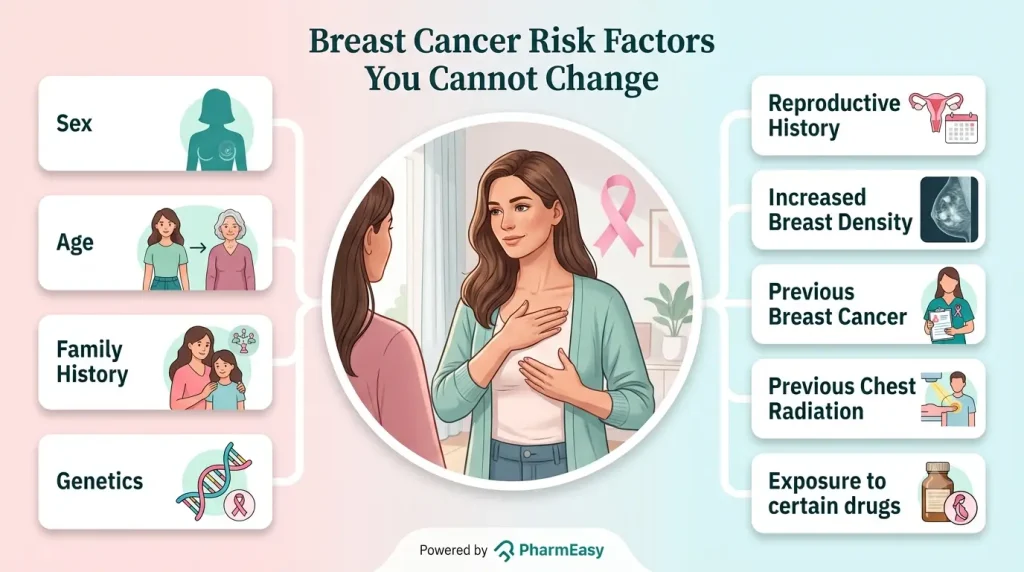
Any factor that can increase the chances of occurrence of cancer are called risk factors. These two fall into two categories: factors you cannot change, such as age, sex and genetics, and factors you may be able to modify through lifestyle and other choices. Both are covered in detail below4
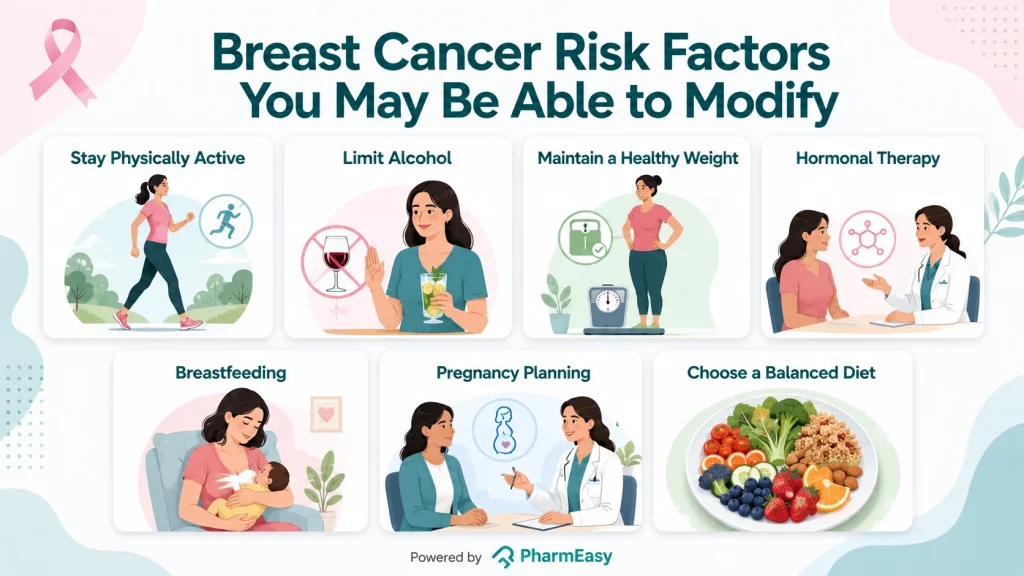
Beyond the modifiable lifestyle factors above, two further options exist for people at higher-than-average-risk.These include9:
Hormone therapies can have both benefits and side effects. These risk-reducing medicines are usually recommended for women in the high-risk category. Please talk to your healthcare professional for an appropriate decision based on your individualised factors.
Regular screening and early diagnosis can help in initiating the management strategies as soon as possible. Though it cannot prevent the occurrence of cancer, some of the early changes in cancer can be detected by regular screening, even before the appearance of symptoms. Early detection helps initiate treatment earlier, improving the outcomes and reducing the chances of complications or deaths by the cancer10.
There are some specific tests can be used for breast cancer screening. Assessment of risk factors is also included as part of screening to understand the overall risk. Your doctor can decide which screening tests are best for you based on your risk factors and health concerns. These can be:
Every cancer screening method possesses benefits and drawbacks. Weighing these factors can help in finding the appropriate tests for you, and your healthcare provider can decide the best one for you.
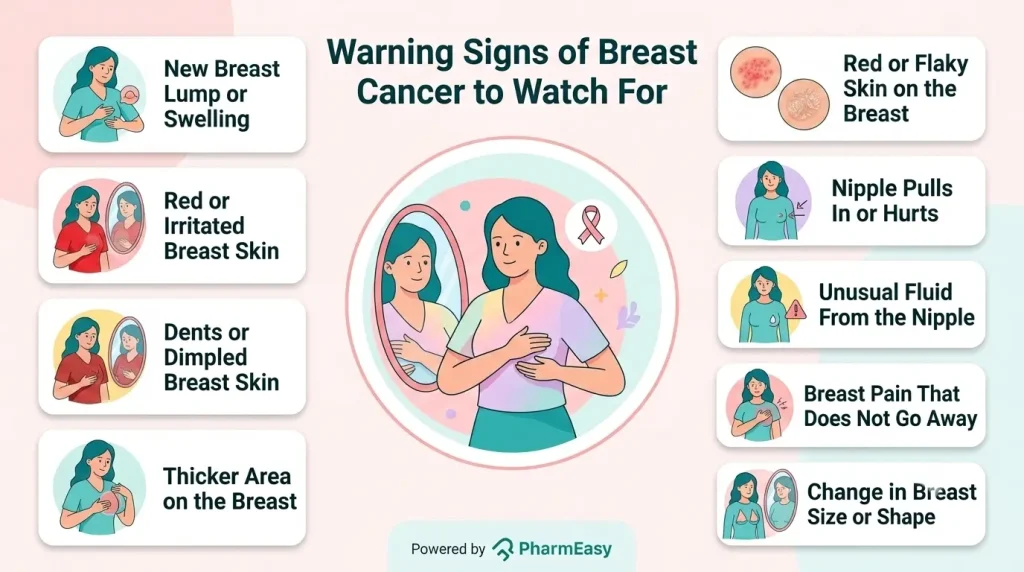
The appearance of breasts can be different in different people. Changes in breasts can be determined by factors such as age, menstruation, taking certain medicines and body weight. However, having a basic understanding of warning signs of breast cancer can help in diagnosing the condition earlier and taking the appropriate management strategies14:
Breast cancer symptoms can be different in different people. It can vary from no symptoms to a few breast cancer symptoms. In some, signs can coincide with other conditions that are not cancers. Proper testing at regular intervals can be beneficial in such cases. If any signs occur, please talk to your doctor and take appropriate measures.
Also Read: Breast Cancer: What It Is, Types, Early Signs, Treatment & Prevention
Though not all symptoms reflect breast cancer, noticing any unusual signs and discuss with your doctor can help in avoiding unnecessary anxiety. Understanding when to consult your doctor can help in timely diagnosis and treatment. Consult your doctor15:
Breast cancer is considered one of the most common cancers affecting women. Although breast cancer cannot be completely prevented, a proper understanding of risk factors for breast cancer can help in following healthy choices and thereby reduce the chances of occurrence. Regular participation in screening programmes can also be helpful in early detection and prompt management of the condition.
Yes, regular physical exercise is linked to reduce the risk of breast cancer in women compared to women who do not7. However, a complete prevention of breast cancer might not be possible, as it is also associated with other risk factors.
Diets rich in vitamin D, folate and fibre and low in saturated fat, grilled meat and alcohol might be beneficial in reducing the risk of breast cancer. However, more evidence is needed to find the association between diets and incidence of breast cancer8.
Breast cancer screening should begin at 40 years of age for average risk women as suggested by the U.S. Preventive Services Task Force16. Your gynaecologist can guide you best about the right age to start, the frequency and the screening test required for you based on your risk.
Yes. Approximately 1 in every 4 cancer cases are related to a positive family history of cancer. Women who have a mother or sister affected by breast cancer are more prone to develop it. If the number of affected first-degree relatives becomes two or more in number, it can increase the chance of occurrence by 2.5 times5.
Yes. Though women are more prone to get affected with breast cancer, it can also occur in men. If the incidence of breast cancer in women is 99%, then in men it is 0.5-1%3.
No. Breastfeeding cannot pass cancer from mother to baby. In fact, breastfeeding for at least a few months after delivery can help reduce the risk of breast cancer occurrence9.
1. CDC. Breast Cancer Basics. Breast Cancer. April 16, 2026. Accessed August 12, 2026. Available from: https://www.cdc.gov/breast-cancer/about/index.html
2. Breast Cancer Prevention (PDQ®) – NCI. February 10, 2026. Accessed August 12, 2026. Available from: https://www.cancer.gov/types/breast/hp/breast-prevention-pdq
3. Breast cancer. Accessed August 12, 2026. Available from: https://www.who.int/news-room/fact-sheets/detail/breast-cancer
4. Causes and Risk Factors | Breast Cancer – NCI. December 2, 2025. Accessed August 12, 2026. Available from: https://www.cancer.gov/types/breast/causes-risk-factors
5. Sun YS, Zhao Z, Yang ZN, et al. Risk Factors and Preventions of Breast Cancer. Int J Biol Sci. 2017;13(11):1387-1397. doi:10.7150/ijbs.21635 Available from: https://pmc.ncbi.nlm.nih.gov/articles/PMC5715522/
6. CDC. Breast Cancer Risk Factors. Breast Cancer. April 15, 2026. Accessed August 14, 2026. Available from: https://www.cdc.gov/breast-cancer/risk-factors/index.html
7. Physical Activity and Cancer Fact Sheet – NCI. February 18, 2020. Accessed August 12, 2026. Available from: https://www.cancer.gov/about-cancer/causes-prevention/risk/obesity/physical-activity-fact-sheet
8. Kotepui M. Diet and risk of breast cancer. Contemp Oncol. 2016;20(1):13-19. doi:10.5114/wo.2014.40560 Available from: https://pubmed.ncbi.nlm.nih.gov/27095934/
9. Breast Cancer Prevention – NCI. August 6, 2025. Accessed August 12, 2026. Available from: https://www.cancer.gov/types/breast/causes-risk-factors/prevention
10. Cancer Screening Overview – NCI. January 13, 2010. Accessed August 12, 2026. Available from: https://www.cancer.gov/about-cancer/screening/patient-screening-overview-pdq
11. Screening for Breast Cancer – NCI. August 6, 2025. Accessed August 12, 2026. Available from: https://www.cancer.gov/types/breast/screening
12. CDC. About Mammograms. Breast Cancer. September 11, 2024. Accessed August 12, 2026. Available from: https://www.cdc.gov/breast-cancer/about/mammograms.html
13. Lynch J, Venne V, Berse B. Genetic tests to identify risk for breast cancer. Semin Oncol Nurs. 2015;31(2):100-107. doi:10.1016/j.soncn.2015.02.007 Available from: https://pubmed.ncbi.nlm.nih.gov/25951739/
14. CDC. Symptoms of Breast Cancer. Breast Cancer. April 15, 2026. Accessed August 12, 2026. Available from: https://www.cdc.gov/breast-cancer/symptoms/index.html
15. Breast cancer: MedlinePlus Medical Encyclopedia. Accessed August 12, 2026. Available from: https://medlineplus.gov/ency/article/000913.htm
16. CDC. Screening for Breast Cancer. Breast Cancer. February 6, 2025. Accessed August 12, 2026. Available from: https://www.cdc.gov/breast-cancer/screening/index.html
Disclaimer: The information provided here is for educational/awareness purposes only and is not intended to be a substitute for medical treatment by a healthcare professional and should not be relied upon to diagnose or treat any medical condition. The reader should consult a registered medical practitioner to determine the appropriateness of the information and before consuming any medication. PharmEasy does not provide any guarantee or warranty (express or implied) regarding the accuracy, adequacy, completeness, legality, reliability or usefulness of the information; and disclaims any liability arising thereof.
Links and product recommendations in the information provided here are advertisements of third-party products available on the website. PharmEasy does not make any representation on the accuracy or suitability of such products/services. Advertisements do not influence the editorial decisions or content. The information in this blog is subject to change without notice. The authors and administrators reserve the right to modify, add, or remove content without notification. It is your responsibility to review this disclaimer regularly for any changes.


