




Best Aerobic Exercise for Weight Loss
By Dr. Himani Bisht +2 more

Medically reviewed by Dr. Himani Bisht
Last updated: Sep 10, 2026 Published on: Jan 22, 2026


Get,

to manage your symptom
Get your,

4 Cr+ families
benefitted

OTP sent to 9988776655



You’ve successfully subscribed to receive
doctor-approved tips on
Whatsapp

Get ready to feel your best.


Register to Avail the Offer
Send OTPBy continuing, you agree with our Privacy Policy and Terms and Conditions
Hi There,
Sign up on PharmEasy now!!


Trusted by 4 crore+ families

OTP sent to 9988776655
You have unlocked 25% off on medicines


Code: NU25

By Dr. Himani Bisht +2 more
Table of Contents
Obesity has become a major public health challenge in India that extends far beyond cosmetic concerns1. To address this growing burden, we must adopt evidence-based strategies. One such effective approach is to focus on weight reduction.
A sustainable way to achieve this is through aerobic exercise2. Aerobic activities are particularly effective for long-term fat loss as they help burn calories and stored body fat while also improving overall metabolic health2,3. Through this blog, we aim to highlight some of the best aerobic exercises for weight loss, common mistakes people make, and essential safety tips to follow for effective and safe results.


Answer a few quick questions to check eligibility.
Your response has been submitted.
Our team will contact you shortly.
Aerobic exercise refers to physical activity that involves large muscle groups (like legs, arms, etc.), is rhythmic in nature, and can be performed continuously for a sustained period. Some common examples include walking, jogging, cycling, swimming, dancing, hiking, and long-distance running4.
Aerobic exercise helps in weight reduction by increasing your body’s energy expenditure. When you perform any type of aerobic workout for weight loss, your body relies on aerobic metabolism. This means that the body uses oxygen to produce energy in the form of adenosine triphosphate (ATP) from carbohydrates, fats, and amino acids. This process raises the number of calories your body burns and eventually helps in weight reduction4.
Note: It is important to understand that for weight loss, a combination of regular aerobic exercise with controlled calorie intake is needed to create a calorie deficit that shows results. For overall health, adults are advised to engage in at least 150 minutes of moderate-intensity aerobic activity per week5. However, individual needs may vary depending on weight goals and overall health status.
Aerobic exercises for weight loss include a wide range of activities that engage large muscle groups and increase energy expenditure. The following section highlights common types of aerobic workouts for weight loss that can be easily incorporated into daily routines for effective weight management.

This is one of the simplest, most accessible, and cost-free aerobic exercises for weight loss and overall health. It helps burn excess calories, improves cardiovascular fitness, and builds stamina6.
How to Do:

This is an effective aerobic exercise that supports weight management efforts. Regular cycling can help achieve significant reductions in body mass index (BMI) and body fat percentage, along with marked improvements in physical fitness parameters such as muscular endurance, strength, and flexibility7.
How to Do:

This is a full-body aerobic exercise that is especially effective for weight loss and metabolic health. It has been seen that regular swimming can significantly contribute towards a reduction in body fat percentage, along with notable improvements in flexibility and cardiovascular endurance8.
How to Do:

This is an enjoyable and effective form of aerobic exercise that supports weight loss and improvements in body composition. Regular dance activity can help people with significant reductions in BMI, waist circumference, and overall fat mass compared with a normal lifestyle9.
How to Do:

Jogging and running are high-calorie-burning aerobic exercises that can significantly aid in fat loss. They help increase metabolic rate and are effective for reducing body fat when performed regularly10.
How to Do:
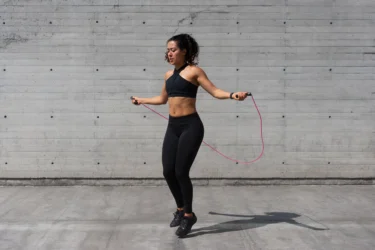
Skipping (rope jumping) is a high-intensity aerobic exercise that is highly effective for weight loss and cardiometabolic health, especially when combined with dietary control. When practised regularly, skipping may lead to significant reductions in body weight, body mass index, body fat percentage, and fat mass11.
How to Do:
Despite regular aerobics for weight loss, many individuals may experience slower-than-expected weight loss due to common and often overlooked mistakes. So, understanding these pitfalls is essential to maximise the effectiveness of aerobic activity and achieve sustainable weight-management outcomes3:
Exercise by itself typically leads to only modest short-term weight loss unless combined with calorie restriction or dietary modification (swapping unhealthy options with healthy ones).
People often increase their food intake in response to exercise, which can offset calorie deficits created by physical activity.
Not gradually progressing activity duration/intensity or failing to meet recommended levels of weekly moderate-intensity activity may reduce the effectiveness of aerobic training.
Focusing solely on aerobic workouts can lead to loss of lean body mass, which may lower metabolic rate and slow down weight loss over time.
Note: Very brief or irregular sessions of aerobic exercise may help improve fitness, but they are generally insufficient for significant, long-term weight loss unless they are performed consistently and combined with appropriate dietary changes.
Also Read: Top 5 Leg Exercises to Improve Blood Circulation
Aerobic exercise offers many benefits but performing it safely is key to maintaining consistency and avoiding injuries. Thus, by taking simple precautions like the ones mentioned below, you can protect your joints, muscles, and overall well-being while you stay active12:
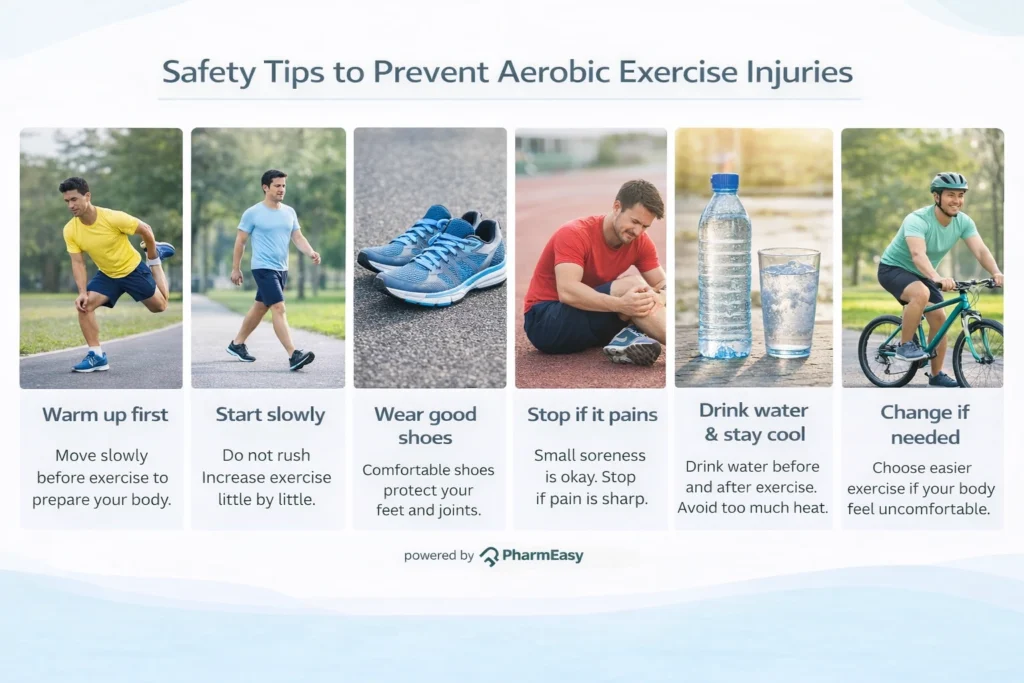
Begin with a few minutes of gentle movement (like slow walking or light stretching) to prepare your muscles and increase blood flow before increasing intensity.
If you are new to aerobic activity, build up your duration and intensity slowly rather than pushing too hard too soon.
Choose comfortable shoes that provide adequate support and cushioning to reduce stress on your feet and joints.
Mild muscle soreness is normal, but sharp or persistent pain may be a sign of injury. In such cases, stop the activity and consult a professional if needed.
Drink water before, during, and after exercise, and avoid intense activity in extreme heat to prevent dehydration or heat-related issues.
Adjust the pace or type of exercise (e.g., switching to water-based activities) if you experience joint discomfort or other limitations.
Also Read: A Complete Guide on Insulin Resistance Diet for Weight Loss
Aerobic exercise plays a vital role in effective and sustainable weight reduction by increasing energy expenditure and enhancing overall metabolic health. Activities such as walking, cycling, swimming, dancing, jogging, and skipping offer flexible and accessible options that can be tailored to individual fitness levels, preferences, and health conditions. Aerobic exercise not only supports fat loss but also improves long-term health outcomes when performed regularly and combined with healthy dietary practices. So, adopting the right type of aerobic activity, avoiding common mistakes, and following safety guidelines can greatly help individuals achieve lasting weight management and overall well-being.
Aerobic exercise may lead to overuse injuries, such as joint pain, if done excessively or without proper technique12. And if not paired with appropriate dietary control, weight loss can also be limited with aerobics alone3.
If you are considering only aerobic exercise for a flat stomach, do not expect dramatic results. Aerobic exercise does help reduce overall body fat, including abdominal fat, by creating a calorie deficit2. However, spot reduction (like losing only belly fat) is not possible, so belly fat decreases gradually as total body fat reduces with regular aerobic exercise and a healthy diet.
For improvements in weight reduction efforts, most adults should aim for 150 to 300 minutes of moderate-intensity aerobic exercise per week or 75 to 150 minutes of vigorous activity13. This should, however, be dependent on individual fitness levels and goals.
Visible changes in weight and body composition from any exercise routine typically appear after 4 to 8 weeks14. However, all of this depends on exercise consistency, intensity, and dietary habits.
Disclaimer: The information provided here is for educational/awareness purposes only and is not intended to be a substitute for medical treatment by a healthcare professional and should not be relied upon to diagnose or treat any medical condition. The reader should consult a registered medical practitioner to determine the appropriateness of the information and before consuming any medication. PharmEasy does not provide any guarantee or warranty (express or implied) regarding the accuracy, adequacy, completeness, legality, reliability or usefulness of the information; and disclaims any liability arising thereof.
Links and product recommendations in the information provided here are advertisements of third-party products available on the website. PharmEasy does not make any representation on the accuracy or suitability of such products/services. Advertisements do not influence the editorial decisions or content. The information in this blog is subject to change without notice. The authors and administrators reserve the right to modify, add, or remove


Comments

Leave your comment...
You may also like






















Comments