




What Is The Link Between Diet And Mental Illness?
By Dr. Malavika Athavale +2 more

Medically reviewed by Dr. Nikita Toshi
Last updated: Dec 19, 2025 Published on: Dec 20, 2021


Get,

to manage your symptom
Get your,

4 Cr+ families
benefitted

OTP sent to 9988776655



You’ve successfully subscribed to receive
doctor-approved tips on
Whatsapp

Get ready to feel your best.


Register to Avail the Offer
Send OTPBy continuing, you agree with our Privacy Policy and Terms and Conditions
Hi There,
Sign up on PharmEasy now!!


Trusted by 4 crore+ families

OTP sent to 9988776655
You have unlocked 25% off on medicines


Code: NU25

By Dr. Malavika Athavale +2 more
Table of Contents
The food we eat certainly plays a major role in our physical health and overall wellbeing. But did you know that it can also affect our mental state and mood?
The interaction between food and mental wellbeing can be as simple as quick relief from hunger leading to a better mood. Or as complex as the gut bacteria affecting the chemicals that our brain produces which has a deeper effect on our psychological state1. Thus, this relationship is actually an intricate one which cannot be summarised easily. However, with this blog, we will try to explain you the broader connection between diet and mental health that will empower you to make the right food choices for your brain.
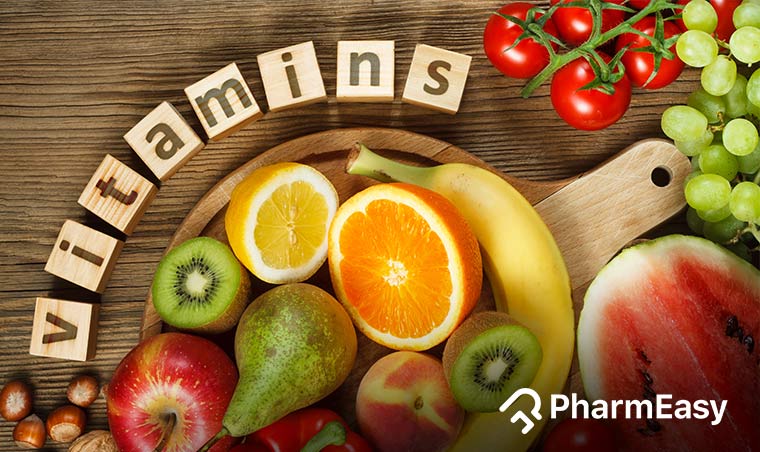
Let us find out the many ways in which diet and mental health are closely intertwined. Keep in mind that this relationship is not easy to study or make unquestionable claims about. But scientists have been studying this link for some time now, so we have some general ideas.
You may know that our food is not only digested by the enzymes our stomach secretes but it is also aided very much by the healthy bacteria in our stomachs. These bacteria are essential for normal digestion. The first way these little organisms help our mood is by allowing us to have smooth digestion. Without good bacteria we may experience indigestion or other digestive issues. These can cause us anxiety and stress issues1.
The microorganisms across our body are collectively known as the microbiome, and each person’s microbiome is unique to them1. The gut bacteria play and important role in the production of neuro-chemicals like serotonin, dopamine, GABA, norepinephrine, and others2. While serotonin is mainly involved with mood regulation, other neurotransmitters are essential for mental functions like focus, feeling motivated, feelings of reward and anxiety3. What your eat influences your gut microbiota and thus the secretion of these neurotransmitters, which can affect your mental and emotional state.
Foods rich in in omega-3 fats such as fish, fermented foods and probiotics, high fibre foods like whole fruits and vegetables, and tryptophan-rich foods (amino-acid which is converted to serotonin) like eggs, tofu and cheese are all good for the gut microbiome, which in turn helps stabilize our mental state4.
On the other hand, excessive, irrational use of antibiotics or medications that destroy this microbiome by killing off the bacteria in our gut can also lead to poor mental health5. It has been noted that people with irritable bowel syndrome (consequently their microbiome is out of balance) are likely to also have disorders such a depression4.
According to a recent study14 conducted on people above the age of 50, higher anxiety levels were believed to be linked to diets rich in saturated fat and sweets. In my opinion, one should restrict sugar intake and indulge in some physical activity to keep mental illness at bay.
Dr. Siddharth Gupta, B.A.M.S, M.D (Ayu)
Moreover, eating regular balanced meals contributes by supporting blood sugar levels. Low blood sugar levels can cause irritability, fatigue and mood swings.
Some foods such as coffee and chocolate are well-known mood stimulants. Caffeine in coffee is a stimulant for the central nervous system, it can help feel charged up and ready for work. Studies also show that people who consume caffeine (mainly through coffee) have a lower risk of mental issues like Alzheimer’s, and dementia9,10. Dark chocolate is found to have an anti-inflammatory effect and it helps stimulate serotonin production thus elevating the mood11. Although there is no singular food or dish that can conclusively ‘cure’ any mental sickness, your diet still affects how you feel.
The following general tips will guide you towards the right diet and dietary habits that can help improve your mental wellbeing.
A healthy dietary pattern, defined by high intakes of fruit, vegetables, whole grains, olive oil, fish, low-fat dairy, and antioxidants, as well as low intakes of animal foods, are linked to a lower incidence of depression, according to a recent study. In contrast, a Western-style diet with a high intake of red and processed meats, refined grains, sweets, high-fat dairy products, butter, and potatoes and a low intake of fruits and vegetables has related to a higher risk of depression15.
Dr. Rajeev Singh, BAMS
It may not be the easiest to visibly see the effects of healthy diets on mental illness. That is because both the brain and microbiome are complex systems. But we know that a poor diet is linked to poor mental and physical health, as well as a weaker immune system. Studies have enough evidence to confirm the benefits of good nutrition on mental health and mood. Not to mention, diets that are not balanced, may lead to long-term health issues like diabetes. If you need help, then speak to our doctor; they can advise you on diet and mental illness, what foods you should include and things you should avoid.
1. Ochoa-Repáraz J, Kasper LH. The Second Brain: Is the Gut Microbiota a Link Between Obesity and Central Nervous System Disorders? Current Obesity Reports. 2016 Feb 11;5(1):51–64. Available from: https://pmc.ncbi.nlm.nih.gov/articles/PMC4798912/3
2. Dicks LMT. Gut Bacteria and Neurotransmitters. Microorganisms. 2022 Sep 14;10(9):1838. Available from: https://pmc.ncbi.nlm.nih.gov/articles/PMC9504309/
3. Martin EI, Ressler KJ, Binder E, Nemeroff CB. The Neurobiology of Anxiety Disorders: Brain Imaging, Genetics, and Psychoneuroendocrinology. Psychiatric Clinics of North America [Internet]. 2009 Sep;32(3):549–75. Available from: https://pmc.ncbi.nlm.nih.gov/articles/PMC3684250/
4. Zhang P. Influence of Foods and Nutrition on the Gut Microbiome and Implications for Intestinal Health. Int J Mol Sci. 2022;23(17):9588. https://pmc.ncbi.nlm.nih.gov/articles/PMC9455721/
5. Dinan K, Dinan T. Antibiotics, and mental health: The good, the bad and the ugly. Journal of Internal Medicine. 2022 Jul 12;292(6). Available from: https://pmc.ncbi.nlm.nih.gov/articles/PMC9796968/
6. Selhub E. Nutritional psychiatry: Your Brain on Food [Internet]. Harvard Health Blog. Harvard Health Publishing; 2022. Available from: https://www.health.harvard.edu/blog/nutritional-psychiatry-your-brain-on-food-201511168626
7. Belliveau R, Horton S, Hereford C, Ridpath L, Foster R, Boothe E. Pro-inflammatory diet and depressive symptoms in the healthcare setting. BMC Psychiatry. 2022 Feb 17;22(1). Available from: https://link.springer.com/article/10.1186/s12888-022-03771-z
8. Skarupski KA, Tangney CC, Li H, Evans DA, Morris MC. Mediterranean diet and depressive symptoms among older adults over time. The journal of nutrition, health & aging [Internet]. 2013 Feb 19 [cited 2019 Jun 19];17(5):441–5. Available from: https://www.ncbi.nlm.nih.gov/pmc/articles/PMC4454450/
9. Nehlig A. Effects of coffee/caffeine on Brain Health and disease: What Should I Tell My patients? Practical Neurology [Internet]. 2015 Dec 16;16(2):89–95. Available from: https://pn.bmj.com/content/16/2/89
10. Chen JQA, Scheltens P, Groot C, Ossenkoppele R. Associations Between Caffeine Consumption, Cognitive Decline, and Dementia: A Systematic Review. Journal of Alzheimer’s Disease. 2020 Nov 4;78(4):1–28. Available from: https://pmc.ncbi.nlm.nih.gov/articles/PMC7836063/
11. Samanta S, Sarkar T, Chakraborty R, Rebezov M, Shariati MA, Thiruvengadam M, et al. Dark chocolate: An overview of its biological activity, processing, and fortification approaches. Current Research in Food Science [Internet]. 2022;5:1916–43. Available from: https://www.ncbi.nlm.nih.gov/pmc/articles/PMC9589144/
12. Dunbar RIM. Breaking Bread: The Functions of Social Eating. Adaptive Human Behavior and Physiology [Internet]. 2017;3(3):198–211. Available from: https://link.springer.com/article/10.1007/s40750-017-0061-4
13. Manoogian ENC, Chaix A, Panda S. When to Eat: The Importance of Eating Patterns in Health and Disease. Journal of Biological Rhythms [Internet]. 2019 Dec;34(6):579–81. Available from: https://www.ncbi.nlm.nih.gov/pmc/articles/PMC7213043/
14. Masana MF, Tyrovolas S, Kolia N, Chrysohoou C, Skoumas J, Haro JM, Tousoulis D, Papageorgiou C, Pitsavos C, Panagiotakos DB. Dietary Patterns and Their Association with Anxiety Symptoms among Older Adults: The ATTICA Study. Nutrients. 2019 May 31;11(6):1250. doi: 10.3390/nu11061250. PMID: 31159322; PMCID: PMC6627391. Available from: https://pmc.ncbi.nlm.nih.gov/articles/PMC6627391/
15. Li Y, Lv MR, Wei YJ, Sun L, Zhang JX, Zhang HG, Li B. Dietary patterns and depression risk: A meta-analysis. Psychiatry Res. 2017 Jul;253:373-382. doi: 10.1016/j.psychres.2017.04.020. Epub 2017 Apr 11. PMID: 28431261. Available from: https://pubmed.ncbi.nlm.nih.gov/28431261/
Disclaimer: The information provided here is for educational/awareness purposes only and is not intended to be a substitute for medical treatment by a healthcare professional and should not be relied upon to diagnose or treat any medical condition. The reader should consult a registered medical practitioner to determine the appropriateness of the information and before consuming any medication. PharmEasy does not provide any guarantee or warranty (express or implied) regarding the accuracy, adequacy, completeness, legality, reliability or usefulness of the information; and disclaims any liability arising thereof.
Links and product recommendations in the information provided here are advertisements of third-party products available on the website. PharmEasy does not make any representation on the accuracy or suitability of such products/services. Advertisements do not influence the editorial decisions or content. The information in this blog is subject to change without notice. The authors and administrators reserve the right to modify, add, or remove content without notification. It is your responsibility to review this disclaimer regularly for any changes.


Comments

Leave your comment...
You may also like




















Comments