Many dog owners feel worried when their pet suddenly becomes weak, develops a fever, and loses appetite. These signs, in many cases, are indicative of tick fever, which is a very common tick-borne disease in dogs. Tick fever is particularly common in warm and humid regions1.
Ticks are blood-feeding parasites that attach to animals and humans to feed on their blood. During feeding, they can transmit the organisms responsible for tick fever. Tick fever can weaken your dog’s immune system and, if left unaddressed, may lead to severe complications that can affect the internal organs2.
The good news is that with early diagnosis and proper care, most dogs recover well. In this article, we will read about tick fever in dogs, how dogs get infected, common symptoms, diagnosis, supportive care, recovery timelines, and tips on how to reduce the risk of tick infestation.
Tick fever is an umbrella term used for several infections spread by ticks, such as babesiosis and ehrlichiosis, anaplasmosis, and in some regions, trypanosomiasis. It can become serious and potentially life-threatening if left untreated. Tick fever is caused by tick-borne pathogens, such as bacteria, viruses, helminths, and protozoa. These infectious organisms may affect the dog’s immune system and blood cells1,3.
This condition is more common in tropical and subtropical climates, where ticks can thrive throughout the year. Usually, dogs that spend time outdoors, in kennels, parks, or grassy areas are at a higher risk of tick exposure. The brown dog tick (Rhipicephalus sanguineus) is among the most common vectors (carriers), capable of transmitting multiple pathogens and completing up to four generations per year in warm conditions1,4.
Ticks locate their hosts by sensing body heat, breathing patterns, body odour, moisture, and vibrations. Some tick species can also detect shadows. They usually position themselves along frequently used animal trails and wait for a suitable host to pass by5.
Unlike fleas, ticks cannot fly or jump. Instead, many species use a behaviour called “questing.” During questing, ticks cling to the tips of grass blades or shrubs using their back legs while stretching their front legs outward, ready to latch onto a passing animal5,6.
Once a dog or another host brushes against the vegetation, the tick quickly climbs onto the body. Some ticks attach to the skin immediately, while others may crawl around to find areas where the skin is thinner, such as around the ears, neck, or between the toes5,6.
Common symptoms of tick fever in dogs may include7:
Veterinarians diagnose tick fever based on the dog’s symptoms, history of tick exposure, physical examination, and laboratory tests. Common diagnostic methods include:
Note: Dog parents should avoid self-diagnosing or giving medications without professional guidance.
Tick fever in dogs is usually treated with antibiotics prescribed by a veterinarian. The course of tick fever treatment in dogs may last for several weeks, depending on the severity of the illness and the type of tick-borne infection involved7,9.
The recovery time for dogs with tick fever can vary depending on several factors, including how early the disease is diagnosed, the severity of the infection, the type of tick-borne illness, and the dog’s overall health.
Most dogs begin to show improvement within a few days of starting treatment, with fever and weakness gradually reducing.
In addition to antibiotics, supportive care such as fluids and rest may also be needed to help the dog recover fully8.
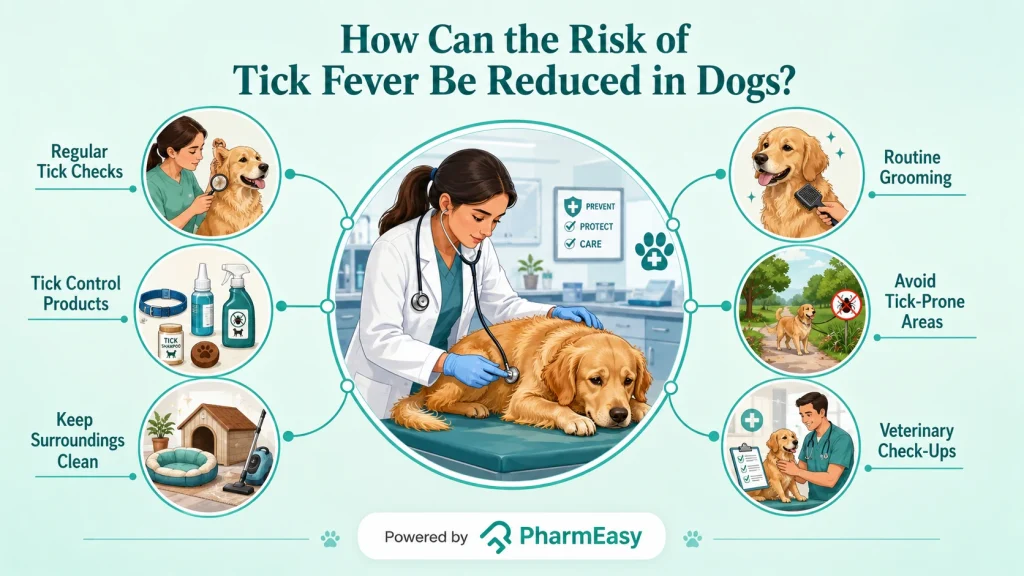
Although it may not be possible to prevent tick exposure entirely, certain precautions can help reduce the risk. These include10,11:
You should seek veterinary care immediately if your dog shows signs of tick fever, such as7:
You should also contact your veterinarian if:
Your veterinarian can recommend the right treatment and tick-control measures to keep your pet safe and healthy.
Also Read: Dog Skin Infection: Causes, Symptoms, Treatment & Home Care
Tick fever in dogs is a common tick-borne illness that may affect a dog’s energy levels, appetite, blood health, and overall well-being. Recognising early signs of tick fever and seeking timely veterinary guidance can make a significant difference in recovery.
Regular tick checks, proper grooming, and maintaining tick-control practices may help lower the chances of infection. If your dog appears unwell after tick exposure, it is always advisable to consult a qualified veterinarian as soon as possible.
Also Read: Why Do Dogs Vomit? Causes, Types, Treatment & Home Remedies
The duration of tick fever depends on the severity of the infection and how early treatment begins. Many dogs start improving within a few days of treatment; however, complete recovery may take several weeks8.
Most tick fever infections in dogs do not directly spread from dogs to humans. However, ticks themselves may carry organisms that can affect humans, so tick control is important10.
In some cases, tick fever can become serious if left unaddressed. It may affect the joints, eyes, and internal organs, and may lead to severe complications9. So, early diagnosis and management is essential for better recovery.
No, Lyme disease and tick fever are not exactly the same. Lyme disease is one specific tick-borne illness, while ‘tick fever’ is a general term used for several infections spread by ticks, such as ehrlichiosis and babesiosis12,13.
Early signs of tick fever may include fever, tiredness, loss of appetite, weakness, and reduced activity levels. Some dogs may also show pain or weight loss7.
Veterinarian-approved tick-control products such as tick sprays, spot-on treatments, medicated shampoos, and tick collars can help get rid of ticks quickly and help reduce further infestation8. However, it is very important not to use tick-control products meant for other animals on dogs14.
Yes. Ticks may enter homes through clothing, other pets, or outdoor exposure10.
Ticks should be removed carefully using proper methods. If unsure, consult a veterinarian or trained professional for safe removal10.
1. Ticks. Companion Animal Parasite Council. Accessed May 27, 2026. https://capcvet.org/guidelines/ticks/
2. Rocha SC, Velásquez CV, Aquib A, Al-Nazal A, Parveen N. Transmission Cycle of Tick-Borne Infections and Co-Infections, Animal Models and Diseases. Pathogens. 2022;11(11):1309. doi:10.3390/pathogens11111309. https://pubmed.ncbi.nlm.nih.gov/36365060/
3. Kernif T, Medrouh B, Eddaikra N, Oury B, Holzmuller P, Sereno D. Ticks as vectors of Trypanosomatidae with medical or veterinary interest: Insights and implications from a comprehensive systematic review and meta-analysis. Heliyon. 2024;10(24):e40895. doi:10.1016/j.heliyon.2024.e40895. https://www.sciencedirect.com/science/article/pii/S2405844024169265
4. Dantas-Torres F. Biology and ecology of the brown dog tick, Rhipicephalus sanguineus. Parasit Vectors. 2010;3:26. doi:10.1186/1756-3305-3-26. https://pubmed.ncbi.nlm.nih.gov/20377860/
5. CDC. About Ticks and Tickborne Disease. Ticks. April 28, 2026. Accessed May 27, 2026. https://www.cdc.gov/ticks/about/index.html
6. Leal B, Zamora E, Fuentes A, Thomas DB, Dearth RK. Questing by Tick Larvae (Acari: Ixodidae): A Review of the Influences That Affect Off-Host Survival. Ann Entomol Soc Am. 2020;113(6):425-438. doi:10.1093/aesa/saaa013. https://pubmed.ncbi.nlm.nih.gov/33244354/
7. Government NT. Ehrlichiosis disease in dogs. January 14, 2025. Accessed May 11, 2026. https://nt.gov.au/industry/agriculture/livestock-and-animals/animal-health-and-diseases/ehrlichiosis-disease-dogs
8. Piccione J, Levine GJ, Duff CA, Kuhlman GM, Scott KD, Esteve‐Gassent MD. Tick‐Borne Relapsing Fever in Dogs. J Vet Intern Med. 2016;30(4):1222-1228. doi:10.1111/jvim.14363. https://pubmed.ncbi.nlm.nih.gov/27353196/
9. Ehrlichiosis in Dogs: Fast Facts for Veterinarians. https://www.cdc.gov/ehrlichiosis/pdfs/fs-ehrlichiosisvet-508.pdf
10. CDC. Preventing Ticks on Pets. Ticks. May 17, 2024. Accessed May 11, 2026. https://www.cdc.gov/ticks/prevention/preventing-ticks-on-pets.html
11. Medicine C for V. Fact Sheet for Pet Owners and Veterinarians about Potential Adverse Events Associated with Isoxazoline Flea and Tick Products. FDA. Published online August 8, 2023. Accessed June 16, 2026. https://www.fda.gov/animal-veterinary/animal-health-literacy/fact-sheet-pet-owners-and-veterinarians-about-potential-adverse-events-associated-isoxazoline-flea
12. Skar GL, Blum MA, Simonsen KA. Lyme Disease. In: StatPearls. StatPearls Publishing; 2026. Accessed May 11, 2026. http://www.ncbi.nlm.nih.gov/books/NBK431066/
13. Berrada ZL, Telford SR. Burden of Tick-borne Infections on American Companion Animals. Top Companion Anim Med. 2009;24(4):175-181. doi:10.1053/j.tcam.2009.06.005. https://pubmed.ncbi.nlm.nih.gov/19945085/
14. US EPA O. Controlling Fleas and Ticks on Your Pet. March 27, 2013. Accessed May 11, 2026. https://www.epa.gov/pets/controlling-fleas-and-ticks-your-pet
Disclaimer: The information provided here is for educational/awareness purposes only and is not intended to be a substitute for medical treatment by a healthcare professional and should not be relied upon to diagnose or treat any medical condition. The reader should consult a registered medical practitioner to determine the appropriateness of the information and before consuming any medication. PharmEasy does not provide any guarantee or warranty (express or implied) regarding the accuracy, adequacy, completeness, legality, reliability or usefulness of the information; and disclaims any liability arising thereof.
Links and product recommendations in the information provided here are advertisements of third-party products available on the website. PharmEasy does not make any representation on the accuracy or suitability of such products/services. Advertisements do not influence the editorial decisions or content. The information in this blog is subject to change without notice. The authors and administrators reserve the right to modify, add, or remove content without notification. It is your responsibility to review this disclaimer regularly for any changes.


A dog bite is painful and dangerous and instils a fear of the animal. It is said that rabies caused by dog bites accounts for about 20,000 deaths in India alone. What is alarming is that 36% of the world’s rabies deaths occur in our country each year. Unfortunately, most victims are children who are bitten by infected dogs1. In this blog, we will discuss how the rabies vaccine and wound care can help prevent the fatal outcomes of dog bites.
Astonishingly enough, a person is more likely to get a dog bite from a dog he is familiar with than from a street dog! A dog bite may lead to serious infections, rabies, and eventually result in death.
First aid is helpful after a dog bite, but always seek medical attention to ensure proper care. This is even more important in cases of a dog bite from an unfamiliar or unknown dog. Talk to your doctor/ animal bite clinic at a hospital about the administration of the rabies vaccine. If the wound does not stop bleeding, there is pus formation or redness with swelling, and if the bitten region is warmer than the other parts of the body, you need to see a doctor ASAP. A dog bite treatment must also include antibiotics to prevent infection.
Did you know?
It is imperative to visit a doctor immediately in case of a dog bite, scratch or even if a dog has licked a cut on the skin2.
To stop any bleeding place a clean towel. Try to keep the injured area elevated. Wash the bite carefully with soap and water. Apply a sterile bandage to the wound. To prevent from infection you can apply antibiotic ointment. Get Rabies Vaccination.
Dr. M.G. Kartheeka, MBBS, MD(Pediatrics)
Thousands of dog bites are reported each year all over the country. Most of these bites may not look serious but should be evaluated by a doctor for post-exposure prophylaxis. Children, more than adults, tend to get dog bites. Rabies infection is life-threatening; therefore, it is essential to consult a doctor or nearest animal bite clinic without delay. Complications associated with a dog bite include:
Washing the dog bite area with soap and water is very important. If you feel that the wound is very deep, is bleeding persistently or if you are bit in the hands or face, it is important to visit a hospital immediately for treatment.
Dr. Ashish Bajaj, M.B.B.S., M.D. in Clinical Pharmacology and Toxicology
Also Read: What Is Hantavirus? Symptoms, Causes, & Effective Prevention
Do not delay in seeking a doctor’s help because post-exposure prophylaxis for rabies is best effective when started early on. Spread this information to your loved ones to spread awareness about this life-threatening condition.
Also Read: Nipah Virus: All You Need to Know
Disclaimer: The information provided here is for educational/awareness purposes only and is not intended to be a substitute for medical treatment by a healthcare professional and should not be relied upon to diagnose or treat any medical condition. The reader should consult a registered medical practitioner to determine the appropriateness of the information before consuming any medication. PharmEasy does not provide any guarantee or warranty (express or implied) regarding the accuracy, adequacy, completeness, legality, reliability or usefulness of the information; and disclaims any liability arising thereof.
Links and product recommendations in the information provided here are advertisements of third-party products available on the website. PharmEasy does not make any representation on the accuracy or suitability of such products/services. Advertisements do not influence the editorial decisions or content. The information in this blog is subject to change without notice. The authors and administrators reserve the right to modify, add, or remove content without notification. It is your responsibility to review this disclaimer regularly for any changes.
81
18