

383+ orders placed in your location

100% NABL & ISO Certified Lab • 100% Accurate Reports
Creatine Phosphokinase Total (CPK) Test
Creatine Kinase, Total Creatine kinase, CPK Test, Creatine Phosphokinase Test, Creatine Kinase Test, Total CK Test
- SummaryThe Creatine Phosphokinase Total (CPK) Test measures the level of CPK enzymes in your blood, which are released when there is muscle damage. Elevated levels may indicate issues with the heart, skeletal muscles, or brain. It is commonly used to help diagnose conditions like heart attacks or muscle disorders. A blood sample is used for the test, and no fasting is required.Read more
- Reports Within6 HrsView Sample Report

 100% NABL & ISO Certified Labs
 - SampleBlood

- AgeAll Age Group
- GenderMale and Female
- FastingNot Required

PharmEasy Promises



Know More About The Test


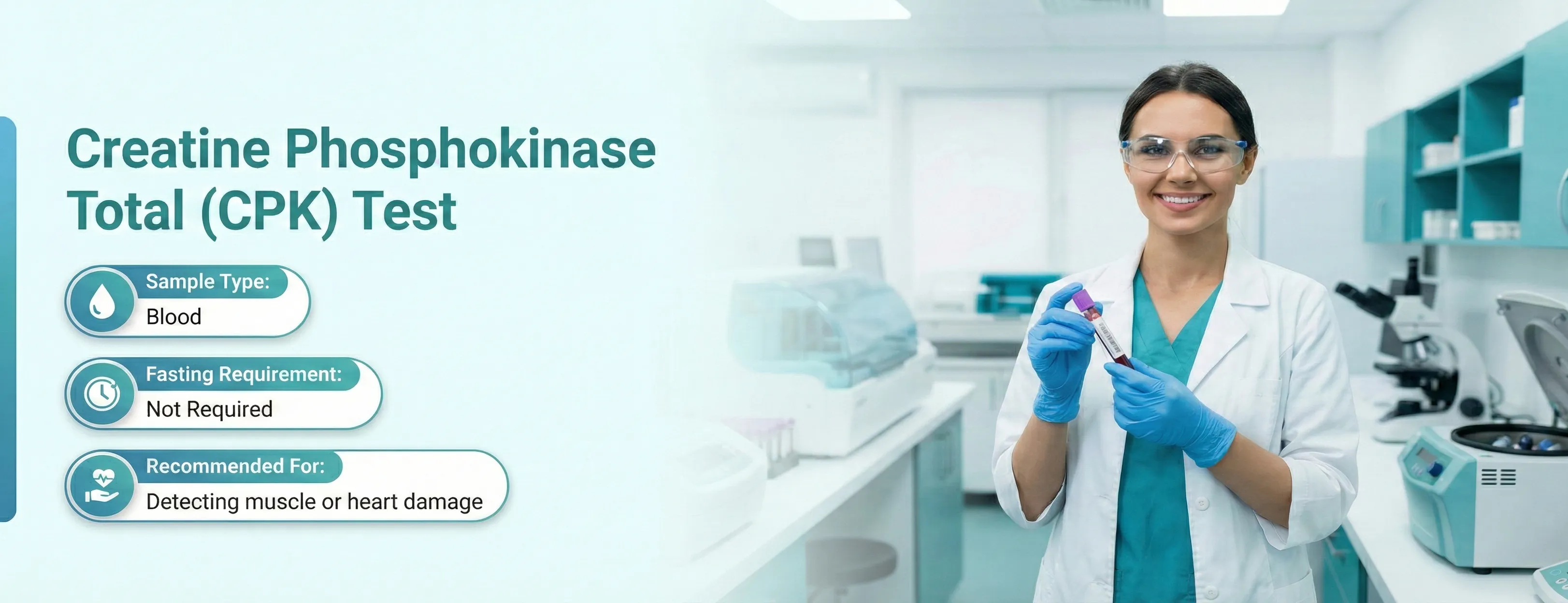
A quick info on Creatine Phosphokinase Total (CPK) Test

Overview
Creatine phosphokinase (CPK) is also known as creatine kinase (CK). It is an enzyme that helps your muscles get energy by supporting important chemical reactions in the body.
Most of this enzyme is found in your skeletal muscles (the muscles you use to move), with smaller amounts in your heart and brain. Normally, only a small amount of CPK/CK is present in the blood due to everyday muscle activity. However, if there is damage to the muscles, heart, or brain, more CK leaks into the blood, causing its levels to rise.
The CPK test checks how much of this enzyme is present in your blood. It is mainly used to detect and monitor muscle damage, but it can also help identify problems related to the heart or brain.

When and Who Should Get a CPK Test Done?
A CPK test may be recommended when there are symptoms or conditions that suggest possible muscle, heart, or brain damage. You may need this test if you have symptoms such as:
- Muscle weakness
- Numbness or tingling
- Muscle pain or cramps
- Trouble with balance or frequent falls
- Swelling in the legs or feet
- Dark-coloured urine
You may also need this test if you:
- Have experienced severe burns
- Are taking medicines, like statins that may affect muscles
- Have had a serious muscle injury (such as crushing or tearing)
- Have had a stroke or traumatic brain injury (TBI)
.png?dim=48x48&q=75)
How Frequently Should You Take the CPK Test?
The CPK test is not a routine screening test. It is usually ordered only when there are specific symptoms or clinical situations that suggest possible muscle, heart, or brain damage.
|
Health scenario |
Context |
Frequency of testing |
|---|---|---|
|
Muscle pain, cramps, weakness |
Suspected muscle injury or muscle disorder |
At onset, and as advised by a doctor |
|
Severe pain after injury (crush/trauma/burns) |
Acute muscle damage |
Immediately (may be repeated every 2 to 3 days if you are in the hospital) |
|
Chest pain, shortness of breath |
Suspected heart muscle injury (e.g., heart attack) |
At presentation (may be repeated every 2 to 3 days if you are in the hospital) |

What Conditions Can a CPK Test Help Detect?
The CPK test helps identify and monitor conditions that cause damage to muscles, the heart, or the brain. It is usually done when high levels of CPK may suggest tissue injury or stress. This test can help detect:
- Muscle damage or injury: Most commonly, high CPK levels indicate damage to skeletal muscles. This can happen due to accidents, severe burns, or intense physical activity.
- Muscle diseases, such as:
- Muscular dystrophy (an inherited condition that causes gradual muscle weakness)
- Rhabdomyolysis (rapid breakdown of muscle tissue that can lead to kidney damage)
- Myositis (long-term inflammation of muscles causing pain and weakness)
- Brain-related conditions: The test can be used after a stroke or traumatic brain injury to assess severity and possible complications.
- Heart-related conditions: The test may help in diagnosing a heart attack or evaluating the cause of chest pain. However, troponin tests are more commonly used to confirm heart attacks today.
- Other specific conditions: Helps differentiate malignant hyperthermia (a severe reaction to anaesthesia) from postoperative infections.
Note: The pattern and timing of CPK levels rising or falling can give important clues about the type and extent of tissue damage, especially in acute conditions like heart attacks.
.png?dim=48x48&q=75)
CPK Test Preparation
What to Expect Before the CPK Test
No fasting is required for a standalone CPK test. You can eat and drink normally. However, if it is part of a broader package that includes fasting tests, your doctor may advise fasting for 8-12 hours. Avoid strenuous exercise for 24 hours before the test, as intense physical activity can temporarily raiseCPK levels and affect interpretation. Always inform your doctor about any ongoing medications.
What to Expect During the Blood Collection
A phlebotomist cleans the skin with an antiseptic, then places an elastic band around your upper arm to make the veins easier to access. A small needle is inserted into the vein; you may feel a brief pinch. Blood is collected into a labelled tube in under a minute.
What to Expect After the CPK Test
A small cotton swab and bandage are placed over the site to stop any minor bleeding. You can return to normal activities immediately. Minor bruising is normal and disappears quickly. If dizzy, sit and rest for a few minutes

What are the Parameters Included in a CPK Test?
The CPK test is a simple blood test that measures only one parameter:
- The levels of an enzyme called creatine kinase in your body.
CK is an enzyme that helps the body produce and use energy, mainly in tissues with high energy needs, such as skeletal muscles, the heart, and the brain.
It exists in three main forms: CK-MM (found mostly in skeletal muscles), CK-MB (mainly in the heart), and CK-BB (in the brain). Inside cells, CK helps store and quickly release energy by supporting energy production (ATP production). When these tissues are damaged, CK leaks into the bloodstream, causing its levels to rise. Therefore, measuring CK levels in the blood helps detect and monitor muscle damage, heart injury, and certain brain conditions.

Normal Range of CPK Test Parameters
The CPK normal range is indicated in the table below.
|
Test parameter |
Normal range (U/L) |
|---|---|
|
Female |
< 167 U/L |
|
Male |
< 190 U/L |
Note:
- Normal ranges may vary slightly depending on the laboratory and clinical context.
- For the CPK test price, please check our app/website for more details.
.png?dim=48x48&q=75)
CPK Test Result Interpretation
The table below provides a general interpretation of CPK blood test results based on whether levels are high or low.
|
Result |
What It May Indicate |
|---|---|
|
Low |
Usually not a concern. |
|
High |
Indicates tissue damage (muscle, heart, or brain). Possible reasons include brain injury or stroke, seizures (convulsions), delirium tremens, dermatomyositis/polymyositis, electric shock, heart attack, myocarditis, pulmonary infarction, muscular dystrophy, myopathy, rhabdomyolysis, and trauma. |
Note:
- Test results may vary depending on age, muscle mass, and physical activity.
- Always consult your doctor to understand your results properly. Elevated CPK results must be interpreted along with symptoms and medical history.

CPK Test Risks and Limitations
The CPK blood test is a simple blood test and is generally very safe. However, there are some minor risks and limitations to consider.
Risks (following are rare and usually resolve quickly on their own):
- You may feel slight pain or a prick when blood is taken.
- Mild bruising, swelling, or bleeding at the site may occur.
Limitations
- CK levels may rise slowly and peak after 1 to 2 days, so one test may not be enough, and repeat tests may be needed to track changes.
- A high CK level shows damage, but not the exact cause. It cannot tell where the damage is located (muscle, heart, or brain).
- Sometimes a CK isoenzyme test is needed for a detailed evaluation.
- Levels can increase due to non-disease factors, such as heavy exercise, recent surgery, muscle injury, injections, or cardiac procedures.

Related and Follow-up Tests
To better understand the cause of abnormal CK levels, doctors may recommend these tests:

CPK Test Sample Collection: Home vs. Diagnostic Lab
|
Feature |
Home Collection (PharmEasy) |
Traditional Diagnostic Lab |
|---|---|---|
|
Convenience |
High - sample taken from your home or office. |
Low - requires travelling and waiting in queues. |
|
Time Saving |
Maximum - no travel time. You pick the time slot. |
Minimum - depends on traffic and lab rush. |
|
Safety & Comfort |
Safe - avoids exposure to other sick patients. |
Moderate - exposure to crowded waiting areas. |
|
Process |
A professional phlebotomist visits you. |
You must visit the facility during its hours. |
|
Report Access |
Digital - sent directly to your app or email. |
Often requires a second visit for physical copies. |
Pro Tip: For the most stress-free experience, book a CPK test on PharmEasy. Enjoy professional service and accurate results without stepping out of your house.

CPK Test Price/Cost
A CPK test is generally available at an approximate price of INR 249, with the final cost varying based on the city and the laboratory chosen. To get a clearer idea of price differences, you can compare CPK test rates across major cities in India.
|
City |
Offer Price |
|---|---|
|
Bengaluru |
249 |
|
Chennai |
249 |
|
Delhi |
249 |
|
Hyderabad |
249 |
|
Kolkata |
249 |
|
Lucknow |
249 |
|
Mumbai |
249 |
|
Nagpur |
249 |
|
Patna |
249 |
|
Pune |
249 |
Was This Test Information Helpful?
Please rate your experience
 Yes Helpful
  Not Helpful
References
People Also Ask
What happens if CPK is high?
What does a CPK of 3 mean?
How to reduce high CPK?
Does CPK damage the kidneys?
What disease has high CPK?
What is a bad CPK value?
Is high CPK an emergency?
Why do males usually have higher CPK levels than females?
Which drugs can increase CPK (CK) levels?
Why is a CPK test done after a stroke?
 4.6 Stars| 7+ Lakhs Ratings & Reviews

Over 10 million happy users PharmEasy Labs
- Because the digital report is available on WhatsApp, there's no need to go back to the lab. Thanks, PharmEasy!
 Sachin sharma11 Jan ‘26
 - Thanks to the coupon discount, the blood test was done at a lower price.Komal04 Jan ‘26
- The lab technician was a good and knowledgeable professional.Rakesh Pandey06 Jan ‘26
- Due to bad weather, it's difficult to reach the lab. But home collection makes things easier.Arjun08 Jan ‘26
- Thanks to the Swasth AI feature, the report is easy to understand.Priya Mehta02 Jan ‘26
- The report is available on the same day. Wow!Vikas Patel05 Jan ‘26
Have any doubts? Ask us.
Ask us anything about the Creatine Phosphokinase Total (CPK) Test to understand it better

We provide trusted, expert-curated health content to support better awareness,prevention, and care.
Backed by experienced doctors, medical experts, and strict editorial standards.