

2524+ orders placed in your location

100% NABL & ISO Certified Lab • 100% Accurate Reports
Prolactin Test
PRL, Prolactin blood test
- SummaryProlactin Test is a blood test that measures the levels of prolactin hormone in your blood. Prolactin Test helps diagnose conditions like prolactinoma, menstrual irregularities, infertility in women and hormonal imbalances in men. This test is done by taking a blood sample from a vein in your arm, fasting is not required for this test. Read more
- Reports Within7 HrsView Sample Report

 100% NABL & ISO Certified Labs
 - SampleBlood

- AgeAll Age Group
- GenderMale and Female
- FastingNot Required

PharmEasy Promises



Know More About The Test


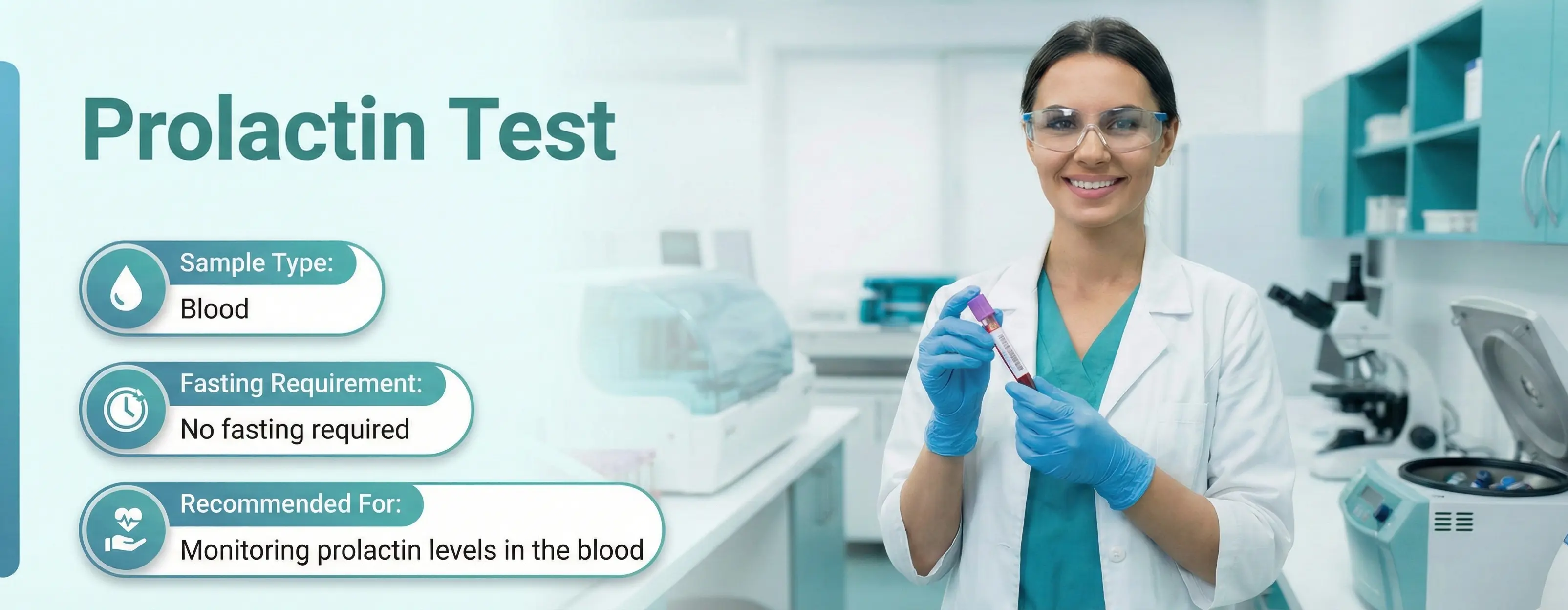
A quick info on Prolactin test

Overview
The Prolactin test, also called the serum prolactin level test, measures the level of prolactin hormone in your blood. Prolactin is a hormone produced by the pituitary gland, a small gland located at the base of the brain. Its primary role is to stimulate and maintain breast milk production (lactation) after childbirth. In women who are not pregnant or breastfeeding, prolactin levels are normally low. In men, prolactin is present in small amounts and plays a role in reproductive function.
Doctors order a Prolactin test because abnormally high prolactin levels (hyperprolactinaemia) disrupt the hormonal balance of the reproductive system - suppressing ovulation in women and reducing testosterone in men. The most common cause of significantly elevated prolactin is a prolactinoma - a benign (non-cancerous) tumour of the pituitary gland that secretes excess prolactin. When detected early, prolactinomas are highly treatable with oral medication.
The Prolactin test monitors the pituitary gland's hormonal output and its impact on the reproductive system. It is used to evaluate irregular menstrual periods, unexplained infertility, abnormal milk discharge (galactorrhoea), erectile dysfunction in men, and to monitor prolactinoma treatment. Fasting is recommended for the most accurate result. Suitable for both men and women.

When and Who Should Get a Prolactin Test Done?
A Prolactin test is performed when symptoms of abnormal prolactin levels are present or when a pituitary tumour is suspected based on clinical evaluation.
This test is usually recommended for:
- Women with irregular, infrequent, or absent menstrual periods (oligomenorrhoea or amenorrhoea) without a clear cause.
- Women experiencing unexplained infertility or difficulty conceiving - high prolactin suppresses ovulation.
- Anyone with galactorrhoea - unexpected milk discharge from the breasts in women who are not pregnant or breastfeeding, or from the breasts in men.
- Men with reduced libido, erectile dysfunction, infertility, or an unexplained decrease in testosterone levels.
- Men or women with persistent headaches or visual disturbances, which may indicate a pituitary tumour pressing on surrounding structures.
- Patients already diagnosed with a prolactinoma - for monitoring treatment effectiveness with dopamine agonist therapy.
- Patients on medications known to raise prolactin - including antipsychotics (haloperidol, risperidone), metoclopramide, and domperidone.
.png?dim=48x48&q=75)
How Frequently Should You Take the Prolactin Test?
Prolactin testing frequency depends on whether you are being tested for the first time, whether you have a confirmed prolactinoma, and how well treatment is working.
|
Health Scenario |
Context |
Recommended Frequency |
|---|---|---|
|
Initial Evaluation |
First-time testing for suspected prolactin-related symptoms. |
Once, to establish the baseline prolactin level. |
|
Confirmed Hyperprolactinaemia |
Follow up after finding elevated prolactin at initial testing. |
Repeat after 4 to 6 weeks to confirm persistence, as a single elevated result can be due to stress. |
|
Monitoring Prolactinoma Treatment |
Patients on dopamine agonist therapy (cabergoline or bromocriptine). |
Every 3 months until levels normalise, then every 6 to 12 months. |
|
Post-Surgery or Radiation |
After pituitary surgery or radiotherapy for prolactinoma. |
Every 3 to 6 months for 1 to 2 years, then annually. |
|
Infertility Management |
Women with anovulatory infertility or irregular periods under treatment. |
Every 3 months during active treatment, or as advised by the gynaecologist. |
|
Medication Monitoring |
Patients on medications that raise prolactin - antipsychotics, metoclopramide. |
Every 6 months to monitor for drug-induced hyperprolactinaemia. |

What Conditions Can a Prolactin Test Help Detect?
A Prolactin test is primarily used to diagnose and evaluate conditions associated with abnormal prolactin levels, including:
- Prolactinoma - a benign pituitary tumour that overproduces prolactin. The most common pituitary tumour. Microprolactinomas (less than 10 mm) cause hormonal symptoms; macroprolactinomas (more than 10 mm) can also cause headaches and visual disturbances.
- Hyperprolactinaemia - the clinical syndrome of abnormally high prolactin from any cause, leading to menstrual irregularity, infertility, and galactorrhoea in women, and hypogonadism in men.
- Hypothyroidism - elevated TSH in hypothyroidism stimulates the pituitary to produce more prolactin. Treating hypothyroidism alone can normalise prolactin.
- Drug-Induced Hyperprolactinaemia - many medications, including antipsychotics, antiemetics, and some antihypertensives, raise prolactin as a side effect.
- Hypopituitarism - a poorly functioning pituitary gland can produce abnormally low prolactin, detected by a less-than-normal result.
- Polycystic Ovary Syndrome (PCOS) - mild prolactin elevation is sometimes found alongside PCOS, contributing to menstrual irregularity and infertility.
Important Note: A single elevated prolactin result does not confirm a prolactinoma. Stress, exercise, and food can transiently raise prolactin. Repeat testing under ideal conditions is always required before a diagnosis is made.
.png?dim=48x48&q=75)
Prolactin Test Preparation
What to Expect Before the Prolactin Test
Fasting for 8 to 12 hours before the test is recommended for the most accurate result. The test should ideally be collected in the morning, 3 to 4 hours after waking, as prolactin peaks during sleep and early morning hours. Avoid vigorous physical exercise, recent sexual activity, and breast stimulation for at least 2 hours before the test - all of which can temporarily raise prolactin. Inform your doctor about all current medications, especially antipsychotics, antiemetics, and metoclopramide.
What to Expect During the Blood Collection
A phlebotomist cleans the skin with an antiseptic, then places an elastic band around your upper arm to make the veins easier to access. A small needle is inserted into the vein - you may feel a brief pinch. Blood is collected into a labelled tube in under a minute.
What to Expect After the Prolactin Test
A small cotton swab and bandage are placed over the site to stop any minor bleeding. You can return to normal activities immediately. Minor bruising is normal and disappears quickly. If dizzy, sit and relax for a few minutes. Your digital report will be available within 24 hours.

What are the Parameters Included in a Prolactin Test?
The Prolactin test measures a single key parameter:
- Serum Prolactin Level - Measured in ng/mL (nanograms per millilitre) or mIU/L (milli-international units per litre). This is the primary result your doctor uses to assess pituitary function and its impact on the reproductive system. Normal values differ significantly between men, non-pregnant women, pregnant women, and breastfeeding women. The result must always be interpreted alongside these population-specific reference ranges.
Because prolactin secretion is pulsatile (released in bursts), a single reading can be misleading. Stress, physical activity, food, breast stimulation, sleep, and even the act of blood collection itself can temporarily raise prolactin. For this reason, a significantly elevated result is typically confirmed with a repeat fasting morning sample before a diagnosis of hyperprolactinaemia is made.

Normal Range of Prolactin Test Parameters
Prolactin normal values vary significantly between population groups. The table below shows standard reference ranges.
|
Population Group |
Normal Prolactin Range |
Unit |
|---|---|---|
|
Non-pregnant Women |
2.0 - 29.0 |
ng/mL |
|
Men |
2.0 - 18.0 |
ng/mL |
|
Pregnant Women (1st Trimester) |
Up to 80 |
ng/mL |
|
Pregnant Women (2nd Trimester) |
Up to 160 |
ng/mL |
|
Pregnant Women (3rd Trimester) |
Up to 400 |
ng/mL |
|
Postpartum / Breastfeeding Women |
More than 200 (may remain elevated during lactation) |
ng/mL |
|
Children (Pre-pubertal) |
1.0 - 15.0 |
ng/mL |
Important Note: Normal prolactin ranges vary between laboratories and assay methods.
.png?dim=48x48&q=75)
Prolactin Test Result Interpretation
The prolactin result must always be interpreted in the context of your gender, pregnancy status, symptoms, and current medications.
|
Prolactin Level |
Classification |
Potential Interpretation and Action |
|---|---|---|
|
Less than 30 ng/mL (women) / Less than 18 ng/mL (men) |
Normal |
Prolactin is within the expected range. No evidence of hyperprolactinaemia. |
|
30 - 100 ng/mL |
Mildly Elevated |
May indicate stress-induced elevation, medication effect, hypothyroidism, or a small prolactinoma. Repeat test and clinical review recommended. |
|
100 - 250 ng/mL |
Moderately Elevated |
Suggests a microprolactinoma or significant medication-induced hyperprolactinaemia. MRI of the pituitary gland is typically ordered. |
|
More than 250 ng/mL |
Significantly Elevated |
Strongly suggests a macroprolactinoma (larger tumour). MRI is essential. Dopamine agonist therapy is usually initiated and requires an endocrinologist evaluation. |
|
Very High (More than 1000 ng/mL) |
Severely Elevated |
Consistent with a large macroprolactinoma or invasive pituitary tumour. Urgent endocrinology evaluation and MRI required. |
|
Low Prolactin |
Hypoprolactinaemia |
Suggests pituitary gland dysfunction (hypopituitarism). Often requires evaluation of other pituitary hormones. |
Disclaimer: This table is for educational purposes only. Prolactin interpretation requires the expertise of a qualified endocrinologist or gynaecologist. A single elevated result must be repeated before clinical decisions are made.

Prolactin Test Risks and Limitations
Potential Risks and Complications
The Prolactin test is a very safe, routine blood test. Complications are extremely rare, and most people feel only a brief pinch. Consult a doctor if:
- The puncture site does not stop bleeding after gentle pressure
- You notice unusual redness, swelling, warmth, or lasting pain at the needle site
- You feel persistently lightheaded after the blood draw - sit and rest for a few minutes.
Understanding Prolactin Test Limitations
Prolactin is highly sensitive to physical and emotional stressors; even the anxiety of a blood draw can temporarily raise levels. A single elevated result is therefore insufficient for diagnosis and must be confirmed with a repeat morning fasting sample. Macroprolactin (biologically inactive prolactin aggregates) can cause falsely elevated total prolactin without true hyperprolactinaemia, a macroprolactin screening test may be needed. Medications including antipsychotics, metoclopramide, and domperidone are common causes of elevated prolactin that can be missed without a thorough medication review. Low prolactin requires evaluation of the full pituitary hormone panel.

Related and Follow-up Tests
An elevated prolactin is the starting point of a pituitary and hormonal investigation. Your doctor will recommend the following tests depending on the degree of elevation and clinical presentation.
|
Prolactin Finding |
Suggested Follow-up Test |
Why It Is Ordered |
|---|---|---|
|
Elevated Prolactin (any level) |
MRI Pituitary Gland (with and without contrast) |
Detects a prolactinoma or other pituitary tumour. The most important follow-up investigation for elevated prolactin. |
|
Elevated Prolactin + Thyroid Symptoms |
Hypothyroidism is a well-known cause of mildly elevated prolactin. Treating hypothyroidism alone can normalise prolactin. |
|
|
Elevated Prolactin + Irregular Periods |
Assesses whether ovarian function and the menstrual cycle are affected by high prolactin. |
|
|
Elevated Prolactin + Infertility |
Complete reproductive hormone assessment to identify the full hormonal picture in infertile women. |
|
|
Elevated Prolactin in Men + Low Libido |
High prolactin suppresses testosterone production in men, causing hypogonadism. |
|
|
Confirmed Prolactinoma on MRI |
Visual Field Testing |
Large prolactinomas can compress the optic chiasm, causing bitemporal visual field loss. |
|
Elevated Prolactin + Medications |
Review Medication List with Endocrinologist |
Many medications (antipsychotics, metoclopramide, domperidone) raise prolactin. Medication change may normalise levels. |
Note: Treatment for hyperprolactinaemia, typically with dopamine agonists such as cabergoline or bromocriptine, is highly effective in reducing prolactin levels and shrinking prolactinomas. Always consult an endocrinologist before starting or adjusting treatment.

Prolactin Test Sample Collection: Home vs. Diagnostic Lab
|
Feature |
Home Collection (PharmEasy) |
Traditional Diagnostic Lab |
|---|---|---|
|
Convenience |
High - sample taken from your home or office. |
Low - requires travelling and waiting in queues. |
|
Time Saving |
Maximum - no travel time. You pick the time slot. |
Minimum - depends on traffic and lab rush. |
|
Safety & Comfort |
Safe - avoids exposure to other sick patients. |
Moderate - exposure to crowded waiting areas. |
|
Process |
A professional phlebotomist visits you. |
You must visit the facility during its hours. |
|
Report Access |
Digital - sent directly to your app or email. |
Often requires a second visit for physical copies. |
Pro Tip: Book your Prolactin test on PharmEasy - a certified phlebotomist will come to your doorstep, and your digital report will be delivered within 24 hours. Convenient, affordable, and accurate.

Prolactin Test Price/Cost
A Prolactin test is typically priced around INR 499. The cost may vary depending on the city and the laboratory you choose. To get a better understanding, you can compare Prolactin test prices across major cities in India.
|
City |
Offer Price |
|---|---|
|
449 |
|
|
449 |
|
|
449 |
|
|
449 |
|
|
449 |
|
|
449 |
|
|
449 |
|
|
449 |
|
|
449 |
|
|
449 |
Was This Test Information Helpful?
Please rate your experience
 Yes Helpful (5)
 Not Helpful
References
People Also Ask
What does high prolactin mean in women?
Can high prolactin cause infertility?
Why does my prolactin need to be tested in the morning while fasting?
Can stress raise my prolactin levels?
Can high prolactin affect men?
What is a prolactinoma and how is it treated?
Can medications cause high prolactin?
 4.6 Stars| 7+ Lakhs Ratings & Reviews

Over 10 million happy users PharmEasy Labs
- Because the digital report is available on WhatsApp, there's no need to go back to the lab. Thanks, PharmEasy!
 Sachin sharma11 Jan ‘26
 - Thanks to the coupon discount, the blood test was done at a lower price.Komal04 Jan ‘26
- The lab technician was a good and knowledgeable professional.Rakesh Pandey06 Jan ‘26
- Due to bad weather, it's difficult to reach the lab. But home collection makes things easier.Arjun08 Jan ‘26
- Thanks to the Swasth AI feature, the report is easy to understand.Priya Mehta02 Jan ‘26
- The report is available on the same day. Wow!Vikas Patel05 Jan ‘26
Have any doubts? Ask us.
Ask us anything about the Prolactin Test to understand it better

We provide trusted, expert-curated health content to support better awareness,prevention, and care.
Backed by experienced doctors, medical experts, and strict editorial standards.