

7+ orders placed in your location

100% NABL & ISO Certified Lab • 100% Accurate Reports
Cardiolipin Test - IgA
Anticardiolipin Antibodies Test, ACL IgA Antibodies, Anticardiolipin Test, Cardiolipin IgA Test, Cardiolipin IgA test, Antiphospholipid antibodies test
- SummaryThe Cardiolipin IgA test detects IgA antibodies against cardiolipin, a phospholipid involved in blood clotting. It helps diagnose antiphospholipid syndrome (APS) and related autoimmune conditions, especially in patients with unexplained blood clots, pregnancy complications, or autoimmune diseases like lupus. The test is performed using a blood sample, and fasting is not required. Read more
- Reports Within36 HrsView Sample Report

 100% NABL & ISO Certified Labs
 - SampleBlood

- AgeAll Age Group
- GenderMale and Female
- FastingNot Required

PharmEasy Promises



Know More About The Test


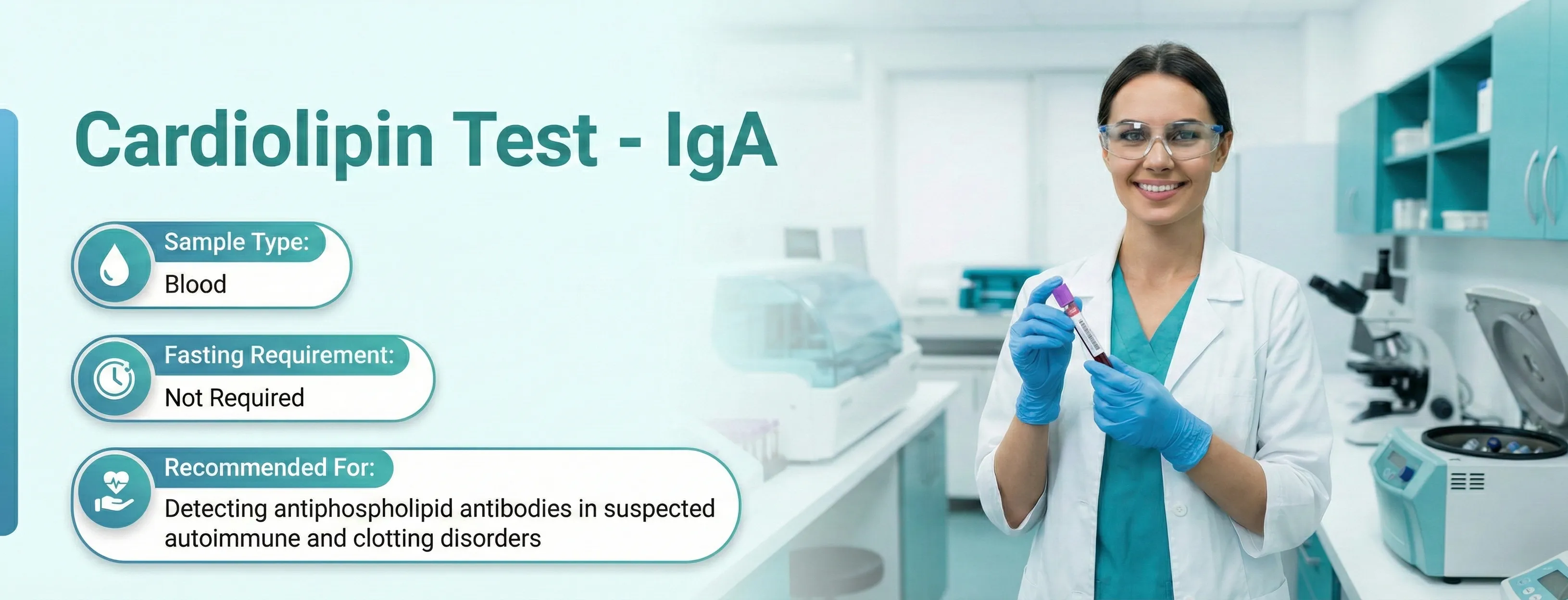
A quick info on Cardiolipin Test - IgA

Overview
Cardiolipin IgA is a blood test that looks for immunoglobulin (Ig)A antibodies against cardiolipin, a fat-like substance that is part of the outer layer of cells and blood platelets. These antibodies are called anticardiolipin antibodies and belong to a larger group of antibodies known as antiphospholipid antibodies. They are also called “cardiolipin IgA” or “anticardiolipin IgA.” In some cases, doctors may use this test as part of an antiphospholipid antibody panel, a group of blood tests used to diagnose antiphospholipid syndrome (APS).
The cardiolipin IgA test helps find out if someone may have APS, a condition that increases the risk of abnormal blood clots and pregnancy problems. A positive test result is more significant if it is confirmed by a repeat test at least 12 weeks later, and the person has a history of blood clots or certain pregnancy losses, such as repeated miscarriages.
This test mainly relates to the blood-clotting system and blood vessels, because these antibodies can increase the chance of clots forming in the legs, lungs, or brain. It is also important for pregnancy, since these antibodies can affect the placenta and are linked with repeated miscarriages and other pregnancy problems.
When and Who Should Get a Cardiolipin IgA Test Done?
Testing is generally required when you present with acute symptoms of thrombosis (such as unexplained pain and swelling in the arms and legs, shortness of breath, stroke, or severe, persistent headaches).
A doctor may recommend the cardiolipin IgA test for the following conditions:
- Presence of symptoms indicating clotting, such as unexplained pain and swellings in arms and legs, shortness of breath, and persistent headache.
- Repeated miscarriages, especially in the second and third trimesters.
- After a partial thromboplastin time (PTT), which measures how long it takes your blood to clot, is longer than normal. This test may be performed as an additional blood test along with the lupus anticoagulant test,
- As a repeat test to determine whether the antibody present is temporary or lasts a long time.
- As part of routine future screening for systemic lupus erythematosus (SLE) patients who initially test negative for antibodies.
.png?dim=48x48&q=75)
How Frequently Should You Take the Cardiolipin IgA Test?
|
Health scenario |
Context |
Frequency |
|---|---|---|
|
Cardiolipin IgA is detected for the first time. |
APS is suspected after a clot or pregnancy complication, but a single positive result can be temporary. |
Repeat after at least 12 weeks to check if the antibody is still present. |
|
Recurrent miscarriages or other pregnancy complications. |
To check whether APS may be contributing to the problem. |
As advised by the doctor. If found positive, confirm with a follow-up test 12 weeks later. |
|
Strong clinical suspicion of APS, but unclear result. |
Test results can vary, and a single result may not provide a clear diagnosis. |
Consider repeat testing 12 weeks later. |
|
After APS has been diagnosed. |
To help manage the condition when needed. |
The doctor advises the frequency based on symptoms and the patient’s condition. |

What Conditions Can a Cardiolipin IgA Test Help Detect?
A positive result on the cardiolipin IgA test that remains positive after 12 weeks suggests that this specific antibody is still likely present in the body. This may indicate:
- Antiphospholipid syndrome (APS): This is an underlying immune disorder that causes abnormal blood clotting (leading to conditions such as deep vein thrombosis or stroke) and related health problems, such as recurrent miscarriages and pregnancy or obstetric complications. Some people with APS may have a low platelet count (thrombocytopenia).
- Systemic lupus erythematosus (SLE): A positive result may be seen in some people with SLE, an autoimmune disease in which immune cells attack healthy tissues.
- Other autoimmune diseases: The antibodies may be found in some other autoimmune diseases, although they are less common than in APS and SLE.
.png?dim=48x48&q=75)
Cardiolipin IgA Test Preparation
What to Expect Before the Cardiolipin IgA Test
No fasting is required for a standalone cardiolipin IgA test. You can eat and drink normally. However, if it is part of a broader package that includes fasting tests, your doctor may advise fasting for 8-12 hours. Avoid strenuous exercise for 24 hours before the test, as intense physical activity can temporarily raise cardiolipin IgA levels and affect interpretation. Always inform your doctor about any ongoing medications.
What to Expect During the Blood Collection
A phlebotomist cleans the skin with an antiseptic, then places an elastic band around your upper arm to make the veins easier to access. A small needle is inserted into the vein; you may feel a brief pinch. Blood is collected into a labelled tube in under a minute.
What to Expect After the Cardiolipin IgA Test
A small cotton swab and bandage are placed over the site to stop any minor bleeding. You can return to normal activities immediately. Minor bruising is normal and disappears quickly. If dizzy, sit and rest for a few minutes.

What are the Parameters Included in a Cardiolipin IgA Test?
The cardiolipin IgA test evaluates the presence and levels of:
Anticardiolipin IgA antibodies: These are antibodies made by the immune system that mistakenly target cardiolipin, a type of phospholipid found in cell membranes. They are associated with an increased risk of unexplained blood clots (thrombosis), recurrent miscarriages, or autoimmune conditions like SLE.

Normal Range of Cardiolipin IgA Test Parameters
The following table shows the cardiolipin IgA test normal range.
|
Parameter |
Normal range |
|---|---|
|
Cardiolipin IgA |
2.22 APL/mL |
Note:
- Normal cardiolipin IgA levels can vary based on age, sex, and the laboratory method used.
- Test results should always be evaluated by a qualified doctor along with symptoms and medical history.
.png?dim=48x48&q=75)
Cardiolipin IgA Test Result Interpretation
The table below provides a general interpretation of cardiolipin IgA test results based on whether levels are positive or negative.
|
Result level |
Interpretation |
|---|---|
|
Positive (≥ 2.22 APL/mL) |
Cardiolipin IgA antibody detected, may be associated with antiphospholipid syndrome or other autoimmune conditions, but cannot diagnose APS on its own. Persistent positivity together with compatible clinical features and other antiphospholipid antibody test results is required for diagnosis. |
|
Negative (< 2.22 APL/mL) |
Cardiolipin IgA antibody not detected. Indicates low risk for autoimmune-related clotting risk from IgA antibodies, though it does not completely rule out antiphospholipid syndrome. |

Cardiolipin IgA Test Risks and Limitations
Risks (rare):
The cardiolipin IgA test is generally safe and poses minimal risk. Mild pain, bruising, or slight bleeding can occur at the needle site. This usually goes away on its own.
Limitations:
Like any medical test, the cardiolipin IgA test has limitations.
- The test alone cannot diagnose APS; it must be interpreted along with symptoms and other laboratory tests.
- A positive result does not always mean you have APS, as these antibodies may also be found in some healthy people or during infections.
- A negative result does not completely rule out APS, especially if other antiphospholipid antibodies are present.
- Antibody levels can change over time, so the test may need to be repeated after 12 weeks to confirm antibody presence.
- The IgA cardiolipin test is not part of the standard diagnostic criteria for APS. It is mainly used in selected situations when other antibody tests are negative, but APS is still suspected.

Related and Follow-up Tests
Depending on your cardiolipin IgA test results and symptoms, your doctor may recommend additional tests, such as the following, to confirm a diagnosis or identify the underlying cause:
- Cardiolipin IgG and IgM antibody tests: Usually performed alongside the IgA test to detect different types of anticardiolipin antibodies.
- Lupus anticoagulant (LA) testing: Helps identify another important antiphospholipid antibody associated with blood clotting disorders.
- Anti-β2 glycoprotein I (β2GPI) antibody test (IgG, IgM, and sometimes IgA): Commonly used with cardiolipin antibody testing to evaluate suspected APS.
- Repeat antiphospholipid antibody testing after 12 weeks: Confirms whether the antibodies are persistently present, which is important for APS diagnosis.
- Complete blood count (CBC): May be performed to check for low platelet count (thrombocytopenia), which can occur in APS.
- Coagulation tests: May be ordered to assess blood clotting, particularly when LA testing is being performed.

Cardiolipin IgA Test Sample Collection: Home vs. Diagnostic Lab
|
Feature |
Home Collection (PharmEasy) |
Traditional Diagnostic Lab |
|---|---|---|
|
Convenience |
High - sample taken from your home or office. |
Low - requires travelling and waiting in queues. |
|
Time Saving |
Maximum - no travel time. You pick the time slot. |
Minimum - depends on traffic and lab rush. |
|
Safety & Comfort |
Safe - avoids exposure to other sick patients. |
Moderate - exposure to crowded waiting areas. |
|
Process |
A professional phlebotomist visits you. |
You must visit the facility during its hours. |
|
Report Access |
Digital - sent directly to your app or email. |
Often requires a second visit for physical copies. |
Pro Tip: For the most stress-free experience, book a Cardiolipin IgA test on PharmEasy. Enjoy professional service and accurate results without stepping out of your house.
Was This Test Information Helpful?
Please rate your experience
 Yes Helpful
  Not Helpful
References
People Also Ask
What does high cardiolipin IgA mean?
Are cardiolipin antibodies related to lupus?
What diseases are linked to cardiolipin?
What happens when cardiolipin is damaged?
What is another name for cardiolipin IgA?
What is the cause of elevated cardiolipin IgA?
 4.6 Stars| 7+ Lakhs Ratings & Reviews

Over 10 million happy users PharmEasy Labs
- Because the digital report is available on WhatsApp, there's no need to go back to the lab. Thanks, PharmEasy!
 Sachin sharma11 Jan ‘26
 - Thanks to the coupon discount, the blood test was done at a lower price.Komal04 Jan ‘26
- The lab technician was a good and knowledgeable professional.Rakesh Pandey06 Jan ‘26
- Due to bad weather, it's difficult to reach the lab. But home collection makes things easier.Arjun08 Jan ‘26
- Thanks to the Swasth AI feature, the report is easy to understand.Priya Mehta02 Jan ‘26
- The report is available on the same day. Wow!Vikas Patel05 Jan ‘26
Have any doubts? Ask us.
Ask us anything about the Cardiolipin Test - IgA to understand it better

We provide trusted, expert-curated health content to support better awareness,prevention, and care.
Backed by experienced doctors, medical experts, and strict editorial standards.